๐ท Elevate your everyday moments with DSLR-like power in a sleek, travel-ready package!
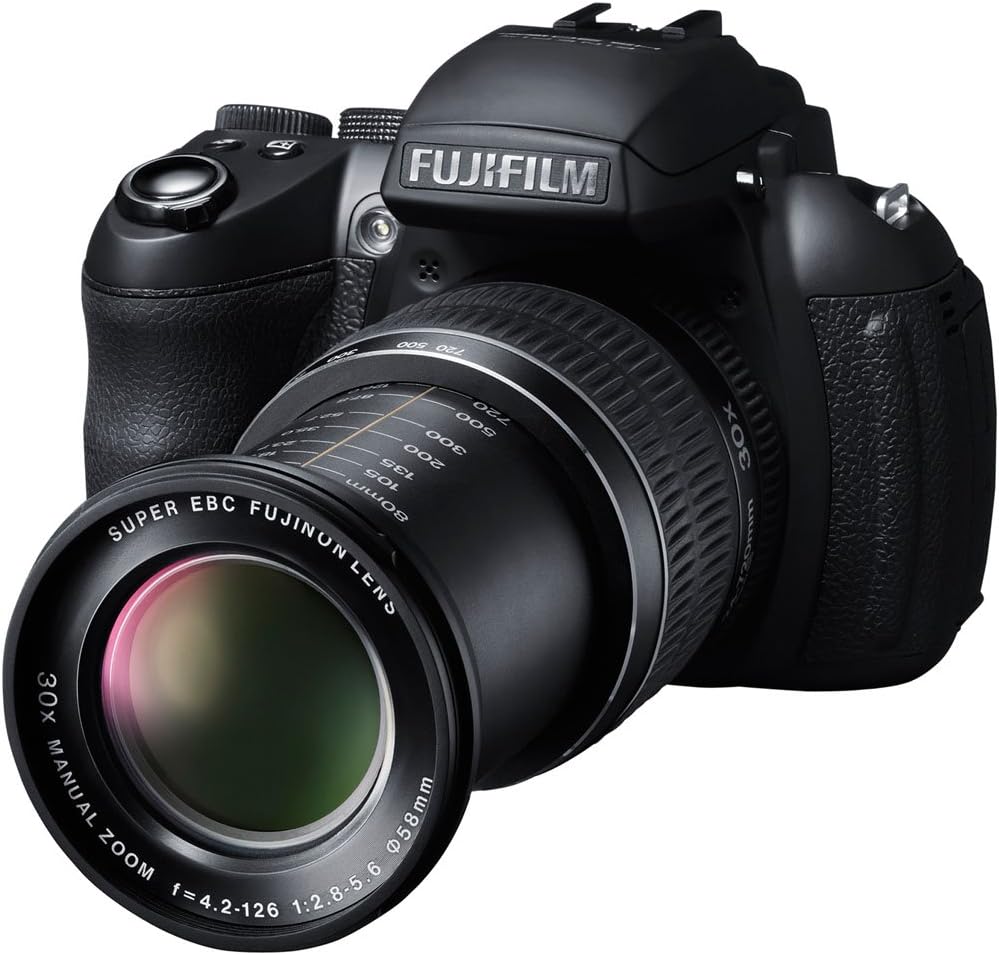
The Fujifilm FinePix HS30EXR is a versatile bridge camera boasting a 16MP EXR CMOS II sensor, a high-quality 30x Fujinon manual optical zoom lens (24-720mm equivalent), and Full HD 1080p video recording with HDMI output. Designed for enthusiasts seeking DSLR-style control without the bulk, it features fast 8fps continuous shooting, advanced image stabilization, a tilting 3-inch LCD, and a bright electronic viewfinder with eye sensor. With extensive manual settings, RAW shooting capability, and intelligent scene recognition, it delivers professional-grade photos and videos in a compact, travel-friendly form.
| ASIN | B006T7QSVS |
| Aperture modes | 5.6 |
| Are Batteries Included | Yes |
| Aspect Ratio | Unknown |
| Auto Focus Technology | Center, Continuous, Contrast Detection, Face Detection, Multi-area, Single, Tracking |
| Autofocus | Yes |
| Autofocus Points | 16 |
| Best Sellers Rank | #364,551 in Electronics ( See Top 100 in Electronics ) #3,278 in Digital Point & Shoot Cameras |
| Bit Depth | 8 Bit |
| Brand | Fujifilm |
| Built-In Media | Battery, Instruction Manual, Tripod |
| Camera Flash | Studio |
| Camera Lens | This camera features a high-quality Fujinon 30x manual optical zoom lens, offering a focal length range equivalent to 24-720 mm on a 35mm camera. |
| Color | Black |
| Compatible Devices | [Inferred: Fujifilm X mountings, SD/SDHC/SDXC cards, HDMI-compatible devices] |
| Compatible Flash Memory Type | SDHC, SDXC |
| Compatible Mountings | Fujifilm X |
| Connectivity Technology | HDMI, USB |
| Continuous Shooting | 11 |
| Customer Reviews | 4.2 out of 5 stars 242 Reviews |
| Digital Scene Transition | zoom |
| Digital Zoom | 2 |
| Digital-Still | Yes |
| Display Fixture Type | Tilting |
| Display Maximum Resolution | 460800 |
| Display Resolution Maximum | 460000 |
| Display Type | LCD |
| Dots Per Screen | [EST] Approximately 153600 dots per square inch |
| Effective Still Resolution | 16 |
| Expanded ISO Minimum | 100 |
| Exposure Control | Automatic |
| External-Memory Size | 8 GB |
| File Format | JPEG (Exif Ver 2.3 ), RAW (RAF format), RAW+JPEG |
| Flash Memory Bus Interface Type | SD bus |
| Flash Memory Installed Size | 20 |
| Flash Memory Type | SD/SDHC/SDXC |
| Flash Modes | Automatic |
| Flash Sync Speed | 1/200 to 1/250 seconds |
| Focal Length Description | 24-720 mm |
| Focus Features | Contrast Dectection |
| Focus Mode | Single-Servo AF (AF-S) |
| Focus Type | Auto Focus |
| Form Factor | SLR-like (bridge) |
| Generation | 30 |
| HDMI Type | Type C Mini HDMI |
| Hardware Interface | HDMI |
| Has Color Screen | Yes |
| Image Capture Type | Stills & Video |
| Image Stabilization | Sensor-shift |
| Image stabilization | Sensor-shift |
| Item Weight | 1.51 Pounds |
| JPEG Quality Level | Fine |
| Lens Type | Zoom |
| Manufacturer | Fujifilm |
| Manufacturer Part Number | HS30EXR |
| Maximum Aperture | 5.6 Millimeters |
| Maximum Focal Length | 720 Millimeters |
| Maximum Image Size | 16 MP |
| Maximum Shutter Speed | 1/4000 Seconds |
| Memory Storage Capacity | 0.02 GB |
| Metering Methods | Multi, Average, Spot |
| Minimum Focal Length | 24 Millimeters |
| Minimum Shutter Speed | 30 seconds |
| Model Name | Fujifilm FinePix HS30EXR |
| Model Number | HS30EXR |
| Model Series | HS |
| Movie Mode | Yes |
| Optical Zoom | 30 |
| Photo Sensor Resolution | 16 MP |
| Photo Sensor Size | 1/2-inch |
| Photo Sensor Technology | CMOS |
| Real Angle Of View | 0.01 Radians |
| Remote Included | No |
| Screen Size | 3 Inches |
| Sensor Type | CMOS |
| Series Number | 30 |
| Shooting Modes | Automatic, Scene |
| Skill Level | Professional |
| Special Feature | Image Stabilization |
| Specific Uses For Product | Travel |
| Supported File Format | JPEG (Exif Ver 2.3 ), RAW (RAF format), RAW+JPEG |
| Supported Image Format | JPEG, RAF |
| Total Still Resolution | 16 MP |
| Total USB 2.0 Ports | 1 |
| Total USB Ports | 1 |
| Total Video Out Ports | 2 |
| UPC | 074101012880 |
| Unit Count | 1.0 Count |
| Video Capture Format | MP4 |
| Video Output | HDMI |
| Video Resolution | FHD 1080p |
| Viewfinder | Electronic |
| Warranty Description | Limited 1 year parts and labor |
| White Balance Settings | Auto, Flash torch |
| Wireless Technology | Yes |
| Write Speed | 11 fps |
| Zoom | Digital Zoom, Optical Zoom |
H**R
Fantastic Camera with Large Zoom Range
This camera is fantastic! It replaced a much older FujiFilm camera, and the additions in features are huge. The photo quality is better, low-light performance is better, and the automatic functions have improved. I specifically wanted a camera with a hot shoe for a separate flash, a long zoom (30x), and one with anti-shake, which this one has. It uses a proprietary battery rather than four AA cells, which turned out to be an advantage. I got two spare batteries and an additional charger, so there will always be one or two fully charged spares. The official Fuji batteries are pricey, but I got the spares + charger from a non-brand-name place here on Amazon. I have gotten several games (300+ photos and 3-hours of on-time) without replacing the battery. With kids who are three-sport athletes, I shoot in poorly-lit conditions--night football, in gyms--and I used to have to manually set the ASA and shutter speed for the action. The HS30EXR has a "Sport" mode that produces game/meet photos better than manual settings. The face detection function in EXR mode makes sure that faces are what gets optimized for lighting the focus. From shooting outdoors in all conditions, I needed a camera that was heavy on the features, but not so expensive that I'd be afraid to take it out in the rain or snow, and the HS30EXR packs a lot of features and quality for the price. A couple pleasant surprises have been how nice the large external screen is for both shooting and for reviewing photos, and that the screen goes blank when the camera senses that you've put your eye to the eyepiece. I was worried about the duration of the charge of the proprietary battery and the cost of replacements, but as written above, the Fuji battery has been an advantage over AA's. Another concern was that I was used to a motorized zoom, and the HS30EXR's zoom is manual. That took very little time to get used to, plus it's less of a drain on the battery. It also took very little time to get used to the controls which are different than my old FujiFilm camera. The HS30EXR uses the more common SD card rather than xD. There's so much that this camera can do that I go through the manual (downloaded as PDF online) and try to learn one new thing at a time. Get yourself a large SD card, as you'll probably be taking a lot of photos. Get a Class 10 card for fast read/write times (video and burst-mode photos).
S**)
Fujifilm HS-30 EXR
PREFACE: This review is primarily intended for Point & Shoot types. I do not delve into MANUAL adjustments, nor do I have any interest in that. I want something that will take good pics without undue hassle and is convenient to take on travel. Well, after a fairly long wait for Fujifilm to release the HS-30, mine arrived this afternoon. I charged the li-on battery (no more four AAs) and took it outside to take around ten test shots. They turned out perfectly. I had the HS-10 ... then HS-20 before this latest incarnation, and really liked both cameras. I've no doubts I'll like this one at least, if not more, than the previous HS-20. You can read all the specs, etc., so I won't get into that. Physically, the electronic viewfinder and LCD are sharp, clear, and bright - and I do detect that slight shortening of the flash unit, which protruded a bit annoyingly on the HS-20. Thus, no problem at all focusing with the manual lens (which I love). I also did not detect the lag one experienced between shots with the HS-20. Now, again, I just received the thing and only took some ten shots ... but I was very happy with the shots. Since mine is the first review, it remains to be seen if problems, such as the overheating warning with the past early editions of the HS-20 produced, will come along as others get their cameras and put them to use. I hope to get out there tomorrow and run this thing through its paces. If anything untoward happens, I will certainly advise. The HS-30, like the HS-20, sure beats the heck out of having to stop to change cumbersome lenses for differing shots/scenes! Additionally, it all fits into a nice/compact Case Logic case, no more lugging around all that other "stuff" in backpacks, etc. :-) In closing, my background is strictly amateur photography. I've no aspirations in becoming a pro. The pics I take are for my own enjoyment, and it ends there. Speaking only for myself, I do believe photography should be fun, not a hassle. I've had the Canon 7D and the 60D, with all the "L" lenses, so I do "know my way around the block" a bit. This is not to say I think this bridge camera takes the place of DSLRs for professional use, certainly not. Enjoy your HS-30, and please do post your experiences so we can all benefit. :-) ADDED: March 15, 2012: Took the camera out to my favorite park and ran it through its paces. There was a slight ... slight ... delay between some shots at the park, but no delay when taking pics indoors and other environments. Not a problem for me. I took 52 pictures, and except for two, they were absolutely perfect, and those two were probably my fault. The zoom works fine, no problems. The LCD is also excellent, though I prefer taking my shots via the viewfinder. Lastly: I am a huge fan of POST PROCESSING any pictures I take, be it with a DSLR or the HS-30. I have a MAC and use APERTURE 3, and Aperture 3 makes a notable difference in getting pictures to look the way I want them (that "finishing touch"). If you're using a Windows machine, you might want to look into software packages designed to work with digital pictures. SUMMATION: Realizing this camera is NOT a DSLR, I would buy it again in a heartbeat. It felt so nice to walk around the park this morning without lugging along a bag filled with heavy lenses. And the resulting pictures more than satisfy me. ADDED: 3-20: Having had this camera since last week, and having taken a lot of shots with it, I can say I take nothing back: it was worth buying. I am speaking strictly from a Point & Shoot perspective here. If one is looking for all the bells and whistles of a DSLR, then get a DSLR, or you're probably gonna be frustrated. Reiterating: though quite advanced for a P&S, this camera, in the end, is NOT a DSLR. ADDED/CONCLUSION: 5-2-12: I've now had the HS-30 for about 1.5 months and have used it extensively. I even took it on the annual trek to Las Vegas a bit over a week ago, and it performed flawlessly. If anything, I would draw the prospective buyer's attention to ACTION photography. I would NOT expect this to behave like a DSLR in this respect, OK? You CAN get a sequence using CONTINUOUS MODE, but I found using a DSLR in this respect (action shots of moving subjects) much more satisfying. Taking shots of static objects however, this camera has worked excellently. I note the price keeps dropping on what they were asking initially for the camera. I think it's a great bargain if you're in the market for a great Point and Shoot camera.
R**M
BLURS THE LINE BETWEEN DSLR AND NON-DSLR
REASONS TO BUY IT: For me it came down to buying a DSLR at the very lowest end, or buying this, which is probably one of the best in its class. Maybe itโs like the difference between being the best college player (this camera) or the worst professional player (low-end DSLR). -This camera is at least $100 cheaper than the cheapest DSLR, but has *almost* as many ways to take a picture. When you throw in the ability to take and edit photos in RAW format, you should expect high quality pictures that you could frame, if you wanted (though, of course, youโll have to learn to use the camera well, first). -The lens is probably as good as you will find *on a non-dslr camera.* However, like DSLR lenses, it will accept filters (58mm, the same size as the Canon Rebel DSLR series). -Also like a DSLR, you can zoom manually, and even focus manually if you choose, though I find I trust autofocus more than my own adjustments. This is a huge advantage over most other point-and-shoot cameras. -It is just a little smaller than a typical DSLR combo (though larger than most point and shoot units). -The viewfinder is a must for taking pictures outside on sunny days. REASONS NOT TO BUY IT -If you donโt want to learn how to use the various settings, it has way more than you need, and is more expensive than simpler cameras. -If you have the money to buy a *good* DSLR, youโd probably be better off with that. For instance, a good DSLR lens would have lower f/stops than this lens. -If you donโt really want a camera, and you are reading this review for no particular reason. HUNDREDS OF WAYS TO TAKE ANY GIVEN PICTURE This thing has more dials and switches than the flight deck of a Boeing 747. For some, that would negative, for others, positive. There are 32 possible modes, and 90 potential parameters to use. Not every mode can make use of each parameter, but suppose half the parameters are available in each mode (which is probably an accurate average) and you have 1500 different possible different ways to take any given picture. This does not count the incremental aperture, shutter, zoom and focus adjustments you can make in many of the different modes, nor the many different increments of exposure or white balance compensation. In addition, if you shoot in RAW format (one of the huge benefits of this camera) you can make almost unlimited adjustments to your pictures on your computer, after you take them. In the midst of all that, however, there are two modes that are basically fully automatic: EXR Auto, and โjust plainโ Auto. These are useful for quick shots and establishing baselines, however, if you just want a camera to โpoint and shootโ this one has way more than you need, and you can find a fully auto camera cheaper. BOTTOM LINE This is a top-of-the-line camera for a non-dslr. The lens has a great range between wide an zoom. The manual adjustments and the ability to use lens filters all make it a great choice for the non-professional enthusiast.
K**E
A very nice, extreme zoom camera.
I bought this as a gift. My wife wanted a digital camera with a viewfinder that you hold up to your eye and a long telephoto lens. This camera has the highest resolution viewfinder that I could find and it is beautiful. It also switches automatically between the back LCD display and the viewfinder. The telephoto is 30x which is terrific. The camera is image stabilized so the telephoto is useful at full range. I really like the camera and so does my wife. It is compact, fits her hands well, and is light. I would have given it a 5 but the battery charger came with a European type cord. I could not plug it in to charge the battery and there were a few tense moments as she unwrapped the gift. I managed to replace the end on the cord, but this should not be necessary.
E**R
Noisy, soft pictures
I tried every mode on this camera and took over 300 pictures with only 3 or 4 being relatively decent after processing out the noise and fixing the exposure in Light Room. I couldn't believe how grainy and noisy the photos were from this camera. I was sorting through some old pictures from an old 5 MP HP I had over five years ago and these pictures were much better than the ones with the brand new, expensive camera that is supposed to be excellent. Nope. Not at all. The face recognition mode (and dog face mode) took soft, even blurry, pictures and the auto release was too slow to even catch the face shot anyway (in one instance catching two tails instead of faces), I do better on my own. The only reason I did give it two stars is that I LOVE the manual zoom and the way the camera feels in my hands. The tilt screen is also a nice feature. These points made me sad to have to send this camera back and I tried really hard to make it work for me. You have no idea how much I really wanted to like this camera. I tried hard to attribute it to user error and "figure it out." It was not me. I did so much research on different settings to try and how to reduce noise. Eventually, after trying everything I could find and reading many reviews about others with problems with noise and soft focus, I concluded that it was not me. If only the image quality was acceptable, I would never have traded this camera for anything. If you're not really picky about image quality and noise, this is probably a very nice camera, I just can't handle it. Overall, extremely disappointed. I had high hopes for this camera. I don't think that clear pictures with minimal noise is too much to ask without having to go to the inconvenience of DSLR. Yes, I am extremely picky, but I have had cheaper cameras in the past that made me happy, so I am pleasable. I just want pictures I am proud to have taken, not embarrassed to share! I sent it back today. I guess I'll spend a bit more and try the Panasonic Lumix FZ200 and hope it does better!
J**N
It didn't work for me, but it might work very well for others.
With high expectations the Fujifilm HS30 arrived yesterday on it's first day of release. I tested it out yesterday afternoon. Today it went back to Amazon. To be specific, the actual performance of the camera did not match everything the official spec sheet said it would do. And there were a few other problems with it, too. Part 1 - THERE IS A LIMIT ON THE ISO / SHUTTER SPEED. Those of you who may have seen my Amazon post on the Canon SX40 will know that over the last five months and 22 pages of Comments and replies I have criticized Canon heavily for putting an unnecessary restriction on its ISO (The old-fashioned term for this was "film speed"). If you want to do low-light photography you have to be able to use a higher ISO and a slower shutter speed. That is the way it has always been for all types of cameras. Canon had placed a new, arbitrary limit of ISO 100 on the camera (which was not on its previous model, the SX30) together with maintaining its maximum 15-second shutter speed limit. This stopped me, briefly, from doing my long-standing, nighttime photography of Monterey Bay Harbor, which sometimes required an ISO 400 with a 15-second shutter speed. There was no way for the user to bypass this limit even in Full Manual Mode. The new Fujifilm HS30 has a similar limit, though it is not nearly as severe. To be fair, this limit on the HS30 is so slight that most people will probably never notice it at all. But for those of you who may be effected by this ISO and Shutter speed limit, here it is. The Website makes no mention of it. Download the .pdf file for the full User Manual for the HS30, and you will see only this small notation repeated both on pages 33 and 34. "The shutter speed is restricted depending on the ISO setting." How much is it restricted? The user manual does not say. I called Fujifilm tech support, and they didn't even know for sure. So I tested the camera myself, and here is the ISO / shutter speed limit, exactly: ISO....100 = 30 second shutter speed limit ISO....200 = 15 second shutter speed limit ISO....400 = 8 second shutter speed limit ISO....800 = 4 second shutter speed limit ISO..1600 = 2 second shutter speed limit ISO..3200 = 1 second shutter speed limit Although all of the publicity says that you can use shutter speeds "from 30 seconds through 1 / 3200 of a second," that is not quite literally true. You can only do that at ISO 100. If you try to do that at ISO 200, then the shutter speed limit is cut in half to 15 seconds. At ISO 400 it is cut in half again to 8 seconds, and so on. Those of you who want a graphic example of what a limit on ISO means may wish to view my video I posted for the Canon SX40 here on Amazon. At ISO 400 with a 15-second shutter speed there are some beautiful nighttime colors reflected from the light of Monterey Bay Harbor. At ISO 100 with a 15-second shutter speed limit the picture is almost entirely dark. The limit on the Fujifilm HS30 at ISO 400 is only 8 seconds, very close, but not quite enough for what I personally need. If that effects you, fine, now you are aware of it. If not, then that's fine too. In which case please simply just ignore this whole part of my post as completely irrelevant to you personally. But be aware that in some modes on the HS30 you cannot use a shutter speed of longer than one quarter of a second. That really isn't very much to work with if you are trying to do any time-exposure photography with this camera, especially nighttime long-exposures. So at least now you know. Part 2 - THERE ARE A FEW OTHER PROBLEMS WITH IT, TOO. Shooting in low light at dim targets in the distance is like shooting blind in the dark if you cannot see what you are shooting at. While the Fujifilm HS30 does have "live view" on the LCD, it does not have an "exposure" live view.* Live view means you see on the LCD exactly what the camera sees. "Exposure" live view means you see on the LCD what the final picture will look like (how light or dark it will be) before you actually take the shot. The LCD lightens and darkens as you adjust the dial. Canon cameras do that. Fujifilm and Nikon cameras apparently do not. (If I am wrong about this, however, then someone please correct this information for the benefit of everyone else reading this post. Thank you.) * Technically called "exposure simulation live preview" or "exposure priority display." Trying to line up on a distant target in low light is fairly easy with an exposure live view LCD, since it lightens as the exposure setting increases. If you want high definition in the shadows you simply raise the exposure. If you want high definition in clouds, then you lower the exposure. Combine the two images in Photoshop and you get an HDR photo (High Dynamic Range) with well defined clouds together with bright colors even in the shadows. With the Fujifilm HS30 you have to guess ahead of time, take the shot and then look at the results afterwards to see if you got it right. On a camera with an "exposure" live view you already know fairly closely ahead of time what the result will be. I personally consider "exposure live view" superior to simply "live view" on the LCD of a camera, because it is simply more intuitive when you look at the LCD and see it for yourself. It is especially important when shooting in low-light conditions since it makes it much easier just to find the actual shooting target, and is also very helpful for doing your own HDR photographs to finish yourself in Photoshop since with HDR you have to deliberately make some portion of each photo look lighter or darker in order to combine two opposites, but the judgment question will be, by how much exposure on each one? The Red Craftsman Toolbox Test. The first poster here noted that there was some washout in the colors with his Fujifilm HS30, and I noticed a similar effect, but for me it depended on the angle of the light source. Here's how to test it for yourself. Take an American-Flag-Red Craftsman toolbox and place it near an open window. When I photographed it from the side, the color was accurate. When I faced the window and shot directly toward the light source, the colors washed out considerably, and I noticed that the toolbox had shifted to a distinctive orange-red color. A parallel test with a small Canon point-and-shoot camera (the SX150) showed no color washout and no similar color shift. Photoshop can easily adjust for this, as the first poster noted, and the HS30 photos would have required that adjustment to them, but only to the ones where the camera was pointed directly toward the light source. Focussing Problems and Image Stabilization Problems. I had heard stories about focussing problems and image stabilization problems with Fujifilm cameras, and they all turned out to be true. I shot from a tripod, from a makeshift beanbag rest (my Filson jacket rolled up) and also from a freestanding position. The tripod shots did much better than the others by far, especially for image stabilization, but some of the others did not do very well at all, especially at much lower speeds of around one quarter of a second. With the bean bag there was some double imaging with the HS30 (which did not show up with the little Canon SX150 by comparison.) Higher shutter speeds obviously worked much better for image stabilization, but in a variety of outdoor and indoor settings I used during the afternoon of that day I just could not get the camera to focus consistently at all. Even some of the well-stabilized shots were still slightly out of focus. To be fair, the shots that were in focus were much better photos on the Fujifilm HS30. No doubt about it. Some of them were truly outstanding. But also to be honest about it, less than half of all the shots I took were very clearly in focus at all, using both manual focus and auto focus. I just couldn't seem to get it quite right. I have heard that people who know how to adjust the focus well on a Fujifilm camera can work around this with much better results than I got. I certainly hope that is true. And the little Canon SX150 is simply no match for the Fujifilm HS30 when it is focussing well. A few of the shots with the HS30 were truly extraordinary. But I can see that learning how to focus the HS30 well and under a variety of different conditions might take some considerable practice before it was fully mastered. In the end I decided it was just more practice than I wanted to undertake. The Fujifilm HS30 camera simply does not work well for me for doing low-light, time-exposure photography, both because of the limits on the ISO and shutter speeds, and because of the lack of an "exposure" live view on the LCD. Since that is my main interest, I decided to return it to Amazon. If you have different interests, then the Fujifilm HS30 camera might turn out to be one of the best Bridge cameras you have ever owned in your life. It certainly has all the potential to be just that. I really do hope there are others who can benefit from this camera better than I did. In either case at least you now have the best information about it that I can provide you from my own limited experience with it. I hope it was of help to you in eventually making your own decision about which camera to buy. Whatever you decide, it should be what you decide that you like best, not what I or anyone else tells you that you ought to prefer, because each of us has our own reasons for preferring one camera over another. Best wishes to all, John
C**S
Best Digital Camera I ever Had!!!
Fujifilm FinePix HS30EXR Digital Camera This is my first Review ever of any Camera on AMAZON or on any site. I read a lot all the Comments and discussion in this site and in others as well about the EXR Fuji Family, before I jumped in and bought this HS30-EXR Camera 03 months ago. I come from the CANON world since 10 years ago and I have no doubt whatsoever this is the best Camera I have had of all the ones (Canon - SX1-IS, SX20-IS and SD980-IS) I had before. I am an Amateur in this world of Phothography and I have practiced a lot with this Camera and read the complete manual thoroughly. Is not an easy Camera to learn, I can tell you that. But this Camera gives you so many possiblities and Modes and settings, that is almost impossible, after you learned it, to take bad Photos with it! This is an exceptional, well built and very Practical camera. I know many of you think and believe this is an awfull, badly built and very difficult to learn Camera!!. Not so. You have to dedicate time, practice a lot and read many, many Blogspot, Sites and reviews, to really start to get a grip on this Camera. I am very happy with it and I paid a very low price for it, so that makes it sweeter to me. I sometimes shoot Raw and PP using the bundle software that came with my Camera. But mostly I shoot out mainly in JPG's on Family meetings, my grandkids parties and plays on playground with them. Also I shoot Landscapes and take lots of movies with it and I think they are outstanding quality. From all the 2000 shots I have taken, probably I have thrown out 200 shots and that to me is an outstanding miracle because most shots have been taken on moving and playing with kids around. With all that in mind, I have no doubts to recommend and praise a lot this Camera HS30-EXR and will encourage anyone thinking on buying a good, solid and pratical Bridge, day to day camera that will last you many, many years!!!. Cheers.... "UPDATE" (01/09.2013) I continue to enjoy this Camera a lot on all my shoting outings. I have enhanced the use of the Camera by adding some very useful add ons: 1) DSRL Kit Radio Flash triggers and Yongnuo YB-560-II Flash and YN-460-II Flash units, 2)Fotodiox SoftBox Kit, 3) Neewer Led Light(160 led fro Movies) CN-160, 4) Hoya UV(O)S-HMC Filter and KENKO Digital CPL MC (Polarizer Filter)5) Leather hand Strap. All of this accesories are helping me a lot with Portrait Photography, Night Movies and more complex and Professional shots. I can not tell you how happy and truly sattisfied I am with this camera. Get if you can. You will not regret this investment. Aaron...
K**L
AVOID this camera - SLOW, soft performance
I had high hopes for this camera after reading many reviews. The fact that it supported RAW file format and had a 30x zoom for the price all felt too good to be true. And as it turns out, it was. This camera is SLOW: to turn on, to wake up, to focus, to switch modes...the list goes on. It also goes into sleep mode from which it is nearly impossible to wake it without turning it off then on again. This wouldn't be so bad except that every time you turn the camera off then on again, you lose whatever custom or programmed settings you had made; reprogramming those settings over and over again because this crappy camera can't seem to wake from sleep is a real drag and caused me to miss any number of great shots, exposed properly. The resolution and crispness of images with this camera is terrible, even in broad daylight with minimal zoom being used; images are SOFT SOFT SOFT. And forget about any level of sharpness when using the zoom, even at the spec'd 30x, where the image quality is basically unusable, even at snapshot size. Lastly, the Fuji RAW file format is rarely supported, if at all, by most of the programs out there so beware that you will have to use Fuji's REALLY sucky utility software to access your RAF files - it's a joke: lame, slow funtionality with an interface that looks like it was designed circa 1993. Take my advice: for another $100, get the Lumix and you'll be A LOT happier. And for another $300, get the lower end Nikon or Canon. With this loser of a camera, Fuji proves in spades that you get what you pay for. Do NOT waste your money here.
Trustpilot
2 weeks ago
2 weeks ago