💧 Measure smarter, not harder — your liquid quality’s new best friend!
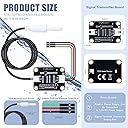
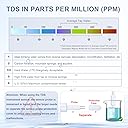
The CQRobot TDS Meter Sensor is a modern, waterproof dissolved solids sensor compatible with Raspberry Pi and Arduino boards. It features a wide voltage input (3.3V-5.5V), outputs a precise 0-2.3V analog signal, and is designed for easy plug-and-play use without soldering. Ideal for scientific research, teaching, hydroponics, and online liquid quality analysis, it offers reliable, high-resolution data with a durable probe built to prevent polarization.


| ASIN | B08KXRHK7H |
| Best Sellers Rank | #128,334 in Industrial & Scientific ( See Top 100 in Industrial & Scientific ) #27 in Conductivity Meters & Accessories |
| Brand | CQRobot |
| Brand Name | CQRobot |
| Current Rating | 4 Milliamps |
| Customer Reviews | 4.2 out of 5 stars 229 Reviews |
| Item Weight | 0.05 Kilograms |
| Manufacturer | CQRobot |
| Material | PLA_(Polylactic Acid), PE_(Polyethylene) |
| Material Type | PLA_(Polylactic Acid), PE_(Polyethylene) |
| Maximum Supply Voltage | 5.5 Volts |
| Measurement Accuracy | +/- 10% F.S. (25 Degree Celsius) |
| Model | CQRSENTDS01 |
| Output Type | Analog Voltage |
| Specific Uses For Product | laboratory, scientific research, teaching, liquid quality analysis, online analysis |
| Style | Modern |
| Style Name | Modern |
P**H
Best TDS sensor available!
Product arrived quickly and was exactly what was needed. This is a great sensor that can be used for many different projects. Easy to set up. Will work well for my hydroponics project.
S**N
Accurate and useful.
It does take a little bit of programing knowledge as the documentation is poor and muddied by a couple different libraries for essentially the same product. With a little bit of perseverance and general arduino knowledge you can get it working. I've had it running for a week now just to make sure it stayed calibrated reasonably well and it's been great. I currently have mine running on an ESP32 DevkitC with wifi connectivity hosting a local web interface and tracking the readings for a week at a time. You can see over the data each time i've bumped the nutrients so it's following my trend line well. Be aware, you'll need a TDS meter that you trust in order to calibrate it but once you get it dialed in it's great. Also here's my basic breadboard test of it to show how simple the circuit is.
J**A
Good probe, but some IMPORTANT TIPS....
Works well. Some tips... - Download and Use the GravityTDS.h library instead of using the sample code. MUCH simpler and easier to implement. - Remember to pull off the cover from the tip of the probe! I didn't even notice the probe cover for the first 20 mins of trying to get it to work. - For most accurate results, buy a separate temperature probe and code your project to have the temperature sensor provide the temperature compensation value for the TDS sensor.
S**G
Check the code on there Wiki
Great product, easily connected with my Raspberry Pi with an additional ADS1115, be sure check there wiki for the code.
K**M
WikiPage Pi example not working
The product build quality seems great. I was able to get it connected with an ADC to my Raspberry Pi a few minutes. However, the configuration instructions aren't very clear on their Wiki page. I noticed the wiki page for other CQRobot products had a zipped file containing the test code but this one didn't. I've spent a few hours trying to get the resolve.
C**.
works perfectly so far with a little calibration!
works great!!
A**E
Inaccurate and poor information
This is the same TDS meter you'll get from Gravity as well, just rebranded. Multiple brands exist for this one product. This meter is just not accurate after testing on both the raspberry pi and arduino mega. Even with calibration the meter is off by huge margins (over 50%) at 0 - 2000 ppm range. It seems the higher the salienity of the solution being measured the less accurate. After preparing multiple test solutions of 0 ppm, 100 ppm, 500 ppm, and 1000 ppm using distilled water and pouring hours of time into trying to get this thing to produce any semi-accurate readings I have to conclude this thing is just junk. Either I got a bad one or it just doesn't work. No information as to exactly how the device works either, confusing specs like 5v input but only 0 - 2.3v output? How does an ADC interpret this then if the output range is lower than the vref range?? No explanation, no datasheet, no documents, only a shotty wiki entry online that has some poorly written and misspelled code on it.
A**A
Excelente producto y funcional
Excelente producto que necesitaba para proyectos de la universidad
Trustpilot
3 weeks ago
2 weeks ago