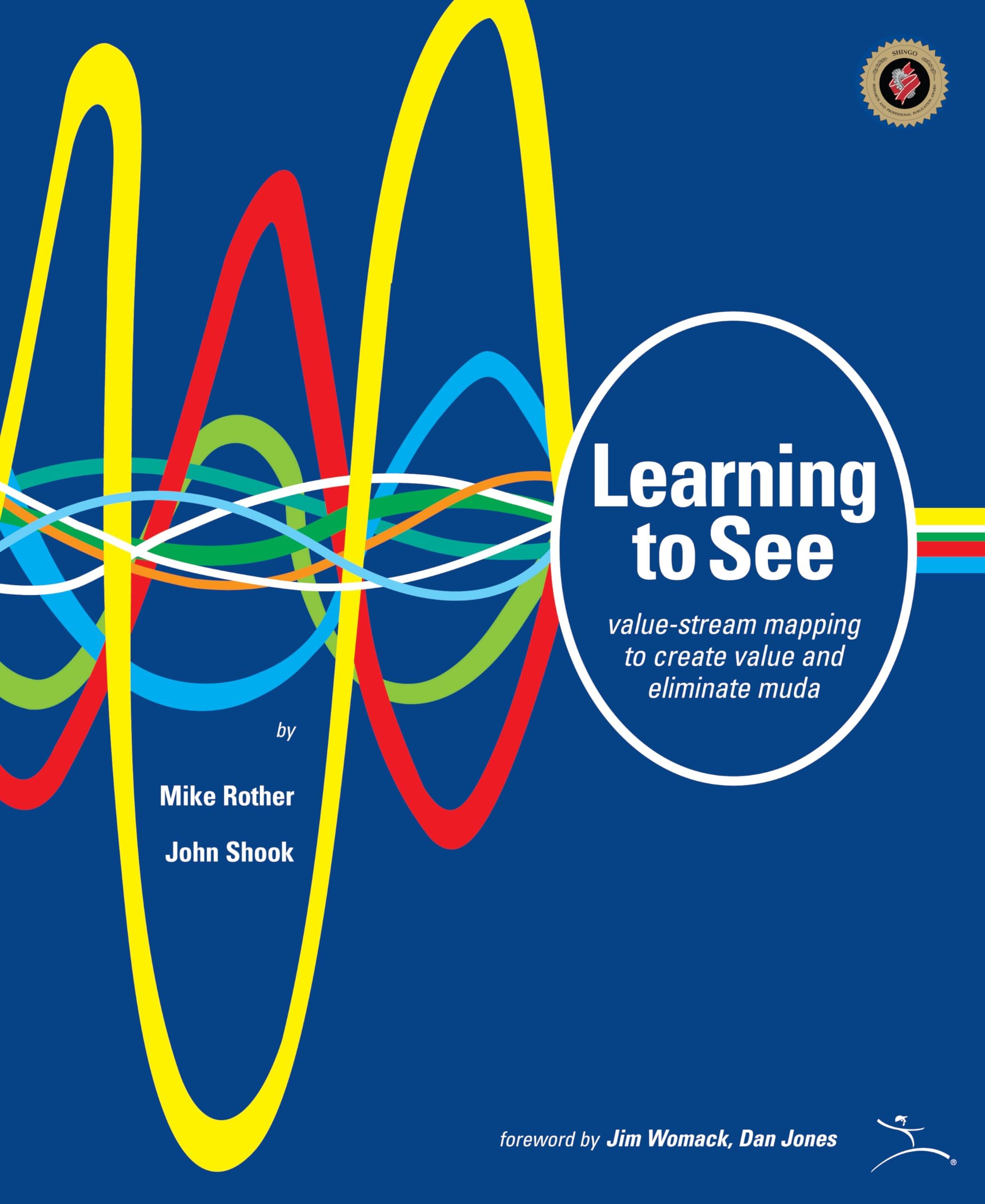
Lean Enterprise Institute,US Learning to See: Value Stream Mapping to Add Value and Eliminate Muda
Product ID: 258679737
Desertcart purchases this item on your behalf and handles shipping, customs, and support to Portugal.
Much more important, these simple maps - often drawn on scrap paper - showed where steps could be eliminated, flows smoothed, and pull systems introduced in order to create a truly lean value stream for each product family.In 1998 John teamed with Mike Rother of the University of Michigan to write down Toyota's mapping methodology for the first time in Learning to See. This simple tool makes it possible for you to see through the clutter of a complex plant. You'll soon be able to identify all of the processing steps along the path from raw materials to finished goods for each product and all of the information flows going back from the customer through the plant and upstream to suppliers. With this knowledge in hand it is much easier to envision a "future state" for each product family in which wasteful actions are eliminated and production can be pulled smoothly ahead by the customer.In plain language and with detailed drawings, this workbook explains everything you will need to know to create accurate current-state and future- state maps for each of your product families and then to turn the current state into the future state rapidly and sustainably.In Learning to See you will find:A foreword by Jim Womack and Dan Jones explaining the need for this tool.An introduction by Mike Rother and John Shook describing how they discovered the mapping tool in their study of Toyota.Guidance on identifying your product families.A detailed explanation of how to draw a current-state map.A practice case permitting you to draw a current-state map on your own, with feedback from Mike and John in the appendix on how you did.A detailed explanation of how to draw a future-state map.A second practice case permitting you to draw a future-state map, with "the answer" provided in the appendix.Guidance on how to designate a manager for each value stream.Advice on breaking implementation into easy steps

| Dimensions | 22.86 x 1.27 x 27.31 cm |
| Edition | 1st |
| Isbn 10 | 0966784308 |
| Isbn 13 | 978-0966784305 |
| Item Weight | 590 g |
| Language | English |
| Print Length | 102 pages |
| Publication Date | 1 December 1999 |
| Publisher | Lean Enterprise Institute,US |
User
ES LO QUE ESPERABA
GRACIAS, ES LO QUE ESTABA ESPERANDO. YA CONOCÍA ESE TÍTULO
User
Draft version?
Missing text, spelling errors.The concepts are the key message and serves its purpose but I don’t know how this made it to print.
User
Great textbook
This is the best book to use to learn value stream mapping, and you can honestly use the insight gained by working through it to improve factory processes. Really.I worked through the book myself over a hotel weekend, and then tried it out, and then read it again. I have honestly used Value Stream Mapping to take $5 million + (probably WAY+) worth of stupid out of the processes at my part of a factory that does about $30M per month in salesThe bad:The book comes with a CD. It's worthless. If you buy a used copy without the CD, don't worry about it.Update: OK, so this was interesting to come across a few years down the road... I bought this book and wrote the preceding review about 5 years ago. I got some very good results out the improvements that eventually came from mapping current state processes, and then mapping the future state, and then getting to work on the differences (lean mfg.). Over the entire factory, the benefit turned out to be a little shy of 10 million dollars. Fast forward five years, and now I've got my own operation to run. Obviously, everyone here has read this book. The factory supervisors and the lead men write the current state, and say what needs fixing. The engineers write the future state, and a Project manager figures out how to get there and prioritizes which problems to work in what order. So far, we've been able to take 5% out of cost in six months, and that's only because we don't have much practice.
User
Everyone should know how to optimise material and information flow
I was fortunate to be coached in this technique many years ago and soon realised many go look but very few see and understand. The book helps me get the subject over while acting as a handy reference.I would recommend Learning to See to anyone who is serious about optimising processes.
User
Benifit of the book
This book is easy to understand with real life example. You can take a example of your own business and production for the Lean Managemant.The explanation is so simple and qualitative.If the proce is good for this type of content.
Trustpilot
3 weeks ago
1 month ago