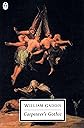

Desertcart purchases this item on your behalf and handles shipping, customs, and support to Portugal.
This story of raging comedy and despair centers on the tempestuous marriage of an heiress and a Vietnam veteran. From their "carpenter gothic" rented house, Paul sets himself up as a media consultant for Reverend Ude, an evangelist mounting a grand crusade that conveniently suits a mining combine bidding to take over an ore strike on the site of Ude's African mission. At the still center of the breakneck action--revealed in Gaddis's inimitable virtuoso dialogeis Paul's wife, Liz, and over it all looms the shadowy figure of McCandless, a geologist from whom Paul and Liz rent their house. As Paul mishandles the situation, his wife takes the geologist to her bed and a fire and aborted assassination occur; Ude issues a call to arms as harrowing as any Jeremiad--and Armageddon comes rapidly closer. Displaying Gaddis's inimitable virtuoso dialogue, and his startling treatments of violence and sexuality, Carpenter's Gothic "shows again that Gaddis is among the first rank of contemporary American writers" (Malcolm Bradbury, The Washington Post Book World ). Review: Accessible Gaddis (Sort of) - I admit it. I am a Gaddis addict who has read the Recognitions four times and JR every two or three years since its publication in 1986. Carpenter's Gothic is another masterpiece, not exactly easy but at least confined pretty much to a single language and words just about anyone can understand. This makes it an excellent place to start on Gaddis for those who may (understandably) be daunted by the longer books. Liz, a stunning redhead and post-debutante daughter of a corporate tycoon whose bribery scandal provoked suicide several years back, is being fleeced by the company pals of her father's, who are administering her father's estate in their own interest. She has a husband, Paul, a battered ex-infantry lieutenant, her deceased father's bagman, who married Liz for her dough and is now helplessly watching it vanish and trying feverishly and incompetently to establish himself as a public relations consultant to a cartoon backwoods evangelist. She has a brother, Billy, a prep school dropout who finds nothing worth doing and finally makes one pathetic and fateful effort in the wrong direction, and she is chanced upon by McCandless, a mysterious stranger, her landlord, who effortlessly seduces her and then tosses her aside for a chance to ride into town with the brother who just keeps showing up. Even Liz's only friend, another heiress trying her best to run through the dough left her by a despised aunt, calls Liz collect from Acapulco. Her life is one ridiculous situation after another, and then it ends, pointlessly, at age 33. McCandless, the landlord, is an initially interesting figure whose incessant smoking may offer something of a key to his real character. He serves as a kind of death impulse in the lives of the other characters, who are simply lost and doing their best with the very little with which they have to work. These others are all so inept that being unscrupulous doesn't even advance their agendas, and nothing really happens to any of them except a series of one off accidents. . Gaddis's persistent major theme is failure and Carpenter's Gothic represents failure on steroids. Nevertheless, as others have pointed out, the language is fantastic and the situations are hysterically funny. Optimists won't like the book much. They should try Dale Carnegie. He's good too, in his way. Review: A Thinking Person's House of Horrors - Taking place exclusively in the eponymous dwelling, CG is a long-winded and by turns creepy and satirical yarn told primarily through the eyes and thoughts of a psychologically, and literally, trapped woman. The book's arc, such as it is (Gaddis favors page-long soliloquy over driving narrative action) concerns said woman dealing with the rigors of living with an abusive, alcoholic husband whose ties to a wayward reverend have gotten him into a mess of trouble. Also worth noting are the woman's interactions with her new home's original owner, a mysterious figure who pops in and out to deliver cryptic messages, smoke incessantly, and rifle through an unsettling amount of ancient documents in an upstairs study. The woman, our hero, is quickly at her wits-end and is pushed even further into the all-consuming darkness of America past and present, in which themes of bigotry, sexual tension, addiction and other general nastiness come to the fore. Imagine, if you will, a very literary (and talky) version of the recent American Horror Story (season one, natch) and you'll have a pretty good idea of the goings-on in Gaddis' house of horrors. Linguistically, the book is a raw and circuitous machine, wherein phrases like 'paper tore' are repeated ad naseum, creating a patchwork effect that adds to the isolation and claustrophobia of the titular house and its effect on its captives. It is not only physically ensnaring, this locale, but verbally so as well, creating a sense of narrative dread within a narrative absent of physical push toward a satisfying climax. That is not to say things end without a certain level of change on display, which is all I'll reveal. If you have an interest in literary horror, you'll find this journey satisfying, if a little taxing on the eyes as Gaddis seems very unfamiliar, as so many postmodernists are, with the virtues ascribed to the 'return' and 'tab' keys.
| Best Sellers Rank | #1,264,056 in Books ( See Top 100 in Books ) #2,910 in Humor About Law & Crime #15,216 in Contemporary Literature & Fiction #16,678 in Classic Literature & Fiction |
| Customer Reviews | 4.3 out of 5 stars 46 Reviews |
L**N
Accessible Gaddis (Sort of)
I admit it. I am a Gaddis addict who has read the Recognitions four times and JR every two or three years since its publication in 1986. Carpenter's Gothic is another masterpiece, not exactly easy but at least confined pretty much to a single language and words just about anyone can understand. This makes it an excellent place to start on Gaddis for those who may (understandably) be daunted by the longer books. Liz, a stunning redhead and post-debutante daughter of a corporate tycoon whose bribery scandal provoked suicide several years back, is being fleeced by the company pals of her father's, who are administering her father's estate in their own interest. She has a husband, Paul, a battered ex-infantry lieutenant, her deceased father's bagman, who married Liz for her dough and is now helplessly watching it vanish and trying feverishly and incompetently to establish himself as a public relations consultant to a cartoon backwoods evangelist. She has a brother, Billy, a prep school dropout who finds nothing worth doing and finally makes one pathetic and fateful effort in the wrong direction, and she is chanced upon by McCandless, a mysterious stranger, her landlord, who effortlessly seduces her and then tosses her aside for a chance to ride into town with the brother who just keeps showing up. Even Liz's only friend, another heiress trying her best to run through the dough left her by a despised aunt, calls Liz collect from Acapulco. Her life is one ridiculous situation after another, and then it ends, pointlessly, at age 33. McCandless, the landlord, is an initially interesting figure whose incessant smoking may offer something of a key to his real character. He serves as a kind of death impulse in the lives of the other characters, who are simply lost and doing their best with the very little with which they have to work. These others are all so inept that being unscrupulous doesn't even advance their agendas, and nothing really happens to any of them except a series of one off accidents. . Gaddis's persistent major theme is failure and Carpenter's Gothic represents failure on steroids. Nevertheless, as others have pointed out, the language is fantastic and the situations are hysterically funny. Optimists won't like the book much. They should try Dale Carnegie. He's good too, in his way.
K**R
A Thinking Person's House of Horrors
Taking place exclusively in the eponymous dwelling, CG is a long-winded and by turns creepy and satirical yarn told primarily through the eyes and thoughts of a psychologically, and literally, trapped woman. The book's arc, such as it is (Gaddis favors page-long soliloquy over driving narrative action) concerns said woman dealing with the rigors of living with an abusive, alcoholic husband whose ties to a wayward reverend have gotten him into a mess of trouble. Also worth noting are the woman's interactions with her new home's original owner, a mysterious figure who pops in and out to deliver cryptic messages, smoke incessantly, and rifle through an unsettling amount of ancient documents in an upstairs study. The woman, our hero, is quickly at her wits-end and is pushed even further into the all-consuming darkness of America past and present, in which themes of bigotry, sexual tension, addiction and other general nastiness come to the fore. Imagine, if you will, a very literary (and talky) version of the recent American Horror Story (season one, natch) and you'll have a pretty good idea of the goings-on in Gaddis' house of horrors. Linguistically, the book is a raw and circuitous machine, wherein phrases like 'paper tore' are repeated ad naseum, creating a patchwork effect that adds to the isolation and claustrophobia of the titular house and its effect on its captives. It is not only physically ensnaring, this locale, but verbally so as well, creating a sense of narrative dread within a narrative absent of physical push toward a satisfying climax. That is not to say things end without a certain level of change on display, which is all I'll reveal. If you have an interest in literary horror, you'll find this journey satisfying, if a little taxing on the eyes as Gaddis seems very unfamiliar, as so many postmodernists are, with the virtues ascribed to the 'return' and 'tab' keys.
J**N
William Gaddis: America's Greatest Novelist?
OK, maybe not, but certainly one of the five best in this century (though I'd be pulling teeth to make such a list). A satirist of the highest, Gaddis always wrote beyond himself, outside of rigid systems, with a quiet(though sometime shrill!) voice, and a fervor which can - and has! - awaken the American soul from its slumber, breath a new breath to festor a new life in it, which has been downed into cataplexy. Buy his books.
S**R
Refurbished, still decayed
A slight, almost theatrical novel by America’s great novelist. Carpenter’s Gothic is a wry satire that takes aim at the curious hybrid blend of Christian zealotry and materialist vanity that has gripped America. Depicted entirely in a Carpenter’s Gothic style house (which Gaddis lived in), we are thrown into this characteristic, dialogue-driven situation of an empire in flames. What is lost here amidst the mad brilliance, is the pathos, the development, and the depth of feeling.
J**J
`There's a very fine line between the truth and what really happens.'
What a bleak world `Carpenter's Gothic' depicts: a world of chicanery, cynicism and opportunism - a world largely absent of compassion and love. And what a challenge it was, to stay with the pace of the novel because it certainly didn't allow me to develop and impose my own reading pace. The novel describes a comparatively brief period in the life of Elizabeth `Liz' Booth, during a period in which she and her husband Paul rent a house from a mysterious man named McCandless. This house, built in the architectural style known as `Carpenter's Gothic', is situated in the Hudson River Valley. It is a house that looks impressive from a distance but is really `a patchwork of conceits, borrowing and deceptions': a fitting setting for the story that is about to unfold. `Feel like I'm in here talking to myself.' The story unfolds in a form of dialogue which is sometimes a set of intersecting monologues; unattributed speech in which the characters (usually Liz and Paul) interrupt each other and in turn are interrupted by the daily intrusions of life - primarily the telephone and delivery of mail. It's up to the reader to interpret what is said, to choose from a range of alternate possible meanings. In the meantime, as the novel progresses, different elements of the plot are revealed making it necessary (at least for me) to revisit some earlier interpretations and conclusions. Paul is obsessed with various schemes, none of which appear to have any real societal benefit and the juggling of which render him completely self-absorbed and Liz completely isolated. The later presence of McCandless, and appearances by Liz's brother Billy, afford the reader a different view of Liz's life. My conclusions? It took me a while to adjust to the rhythm of this novel but once I found a rhythm I was comfortable with I found I couldn't put the novel down. It was a little like watching a high speed car crash in slow motion in order to try to work out what happened. And now that I'm finished, I suspect that I could read the novel again and form some different conclusions. This is my first William Gaddis novel: I'll have to try to track down some others. Jennifer Cameron-Smith
E**S
The most breathless novelist of all time?
Gaddis must give Thomas Bernhard a run for his money. While Bernhard specialises in the ranting monologue -- and denies the reader the breathing space of a single paragraph-break -- Gaddis plunges us into a cacophony of competing voices. Passages of description and narration are few and far between, and even when we get them, they're written telegraphically, almost as a stream-of-consciousness, with only the most minimal punctuation. I'm an advocate of lucidity in prose as a rule, but Gaddis's energy does away with the distinctions between lucidity and obscurity -- after a single page of this novel, you know you're in the hands of a master, one of the greatest writers of dialogue the novel has known. (He makes David Mamet seem quiescent by comparison.) The material of the novel seems terribly unpromising. It's set almost entirely in one house (full of false walls and chimneys unconnected to fireplaces -- a sure sign that everything is not as it seems) and the protagonist, Liz, is a nervous wreck. None of the characters really communicate with one another -- or at least not while they're talking. The plot is inordiantely complex, and we're often given information that doesn't make sense at the time. And Liz is the only person who really manages to elicit any sympathy from the reader. But it's still a thrilling read, because Gaddis stokes the rhetorical fires unceasingly and with unflagging wit. A good starting point for his three larger novels.
S**P
Challenging, but well worth it...
Having heard so much praise for Gaddis' work and having read excerpts from all four of his novels, I decided to give "Carpenter's Gothic" a try. I must say that I was not at all surprised to find that everything I've heard about Gaddis' virtuoso prose and dialogue is absolutely true. The man was an absolutely brilliant writer. His dialogue is the best I've ever read. I also can see why he never really became popular: he's not the easiest writer to read. A book like this has to be read at least two times in order for the reader to catch up on a lot of what is going on. Not that this would be much of a chore. In fact, I think that anyone who has read this book would look forward to a second go-round!
H**B
Worth a look
I read it a long time ago, and some of the dialogue has stuck with me, but overall there's an emptiness of vision underlying this work. Whether or not the book satirizes Christianity or fundamentalism is hard to say; if it does, it doesn't try very hard. One character rants against the language of evangelization, but that character turns out to be a venal, self-obsessed murderer. What does that say about his opinions? In fact, one irony is the work may implicate readers who agree with the anti-Christian diatribes ... but I'm not sure. At least the book's short and some of it is memorable.
C**N
Super
Un anglais facile à lire mais un texte qui peut parfois laisser perplexe. Intéressant à étudier . N'hésitez pas à l'acheter, c'est de la bonne littérature qui fait bien réfléchir .
P**N
This is how cliches die
Just finished William Gaddis's third novel, Carpenter's Gothic. I'd been meaning to read it and, knowing I'd be out at sea for a few days, figured now was the time. The problem is that with a Gaddis novel, now is never really the time. His books are all-consuming and time-consuming at the same time; you need to focus, but the focus must also be sustained. I think of his novels as the sort to force the cultivation of focus, not just its exercise: you go into them expecting to struggle, but in fact the struggle isn't even the hardest bit. What's hardest is learning to struggle, figuring out what kind of attention you need to be paying, and for how long each moment of effort will go on. Carpenter's Gothic is -- if you exclude Agape Agape, which I would not call a novel in any significant sense -- Gaddis's shortest novel, and I read it relatively quickly. But then, I set myself high standards when I was reading The Recognitions: six months of nothing but reading that, more than once, carefully, adoringly. JR took about a month. Everything in Carpenter's Gothic happens in a single house built in the style suggested by the title: wooden, derivative, or, in the words of a central character, "a patchwork of conceits, borrowings, deceptions, the inside's a hodgepodge of good intentions like one last ridiculous effort at something worth doing even on this small a scale..." What I quoted is a passage I've seen a few times in Gaddis criticism, and having read the novel I understand its importance. This novel is bursting with characters trying to make do with what is there, and often doing it badly, miserably. The back cover copy on my edition calls this a "tempestuous comic novel" -- if this is a comic novel, I've lost my funnies. I feel almost dead after reading it, much as I did when I finished JR. The humor is there, but it's not funny very often. This is not a drawback. Whatever remains lighthearted throughout the book serves a higher purpose than providing laughter. It is relief from the endless sense of gloom and sadness. The Recognitions has moments of utter hilarity to it, frequent moments, but it, too, is generally bleak. The difference is partly in this novel's conciseness. There's less scope for digression, and jokes aren't really useful here the way they are in the longer books. Instead, what drives things forward here seems to be a kind of playful seriousness, of taking cliches seriously enough that they no longer need satirizing or lamenting. So you have a truly horrible, lying abuser of a husband, his wife utterly frozen with fear and longing and a mysterious artist figure/geologist with whom she goes for her affair. You have the irresponsible and impressionable younger brother, the Christian fundamentalists as idiotic as they ever are portrayed in fiction, the dubious strangers walking into the house. Gaddis mentioned in an interview I read once that he was playing with cliches, but this wasn't what you'd expect. The cliches here are purely formal; he departs from them. It's a remarkable, unsettling thing to see cliches stripped of their power. Films like Shrek find almost all their strength in their clever subversion of the hackneyed and the eye-rollingly obvious; the Austin Powers films, too, take what we all know about spy films and just nod along with us as we delightedly identify the things being skewered. I've been trained, by my own prejudices and by a very powerful culture of sarcastification, to see a distance from boring tropes as a way to keep them at bay. But Carpenter's Gothic is an example of what Slavoj Zizek often goes back to in his early work: overidentification, or taking the dominant ideology so seriously that you actually end up displacing it. It's a fascinating idea, one of my favorite little parts of Zizek's explicitly Lacanian work, and of course Gaddis did this perfectly well in JR, too -- but here it's the formal aspect of the novel's power that springs from overidentification. This abusive husband, Paul, is truly a wretched creature, but for whatever damned reason, a relatable monster; this powerless wife, Liz, probably the closest thing to a protagonist here, is not an idealized sufferer who could only be rescued by the shadowy artist, McCandless -- and he finds no redemption either, because he is naive and cynical at every step. These people rant and lie to each other, ignore the moments of truth as so much more irrelevance, and suffer in absolute isolation. It's glorious. You forget that you've seen this a million times, that of course the affair was going to come, that of course the house is somehow symbolic in this way and that. The far-fetched coincidences are not a relief. The escape from Gaddis's narrator's unrelenting exteriority comes only from the inner despair betrayed by what the characters say to each other, even as they're being ignored. It's by listening to them that you get any sense of who they are. And if the reader doesn't listen, it's likely nobody else will, either. It's a chaos of babbling and contradiction in that house. I loved it and want to die.
L**U
Pour les courageux...
Livre brûlé dès la fin de mes études... lu, lu lu et relu pour tenter de comprendre, que de cauchemars à l'idée de devoir le relire un jour. Peut-être n'étais je pas assez mûre..
P**E
An Unusual Author
It turned out that this book wasn't available and couldn't be delivered. In general, from reading one of his other books, 'A Frolic of His Own', I would recommend William Gaddis to anyone looking for a novel literary experience. He has a humour and style all his own.
Trustpilot
1 day ago
3 weeks ago