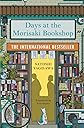

Desertcart purchases this item on your behalf and handles shipping, customs, and support to Portugal.
📖 Unlock the magic of Tokyo’s hidden bookshop—where every page feels like home.
Days at the Morisaki Bookshop is a 147-page translated Japanese bestseller that explores themes of love, loss, and renewal through the eyes of Takako, a young woman finding solace in her uncle’s second-hand bookshop in Tokyo. Praised for its authentic cultural detail and emotional depth, this award-winning novel offers a gentle, heartwarming read perfect for millennial professionals seeking literary comfort and cultural insight.


| Best Sellers Rank | 22,346 in Books ( See Top 100 in Books ) 79 in Cultural Heritage Fiction 170 in Marriage Relationships 348 in Marriage |
| Customer Reviews | 3.9 out of 5 stars 13,626 Reviews |
P**S
A lovely gentle read.
I've really enjoyed this book. The ideas behind it are quite simple. First, anyone who loves reading will instantly relate to four of the characters' relationship with books. Second, anyone who has ever been in love will relate to the experiences of the two main characters. Despite this simplicity there is also an underlying complexity to the story. The book examines the interrelatedness of people through their often unexceptional acts. Life has not been kind to several characters, but through the actions of those around them life turns in directions that the characters did not expect, but desperately wanted. It is a very good translation. Sometimes translated works lose something of the atmosphere of place. This, on the other hand, is still very much a Japanese book about very ordinary Japanese activities. The main characters are all well rounded. I'm sure that it would be possible to walk the streets of Tokyo and recognise real people like those in the book. The characters are more complex than they first appear. This is not a lengthy book. I read it over two short sessions. There is, I suppose, nothing special about it, but when I reached the final page, I had the same feelings as when I read a longer book, perhaps over many days. There was a sense of loss, the loss of friends, the loss of places, and even the loss of customs that no longer feel alien. This is a book to read, as I have, on a miserable day. Something nice to drink. A snack. This book. Together, the perfect antidote to the bad weather. A gentle book. A book for when you need cheering up. I heartily recommend this, not as great literature, but as a feel good, heart warming panacea to cheer you up.
J**U
Strange little book that peaks into Japanese culture
There are a lot of Japanese novels that have been translated into English around at a moment and a recent trip to Japan had made me curious. This one promised to be about the "comfort that can be found in books" so shouldn't fail on any level. It was a debut novel and won a literature prize so I had high expectations. There are 147 pages - 20 chapters split into 2 parts. First published in Japan during 2020 then 2023 in England. There is a wonderful sense of social awkwardness that often seems to be present in Japanese novels. Generally, their society is polite on the surface but often without too much depth. That seems to sum up Takako's life until she lets some people get close to her - then the image slips and her life becomes more genuine. Everything seems to have thoughtful detail in their descriptions which encourages the reader to slow down and hopefully emulate the sensation of spending time in a bookshop. Time invested in reading gives the reader the opportunity to stand back from their lives and maybe make some decisions - certainly always to give some healing time. This is Takako's experience and the author encourages the reader to share this. I was never completely convinced about how the plot played out as unlikely events happen but I was curious to see what would end the story. It's a strange little book which gives a peep into Japanese culture. There are a lot of dark issues within the story and all of them could be plausible - they also give a readable story when put together. I would be very careful before recommending the book to anyone but I am pleased that I found it.
D**N
nice pallet cleanser
Easy to read shorter story, some moving pages about the love of reading but for a story about a bookshop there weren’t many pages about the FMC living there. Felt like this was a little underdeveloped but still a wholesome worthwhile read.
O**N
A Heartwarming Journey of Healing and Self-Discovery
“Days at the Morisaki Bookshop" by Satoshi Yagisawa is a gem of a novel that will resonate with anyone who has ever found solace in the pages of a book. From the moment I picked it up, I was drawn into the cozy, inviting world of Morisaki Bookshop and its endearing characters. The story follows Takako, a young woman grappling with personal heartbreak, who finds herself reluctantly helping out at her uncle’s quaint bookshop in Tokyo’s Jimbocho neighborhood. What starts as a temporary refuge from her troubles turns into a transformative experience, as she discovers the healing power of literature and the warmth of human connection. Yagisawa's writing is beautifully evocative, bringing the bookshop and its surroundings to life in vivid detail. The narrative is gentle yet compelling, filled with quiet moments that resonate deeply. I particularly loved the nuanced portrayal of Takako's journey from despair to hope, and the way the bookshop becomes a sanctuary not just for her, but for the community around it. One of the standout aspects of the novel is its celebration of books and reading. As an avid reader, I found myself enchanted by the numerous literary references and the heartfelt discussions about favorite books. It reminded me of the magic of discovering a book that speaks to your soul and the joy of sharing that experience with others. The supporting characters, from the quirky uncle Satoru to the loyal customers, add depth and charm to the story. Their interactions with Takako provide moments of humor, wisdom, and poignancy, making the narrative all the more rich and relatable. In a world that often feels overwhelming, "Days at the Morisaki Bookshop" is a comforting reminder of the simple joys that can be found in a quiet corner with a good book. It’s a must-read for anyone who loves stories about personal growth, community, and the enduring power of books. Highly recommended!
H**L
Flowing prose style
I really enjoyed this book. I more or less read it in two sittings and found I didn’t want to put it down and loved being in the world and in the company of the characters. I liked the slow development of the story and emotional developments of the characters. I think it is very well written; the prose is lovely to follow. I did find myself wondering if it wasn’t set in Japan if I would’ve had the same positive approach to the overall book as if you swapped out the cultural references and behaviours the story line would not really be so gripping in an English setting. I felt that it could be seen as simplistic so I found myself in two minds as to the overall quality of the book. I noticed lots of people talk about comfort blanket and easy read and cosy. All of which suggest a certain genre in England of very easy comfortable books, but I don’t really feel this fits into that genre , although it could do, I am not sure. I really enjoyed being inside Japanese people’s ways of thinking and their customs which as an outsider you don’t get to do. I liked the easy flow of the writing and story and would recommend.
N**T
Very flat characterisation
I'm afraid to say that this novel didn't really work for me - or maybe it's more that I wasn't the right reader for the book. I didn't feel I knew anything about the characters, including the main one (who wasn't proactive enough to call the protagonist) even by the end of the book. As someone who dearly loves depth of character and character development, this wasn't a very satisfactory situation for me and left me unable to connect with the characters even in misfortune. In addition, the fact that one of the main premises of the plot - that main character Takako changes her attitude to books and reading overnight - didn't seem credible. Would she really suddenly wish that she had a book to hand, when she had previously seemed quite dismissive of the habit of reading? And, after her efforts to rearrange the books in her accommodation above the bookshop itself, would she genuinely have that moment of epiphany - there were numerous books available to her without even going down to the shop? And as for pulling a book out at random from a pile of books - well, wouldn't that lead to a major 'bookalanche'? Maybe I'm being too pedantic, but these are issues which pulled me out of the narrative. The story itself is delivered in a simplistic manner, but does touch upon issues such as loneliness and the hazards for relationships of not communicating effectively. I'm so sorry not to have loved a novel in which books play such an important part, but, sadly, overall it's 2.5 stars from me.
T**A
Gentle book!
Really lovely book. Nothing much happens, and it’s pretty slow—but there’s something about it that keeps you reading. It has this quiet, comforting feel to it. I loved all the characters. Each one felt important in their own way, and they all had a place in the story. By the end, they kind of stayed with me. It’s not a dramatic book, but if you’re in the mood for something gentle and warm, with a bit of heart, this is perfect.
M**N
A big hug...
Books about books and bookshops are pretty much a winner for me. I am actually a little wary though – what if such a book lets me down and (gasp) disappoints in its depiction of one of my favourite places in the world? Can such a book accurately describe my love for such places? Well, no fears on this one. From the first few lines I was hooked. Young (well, in her twenties) Takako finds her life in Tokyo suddenly changed when her boyfriend out of the blue announces he is going to get married – not to her. This is a shock, understandably. Takako gives up work but then takes up the kind offer of her Uncle Satoru to live and work in his second-hand book shop in Jimbocho, a kind of Japanese version of Hay on Wye in Tokyo. She is initially reluctant, not really being a reader, and feeling that a move back towards family could be an admission of failure, but the quiet charm of the place works its magic and before long, living above the shop, Takako learns to love it. Although books are an essential part of the story, this book is really about relationships. Although Takako knows a little about her Uncle Satoru, it’s not really a lot and she hasn’t seen him in years – the rest of her family regard him as a bit of an idiot. Working for him, she gets to know her Uncle better, and realises that he is a much more complicated person than she realised. Satoru’s relationship with his wife Momoko is complicated. At the beginning of the book, we find that Momoko walked out five years ago, although in the second half of the book she returns. This is a book that exudes gentle melancholia and a certain nostalgic charm, combined with the complexity of human relationships (well, humans and a cat) and the profoundness of life. Not a lot really happens, but as an encapsulation of a no-doubt idealistic Japanese lifestyle and as a meditation on the important things in life it worked wonderfully well for me. The Studio Ghibli feel is strong with this one, and I also think that fans of Haruki Murakami should like this one too, although this is not as complex. Days at the Morisaki Bookshop is for anyone who loves Japanese culture or literature, or would like to. At a mere 160 pages this can be a quick read – I read it in two short sittings – but like the best contemporary Japanese writing, it has scenes that I’ll remember for a long time. Whisper it quietly, but this is a great big hug in a book.
K**Y
A japanese cozy read 🫰🏻🌱
The quality of book is amazing go for it . A Japanese novel that feels like home 💖. Obviously the plot takes place majorly at a bookshop and every bibliophiles will love that part . But apart from the bookstore the story feels average but it is bonded with so much of raw emotions 🥹. The novel explores the story of a girl named Takako ,who trying to figure out peace from an unwanted chaos happened on her love life. She just gone through a deceit from a person whom, she thinks is her boyfriend but was not. She just returned from that chaos,homeless and even jobless,to her uncle's home aka Morisaki Bookshop . She lives there in that bookshop which was a hereditary thing ,from even three generations before 📚🫰🏻. From there it shows us how that bookshop became an inevitable place in her life as she came across many things during that stay ✨✨ The writing is so simple that we can easily connect with the characters and plot.The book moreover feels like a warm hug in a bad day✨🫰🏻.The jimbhocho town is calling me to stay there for the rest of the life to do the honour of reading and reading and reading........
A**R
Excelente entrega
Excelente, llegó el mismo día, en buen estado el empaque, la carátula y contra portada tiene unas marcas de una pinzas.
A**R
Nice read
Beautiful
N**N
Impression de qualité, lecture fluide pour les débutants en anglais
La couverture du livre et l’impression sont de très bonne qualité L’histoire est originale et captivante Je conseille fortement pour une première lecture en anglais pour les débutants
O**.
Warm, Comforting & Beautifully Written
This was such a relaxing and comforting read. Days at the Morisaki Bookshop has a very calm, reflective atmosphere that makes it perfect for quiet evenings or weekends when you just want to slow down and enjoy a thoughtful story. The writing feels gentle and natural, and the setting of the small Tokyo bookshop is incredibly cozy and immersive. Even though the story is simple on the surface, it explores loneliness, healing, relationships, and personal growth in a very genuine way. The characters feel human and easy to connect with, especially through the small everyday moments that make the novel feel authentic. What I especially enjoyed was how the book captures the feeling of finding comfort through literature and routine. Fans of Japanese translated fiction will probably appreciate the subtle emotional style and slower pacing.
Trustpilot
2 weeks ago
1 day ago