
Buy anything from 5,000+ international stores. One checkout price. No surprise fees. Join 2M+ shoppers on Desertcart.
Desertcart purchases this item on your behalf and handles shipping, customs, and support to Portugal.
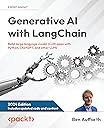
2024 Edition โ Get to grips with the LangChain framework to develop production-ready applications, including agents and personal assistants. The 2024 edition features updated code examples and an improved GitHub repository. Get With Your Book: PDF Copy, AI Assistant, and Next-Gen Reader Free Key Features Learn how to leverage LangChain to work around LLMsโ inherent weaknesses Delve into LLMs with LangChain and explore their fundamentals, ethical dimensions, and application challenges Get better at using ChatGPT and GPT models, from heuristics and training to scalable deployment, empowering you to transform ideas into reality Book Description ChatGPT and the GPT models by OpenAI have brought about a revolution not only in how we write and research but also in how we can process information. This book discusses the functioning, capabilities, and limitations of LLMs underlying chat systems, including ChatGPT and Gemini. It demonstrates, in a series of practical examples, how to use the LangChain framework to build production-ready and responsive LLM applications for tasks ranging from customer support to software development assistance and data analysis โ illustrating the expansive utility of LLMs in real-world applications. Unlock the full potential of LLMs within your projects as you navigate through guidance on fine-tuning, prompt engineering, and best practices for deployment and monitoring in production environments. Whether you're building creative writing tools, developing sophisticated chatbots, or crafting cutting-edge software development aids, this book will be your roadmap to mastering the transformative power of generative AI with confidence and creativity. What you will learn Create LLM apps with LangChain, like question-answering systems and chatbots Understand transformer models and attention mechanisms Automate data analysis and visualization using pandas and Python Grasp prompt engineering to improve performance Fine-tune LLMs and get to know the tools to unleash their power Deploy LLMs as a service with LangChain and apply evaluation strategies Privately interact with documents using open-source LLMs to prevent data leaks Who this book is for The book is for developers, researchers, and anyone interested in learning more about LangChain. Whether you are a beginner or an experienced developer, this book will serve as a valuable resource if you want to get the most out of LLMs using LangChain. Basic knowledge of Python is a prerequisite, while prior exposure to machine learning will help you follow along more easily. Table of Contents What Is Generative AI? LangChain for LLM Apps Getting Started with LangChain Building Capable Assistants Building a Chatbot like ChatGPT Developing Software with Generative AI LLMs for Data Science Customizing LLMs and Their Output Generative AI in Production The Future of Generative Models Review: Great for getting started w/LLM apps - I have not used LangChain before, and I am looking at this book to learn how to create an LLM app. I am really looking forward to trying it out for all three types of apps covered in the book - assistants/chatbot, code generation, and data science. The book is clear and straight to the point, so I expect to be able to try these out fairly quickly. I have gotten through the "setting up the dependencies" section. I cloned the book's github repo, and I tried three methods for variety's sake to create a python environment: pip, conda, and Docker, all on Windows, and I believe I have them all set up. I hit some bumps, but I was able to follow the onscreen error messages and get past them. For pip, I needed to install MSFT Build Tools to get C++. For the conda case, I had to modify the yaml file for two of the packages - ncurses and readline, which have different names for Windows. In Chapter 2 there is a comparison of LangChain with other frameworks, from which you get a feel that choosing LangChain at this moment is the best choice. I am happy to have found this book, and I can't wait to proceed w/the next steps. It's a lot of fun to be able to interact w/LLMs. Review: A good book, be prepared for extra research. - This is one of the best books on Generative AI (at least developing with/against) that I've seen thus far. That said, it's not perfect - in fact, kind of far from it. The Good: The first 3-4 chapters (especially the first 3) are a goldmine when it comes to a good landscape view of AI currently. What I greatly appreciate about this book is that while it still has some focus on OpenAI (through use), it does talk about other models out there. Way too many books focus on integrating with OpenAI instead of illustrating that you can (and sometimes should) be running your own models. I found the first 3 chapters to be, by far, the best in the book. In my opinion, the first three chapters are worth the cost of the book. The Bad: You'll need to be prepared for a lot of extra research. Starting around Chapter 4, you'll see new syntax and classes used that don't explain _WHY_ they're being suggested. There's also a good deal of hand waiving in terms of the details for the implementation choices. Below is an example: On page 158, you'll read about the ConversationalRetrievalChain - which is intended to, given vector store, search against documents loaded in it. Then, on page 161 you're presented with "ConversationChain". It mentions that it's to remember past interactions with the LLM, then gives a bunch of code. It doesn't do anything to contrast the two. In other words, you'll be finding something, noting it down on paper, and finding the distinction yourself (I found myself on a LangChain ticket that explained the difference). The other "bad" about the book is also part "good" too (somewhat). The Github repo is important to find and pull from. The code in the book in some cases works poorly, or is missing crucial points that if you type what's presented in the book, you may not get a fully running thing. So the github repo, grepping through repo looking for the code that best matches what you're reading then copying/pasting is important. It doesn't help that the Github repo doesn't denote the projects by chapter so it's easier to find the code. You'll also want to do this anyways, because even in earlier revisions of the code, there were bugs present. E.g. with the chatbot, multiple "AI" outputs because of the way it was called/instantiated. To the author's credit, he is making changes and most of them are good (not all, I find myself disagreeing with some of the changes and have multiple versions of his code up since some elements in the older versions are better for learning than the newest code checked on yesterday). The theme in the "bad" is be prepared to search, take notes, and write/highlight in the book. Summary: Despite the negatives, this book is absolutely fantastic and the best that I've found so far. O'Reilly had the preview version, which I was reading til the full release came out and bought the book too. I do recommend the book if you want to develop against LLMs - and I also recommend it for the first 3 chapters for more summary information. Just a few tips: 1. Make sure you do as many of your own code examples using what's presented in the book at the Github profile to solidify knowledge. If you plan to read the book and not implement right away, you'll gain little after Chapter 3. 2. Take notes - ample notes, search and contrast. The name differences between the classes are important, and there's little explanation in the book. I find myself noting the class names on paper, drawing relationships, and explaining them based off searches (and what little may be in the book that helps). That all said, I do recommend the book.


| Best Sellers Rank | #1,317,446 in Books ( See Top 100 in Books ) #455 in Computer Neural Networks #465 in Natural Language Processing (Books) #1,093 in Python Programming |
| Customer Reviews | 4.1 out of 5 stars 95 Reviews |
H**T
Great for getting started w/LLM apps
I have not used LangChain before, and I am looking at this book to learn how to create an LLM app. I am really looking forward to trying it out for all three types of apps covered in the book - assistants/chatbot, code generation, and data science. The book is clear and straight to the point, so I expect to be able to try these out fairly quickly. I have gotten through the "setting up the dependencies" section. I cloned the book's github repo, and I tried three methods for variety's sake to create a python environment: pip, conda, and Docker, all on Windows, and I believe I have them all set up. I hit some bumps, but I was able to follow the onscreen error messages and get past them. For pip, I needed to install MSFT Build Tools to get C++. For the conda case, I had to modify the yaml file for two of the packages - ncurses and readline, which have different names for Windows. In Chapter 2 there is a comparison of LangChain with other frameworks, from which you get a feel that choosing LangChain at this moment is the best choice. I am happy to have found this book, and I can't wait to proceed w/the next steps. It's a lot of fun to be able to interact w/LLMs.
D**T
A good book, be prepared for extra research.
This is one of the best books on Generative AI (at least developing with/against) that I've seen thus far. That said, it's not perfect - in fact, kind of far from it. The Good: The first 3-4 chapters (especially the first 3) are a goldmine when it comes to a good landscape view of AI currently. What I greatly appreciate about this book is that while it still has some focus on OpenAI (through use), it does talk about other models out there. Way too many books focus on integrating with OpenAI instead of illustrating that you can (and sometimes should) be running your own models. I found the first 3 chapters to be, by far, the best in the book. In my opinion, the first three chapters are worth the cost of the book. The Bad: You'll need to be prepared for a lot of extra research. Starting around Chapter 4, you'll see new syntax and classes used that don't explain _WHY_ they're being suggested. There's also a good deal of hand waiving in terms of the details for the implementation choices. Below is an example: On page 158, you'll read about the ConversationalRetrievalChain - which is intended to, given vector store, search against documents loaded in it. Then, on page 161 you're presented with "ConversationChain". It mentions that it's to remember past interactions with the LLM, then gives a bunch of code. It doesn't do anything to contrast the two. In other words, you'll be finding something, noting it down on paper, and finding the distinction yourself (I found myself on a LangChain ticket that explained the difference). The other "bad" about the book is also part "good" too (somewhat). The Github repo is important to find and pull from. The code in the book in some cases works poorly, or is missing crucial points that if you type what's presented in the book, you may not get a fully running thing. So the github repo, grepping through repo looking for the code that best matches what you're reading then copying/pasting is important. It doesn't help that the Github repo doesn't denote the projects by chapter so it's easier to find the code. You'll also want to do this anyways, because even in earlier revisions of the code, there were bugs present. E.g. with the chatbot, multiple "AI" outputs because of the way it was called/instantiated. To the author's credit, he is making changes and most of them are good (not all, I find myself disagreeing with some of the changes and have multiple versions of his code up since some elements in the older versions are better for learning than the newest code checked on yesterday). The theme in the "bad" is be prepared to search, take notes, and write/highlight in the book. Summary: Despite the negatives, this book is absolutely fantastic and the best that I've found so far. O'Reilly had the preview version, which I was reading til the full release came out and bought the book too. I do recommend the book if you want to develop against LLMs - and I also recommend it for the first 3 chapters for more summary information. Just a few tips: 1. Make sure you do as many of your own code examples using what's presented in the book at the Github profile to solidify knowledge. If you plan to read the book and not implement right away, you'll gain little after Chapter 3. 2. Take notes - ample notes, search and contrast. The name differences between the classes are important, and there's little explanation in the book. I find myself noting the class names on paper, drawing relationships, and explaining them based off searches (and what little may be in the book that helps). That all said, I do recommend the book.
H**N
Must have book for LLM and Generative AI
"Generative AI with LangChain" offers a timely exploration of the evolving landscape of language models, particularly in the context of LangChain's transformative potential. Auffarth adeptly navigates the complexities of LLM-powered applications, providing a comprehensive guide for both beginners and seasoned developers alike. The book demystifies key LangChain developments by abstracting LLM complexities while empowering readers with advanced customization options. From fundamental concepts to intricate techniques like agents and chains, Auffarth equips readers with the tools necessary to enhance applications and navigate production deployment effectively. What sets this book apart is its multifaceted approach, bridging theory with hands-on examples across diverse domains like information extraction and chatbots. By combining conceptual foundations with real-world implementations, Auffarth ensures readers gain not only a deep understanding of LangChain but also the skills to tailor it to their specific applications. "Generative AI with LangChain" stands out among existing resources by offering a comprehensive, well-rounded exploration of LangChain's capabilities. Auffarth's expertise shines through in his intuitive explanations and applied case studies, making this book an invaluable resource for anyone looking to harness the power of language models in their projects.
R**R
Excellent Intro to Langchain
"Generative AI with Langchain" comprehensively explores building Generative AI software and individual components using Langchain. From understanding the fundamentals of generative models to practical applications in various sectors, the book navigates through topics such as enhancing language models with external knowledge, developing AI-driven assistants, and deploying generative AI in real-world scenarios. It addresses critical concerns like misinformation, ethical deployment, and the future societal impacts of AI technologies. With insights into LLM customization techniques, and deployment strategies, the book offers a roadmap for harnessing Langchain's potential in the Gen AI landscape.
E**N
Very Little of It Works Seamlessly
Bought this to ramp up on langchain. First two chapters were a decent amount of non-technical fluff, which is probably fine if this is your first book on modern trends in AI/LLMs. Subsequent chapters actually dive into technical examples of using langchain APIs and integrations with hugging face, open ai, etc. The problem is, very few of the examples work without significant amount of troubleshooting and rejiggering. I'm not talking about "you didnt follow the instructions and forgot to procure an API key". Im talking about "the model in the example just completely doesnt work anymore, even if you have a pro subscription to hugging face hub", or weird versioning issues among the various libraries. Moreover, the github repo doesnt actually have clear chapter specific code, so you cannot just clone the repo and rerun those examples verbatim to rule out any issues local to your setup, or get an updated version of the examples should the models in them have to actually change due to deprecation. The book is fairly new, so it's confusing on why so many things already don't work. IMO, you may be better just going through the langchain walkthroughs. I've gone through other AI books from other publishers and had some issues due to API changes, but at least in those cases, much of it was addressable by reverting to library versions specified or by using the accompanying jupyter notebooks. Also, those issues only popped up 10% of the time.
A**H
very lucid explanation of how to build around LLMs using python/langchain
i'm only 100 pages into this book, but boy is it well phrased and extremely clear. i write apps around LLMs, including RAG architectures. perhaps it's just the current state of my learning, but i've found this book to be extremely helpful and very logically organized. I'll revisit this review once i'm through the entire book, but so far 10/10. it's easily the best and most self-contained book i have on the subject.
J**Y
Good conceptual overview as of mid-2023, but code will need constant updates
This book has a lot of good info on current models, techniques, and what chaining LLMs is all about, but because langchain is updated so frequently it's hard to keep the code up-to-date. Langchain is already a super messy framework (so I've heard), and is undergoing rapid evolution. Take a look at the pypi.org release history for the langchain package - it's being updated every few days to once a week. The first code sample in the book using a fake LLM doesn't work, and other early code samples are already deprecated or slated to be deprecated in a near-term langchain release. The documentation on langchain should be helpful for getting started there while this book has good conceptual coverage and ideas of what you can do. I'm sure many of the code examples work but once I found several in the 3rd chapter weren't working I skipped the rest for now. However, this book provides a good conceptual overview for the first 2 chapters and discusses state-of-the-art models and techniques as of 2023. However, these will also soon be out of date and the book will need to be updated or you'll have to go somewhere else to find the latest in late 2024, 25, and beyond. The writing is fine, but there are a lot of lists and tables which LLMs are good at generating. I'm not sure how much of this book was written/drafted by an LLM as a result. Many places could've been more direct and to-the-point as well. Overall a good book but it's going to require a lot of upkeep on the code. I've been told by Packt the author will be keeping code up to date on the github for the book.
H**V
There is no color in the book
I just bought the book. It is missing colors. Everything is black and white and like a copy. I have downloaded the pdf using the QR code and it has colors. It is not just that. If it was black and white and good quality I would be ok. It is like, this printed when there was a little ink left in the cartridge.
D**T
A valuable resource
Today, Generative AI and Large Language Models (LLMs) are reshaping the world. LangChain is a framework for developing applications powered by language models. This book has, therefore, arrived at exactly the right time, is insightful, and delves into the critical role of LangChain in builing LLM-powered applications. The book comprises of ten distinct chapters. The author starts by introducing generative models, explaining transformers, the theory behind them, and the evolution of AI. The author then moves into more complex, LangChain-orientatated, discussions exploring a range of topics including setting up LangChain, building chatbots, automation in data science, and the complexities of deploying real-world generative AI applications. There is a wealth of valuable content contained within, much of which comprises crucial information, particularly considering contemporary issues and challenges. The author is adept at articulating intricate ideas in a clear manner. For example, the author offers a beginner-level explanation of getting started with LangChain, including the code for doing so. This approach of providing the code and describing it allows readers to gain hands-on experience and a deeper understanding of the concepts being discussed. If there is a minor gripe, it is that much of the code examples rely on OpenAI. In summary, Generative AI with LangChain is an informative read. The author has managed provide a practical guide for one of the key tools of today. Whether you are a developer, or someone who is just interested in understanding LangChain, this book is a valuable resource.
K**A
[MUST READ] A Comprehensive Guide to Generative AI with Langchain
"Generative AI with Langchain" by Dr. Ben Auffarth is a convergence of artificial intelligence and Generative AI. Its a comprehensive guide for both beginners and experts in the data science field. Dr Ben Auffarth had meticulously crafted this book which serves as a valuable resource for those delving into the realms of Generative AI. One of the most commendable aspects of this book is its content structure and its readability. Despite the complexity of the subject, the author explained the intricate concepts in a clear and concise manner, making it suitable for readers with varying levels of technical expertise. Irrespective of whether you are an expert AI researcher or a beginner to the field, you'll find valuable insights to deepen your understanding of Generative AI and Langchain. This book also talks about the recipe for building a chatbot like ChatGPT for enterprise, leveraging the capabilities of external knowledge sources/domain specific data via Retrieval Augmented Generation(RAG). This also emphasise on customizing the LLMs via Supervised Finetuning(SFT), Prompt Engineering(PE). This book is a starter kit for those who intend to build LLM based applications by leveraging the Langchain as an orchestrator for their application. This book also outlines the limitations of the current LLM models and ways to mitigate them for our specific use cases. By showcasing how Langchain can be used to generate different modalities like text, images, videos and speech, the book inspires readers to push the boundaries of what's possible with AI-driven creativity. This book also uncovers the need for going beyond the stochastic parrots of LLM models by harnessing the Langchain framework. In summary, Generative AI with Langchain" is a must-read for anyone interested in exploring the fascinating world of Generative AI. Ben Auffarth alongside their lucid writing style and focus on fostering creativity, renders this book an invaluable asset for researchers, practitioners, and enthusiasts alike. Whether you seek to enhance your comprehension of AI or ignite your creative spark, this book is sure to make a lasting impact. I highly recommended this book.
H**U
Great introductory book
If you are interested in getting an intro to LLM powered applications then you should start with this book.
S**O
Informative
The book is well written and informative. Perfect starter textbook for RAG applications with LangChain.
A**I
Excellent book
Explanation is good. Need a basic knowledge of python and gen ai to start this book. Worth for buying. Modules are well organized.
Trustpilot
1 month ago
1 month ago