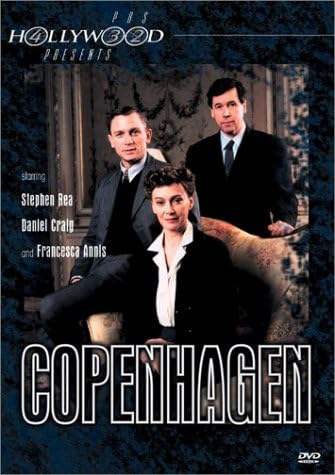
Copenhagen (PBS Hollywood Presents)
Product ID: 69049173
Desertcart purchases this item on your behalf and handles shipping, customs, and support to Portugal.
This 2002 film, based on the play by Michael Frayn, imagines what might have happened between the physicists Niels Bohr (Stephen Rea, The Crying Game ) and Werner Heisenberg (Daniel Craig, The Road to Perdition ) on a particular night in September of 1941. Heisenberg was collaborating with Nazis in Germany; Bohr, a Jew, was living in occupied Denmark but had contact with physicists on the Allied side. Something in this meeting destroyed their longstanding friendship; Frayn envisions their ghosts--and that of Bohr's wife, Margrethe (Francesca Annis, Dune )--reliving, arguing, and fantasizing about a conversation in which an innocent topic like skiing could slide into a dangerous discussion of physics and politics. This skillfully woven and well-acted conversation, far from being a static talk-fest, has all the dynamism of a psychological thriller. Our intentions, like the particles at the heart of physics, can never be known for certain. --Bret Fetzer Inspired by actual events which have baffled and intrigued historians for years, this Tony Award-winning drama by Michael Frayn (Spies, Noises Off) comes to life in this stirring presentation. At a 1941 meeting, two brilliant physicists and longtime friends, Denmark's Niels Bohr (The Crying Game's Stephen Rea) and Germany's Werner Heisenberg (The Road to Perdition's Daniel Craig), find themselves on opposite sides of World War II. Heisenberg's covert trip at great risk to see Bohr and his wife, Margrethe (Reckless' Francesca Annis), in Copenhagen results in disaster. Why did Heisenberg really go to Denmark, what did the two men discuss, and what happened during this pivotal meeting which became a defining moment of the modern nuclear age? "Among the most exhilarating, challenging and involving two hours you ever spend in a theater!" - The Nation Review: Most unusual, speculative history. Small cast, superbly acted. No blockbuster action. - If you've ever watched Sleuth, you know that a small cast can deliver a completely riveting movie experience. Copenhagen delivers just as powerfully. The premise is that Heisenberg, German physicist, makes a mysterious visit to Bohr, Danish physicist and Heisenberg's mentor, during the height of WW-2. At the time, Denmark was was occupied by Germany. History does not record what the two discussed; the entire premise of the movie is a speculative take on what they might have discussed. The speculation is revealed from in-the-moment scenes to retrospective recollections, and is revealed as profoundly important in what was communicated, and what wasn't. None of the three actors overpowers the others; they all contribute superbly and critically to the story and its narrative. You do not have to be a nuclear physicist to enjoy the movie, but an awareness of the history of nuclear physics will be a definite plus. My marginally informed estimate is that the movie doesn't make any mistakes wrt the physics, except that I expected the term "absorption cross-section" to be used where the movie uses "diffusion equation". Again, though, the particle physics isn't the central point and doesn't get in the story's way. Rather, it's the implications of that physics, and what each man perceives of it, and how each man perceives his place in the panoply of scientists and in the context of his nation that form the core of the story. And don't get me wrong-- the woman is utterly critical to the story, as she is the rigorous conscience of both men, and the measurer of truths of the mind and spirit, just as the men are of the truths of the physics. Highly recommended, even with a near total lack of action. Review: provocative and deeply moving - Heisenberg wrote about his 1941 meeting with Bohr in Copenhagen in his book "Physics and Beyond." Both were pioneering greats earlier in the century; Heisenberg had done his best work while he worked with Bohr in Copenhagen. By 1941, though, he was heading the Nazi's nuclear program, and Bohr was living in occupied Denmark only too aware of his Jewish heritage. It's clear that the meeting was a failure on all counts and not long afterwards Bohr fled Denmark for his life as the German occupiers began to enforce so-called "race laws." What's mysterious is what Heisenberg hoped to accomplish with the meeting. He wrote that he wanted to warn Bohr (and presumably through him the British and Americans) that a nuclear weapon would require too many resources and take too long to complete to be of use in the war, but this may have been a ruse. Did he deliberately prevent the Nazi regime from getting an atomic bomb or did he fail to attain it because of a simple blunder? The film repeats the circumstances of the meeting several times, varying them slightly with each telling. So, we have a kind of post-modern retelling with variations. The acting is superb, and the story completely engaging. The ethical issue is whether scientists who have the expertise to possibly produce weapons of enormous destructive power should withhold their expertise from governments who would certainly use those weapons and whether these scientists are morally culpable for their use, but also whether the Nazi regime was an enemy against which it would be morally justifiable to use such weapons. The more immediate issue is whether a deep friendship based on the joint pursuit of knowledge can survive a deep political and ethnic divide. The film is provocative and deeply moving.
| Contributor | Daniel Craig, Francesca Annis, Howard Davies, Michael Frayn, Stephen Rea |
| Customer Reviews | 4.3 out of 5 stars 303 Reviews |
| Format | Closed-captioned, Color, DVD, Letterboxed, Widescreen |
| Language | English |
| Runtime | 1 hour and 30 minutes |
| Studio | PBS |
E**T
Most unusual, speculative history. Small cast, superbly acted. No blockbuster action.
If you've ever watched Sleuth, you know that a small cast can deliver a completely riveting movie experience. Copenhagen delivers just as powerfully. The premise is that Heisenberg, German physicist, makes a mysterious visit to Bohr, Danish physicist and Heisenberg's mentor, during the height of WW-2. At the time, Denmark was was occupied by Germany. History does not record what the two discussed; the entire premise of the movie is a speculative take on what they might have discussed. The speculation is revealed from in-the-moment scenes to retrospective recollections, and is revealed as profoundly important in what was communicated, and what wasn't. None of the three actors overpowers the others; they all contribute superbly and critically to the story and its narrative. You do not have to be a nuclear physicist to enjoy the movie, but an awareness of the history of nuclear physics will be a definite plus. My marginally informed estimate is that the movie doesn't make any mistakes wrt the physics, except that I expected the term "absorption cross-section" to be used where the movie uses "diffusion equation". Again, though, the particle physics isn't the central point and doesn't get in the story's way. Rather, it's the implications of that physics, and what each man perceives of it, and how each man perceives his place in the panoply of scientists and in the context of his nation that form the core of the story. And don't get me wrong-- the woman is utterly critical to the story, as she is the rigorous conscience of both men, and the measurer of truths of the mind and spirit, just as the men are of the truths of the physics. Highly recommended, even with a near total lack of action.
T**3
provocative and deeply moving
Heisenberg wrote about his 1941 meeting with Bohr in Copenhagen in his book "Physics and Beyond." Both were pioneering greats earlier in the century; Heisenberg had done his best work while he worked with Bohr in Copenhagen. By 1941, though, he was heading the Nazi's nuclear program, and Bohr was living in occupied Denmark only too aware of his Jewish heritage. It's clear that the meeting was a failure on all counts and not long afterwards Bohr fled Denmark for his life as the German occupiers began to enforce so-called "race laws." What's mysterious is what Heisenberg hoped to accomplish with the meeting. He wrote that he wanted to warn Bohr (and presumably through him the British and Americans) that a nuclear weapon would require too many resources and take too long to complete to be of use in the war, but this may have been a ruse. Did he deliberately prevent the Nazi regime from getting an atomic bomb or did he fail to attain it because of a simple blunder? The film repeats the circumstances of the meeting several times, varying them slightly with each telling. So, we have a kind of post-modern retelling with variations. The acting is superb, and the story completely engaging. The ethical issue is whether scientists who have the expertise to possibly produce weapons of enormous destructive power should withhold their expertise from governments who would certainly use those weapons and whether these scientists are morally culpable for their use, but also whether the Nazi regime was an enemy against which it would be morally justifiable to use such weapons. The more immediate issue is whether a deep friendship based on the joint pursuit of knowledge can survive a deep political and ethnic divide. The film is provocative and deeply moving.
N**K
Super nerdy, especially for Physicists - in a good way.
Unique style of characters juxtaposed against each other in different times, view points, or attitudes belonging to both character, audience, and history. Very trippy: If you are interested in physics, World War II, or how Walter White got his nickname - I think you will like this film if you give it full attention (you will not know what is going on sometimes, but the dialogue is brilliant). The casting is obviously on point. You get to see Craig before he ever appeared in a Bond film, Stephen Rea before he was in V for Vendetta, and Francesca Annis after she was Lady Jessica in Dune (1984). Ha, what a trip. If you look at historical photos, the casting is actually surreal. Enjoy.
M**H
THREE GREAT ACTORS SHINE IN "COPENHAGEN"
Haunting in more ways than one "Copenhagen" is framed by the meeting of the ghosts of three friends who try to come to grips with why sixty years earlier their friendship was destroyed by a visit. This film is fascinating in structure and brilliantly realized as drama. Francesca Annis is simply wonderful as the wife of Danish Physicist Niels Bohr. She is as brittle and supportive of her husband as she is distrustful and yet tender to their old friend, German physicist Werner Heisenberg. Stephen Rea towers in his portrayal of Bohr and commands the screen in velvet gloved over steel performance. His role is one of such extreme depth and subtlety that I was truly impressed with what he delivered. As Heisenberg, Daniel Craig is a towering presence. Not that the personality of the man he plays is towering, but in his grasp of the complexities and conundrums is. What he does with the slight turn of the head, the shifting of the eyes and the turn of the mouth or the pout of his lips is a lesion in the art of screen acting. It is all about thinking and Craig lets us see what he is thinking. He has the ability to inhabit the moment and let the deepest and sometimes the guarded emotions play across his face. So here you have three great actors in a challenging work that is worthy of your time you might give to it. This film raises an important question, that of moral responsibility to humanity and when it is split like an atom by the three characters it multiplies the question into even deeper ones of loyalty, friendship, and love. A wonderful experience is waiting your arrival in "Copenhagen".
T**A
An excellent movie with great actors and a wonderful director based on play "Copenhagen"
It is a great movie, but, to my great sorrow, this movie is not appropriate for our fast pacing time and for the people who are not used to stop and to think a bit. It also demands some very minor understanding of the basics of physics gotten either due to a decent knowledge of a high school physics or through reading well written popular books on physics of the XX century. One may enjoy the movie even if one skips all the physical stuff involved there for one may grasp the its main subject the tragedy of people feeling themselves responsible for having made the world they lived in hundred years ago and the one we live in now much more vulnerable to the total destruction, but still the knowledge of physics helps to understand precisely what people in the play are talking about and not to be distracted by unknown words and notions. All this will help us to think more clearly about the most important question this film poses even if it is not formulated explicitly: why almost a century later our world, our planet as a whole, has not become safer and continues to move to the self destruction and what if anything people working over the fascinating projects of the future can do to avoid this looming disaster to happen.
K**N
A Vetting
This movie looks at some complex themes in some ways - beyond friends, love, hatred, the morality of science as an act of contributing to war.. Three ghosts really but the themes explored are so visceral. It can be boring at times as the themes ebb and flow. Dark. Scientific. And yet it involves very real themes such as one's otherness as a means of being used by society. And about allowing oneself to be used. If you love science this is for you. If you're a romantic or a dreamer stear very clear. This is like a Sylvia Plathe play with cinematic overtones. (Yes I know Plathe was not a playwright).
V**D
NOW I get it!
I was fortunate to see this play during it's Broadway run. While it was brilliantly acted, directed and was able to add one chilling element the film can't (the onstage audience in the elevated gallery, always looking like a silent jury)at times I had trouble following when we were seeing a flashback, an inner dialogue, or plot development. (The physics in the play is quite well presented but trust me, don't have that second tequilla shot before the curtain, no matter what!You really have to be on the ball for this one.) However, now having seen the film twice, many things come clear. The magic of film allows the players to think private thoughts without us mistaking them for side comments being made under the breath. Also, it is very clear when we are listening to the ghosts and the live players. But what REALLY gave me an ah-ha moment was when I finally saw that the play is crafted to mimic the act of nuclear fission. Instead of a neutron colliding with and splitting an atom into several directions, setting off a chain reaction, we witness two brilliant physicists colliding, also under forced circumstances and the split is represented by the various possible outcomes of that collision. We view several versions of the same encounter, each with different implications and motives. I can't wait to see this again and see where bells "ding" for me this time. The score is haunting and adds a great deal, as solo piano is unsurpassed in evoking a sense of isolation and loneliness. Acting is uniformly solid. I know I'll get lambasted for this, but I really preferred this cast over the b'way cast, especially Steven Rea, who added just a touch of melancholy to the role that I don't remember in the original. Give it a try. You may come away with the uneasy feeling that in a roundabout way, these men may have saved our planet.
W**W
tedious narration
Couldn't watch past 10 minutes. The film seemed to have endless narration of what I was watching. Just show the action... please. Film topic seemed good but too tedious for me to find out....
B**G
Excellent and fascinating dramatization
As a once student of physics, I appreciated the way the dialogue makes efforts to explain some aspects of quantum physics concepts, as well as presenting the moral dilemmas and circumstances associated with the atomic bomb development (and eventual use) during WW2. Highly recommended. Daniel Craig, Stephen Rea, and Francesca Annis (who plays the part of Bohr's intellectual wife) all deliver commanding and convincing performances. I particularly appreciated the prologue and epilogue documentary segments with Michael Frayn discussing background and afterthoughts regarding the actual historical facts and recent learnings (after the play was written).
A**R
Copenhagen DVD
Interesting movie. It's based on real facts and it's quite astounding.
A**R
Excellent Rendition of Michael Frayn's Play
A complex story of the wartime meeting between Neils Bohr and Werner Heisenberg. Thought to be a spy mission by Heisenberg to find out what the Western allies were up to in their developments of the Atom Bomb. A long lasting friendship between these two geniuses was destroyed. Both men subsequently distorted what might have been discussed. In the event the Nazi's development of nuclear reactors and possible an atom bomb failed
C**E
Histoire intéressante mais ardue
Attention, c'est complexe, surtout en anglais car le sujet n'est pas simple, le film tient plus d'une pièce de théâtre. Beau jeu d'acteurs
E**N
DVD called Copenhagen
As advertised . A good DVD to watch.
Trustpilot
3 days ago
2 weeks ago