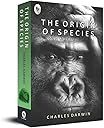
- Origin of Species , The
Product ID: 764419728
Desertcart purchases this item on your behalf and handles shipping, customs, and support to Portugal.
Buy Origin of Species , The on desertcart.com ✓ FREE SHIPPING on qualified orders Review: I see why this is considered such a great book - I finally got around to reading this famous scientific work. I have to say that I'm impressed with his clarity, logic, and scientific ability. He's blessed with a curiosity that is unbounded and the ability to test out all kinds of things using the scientific method. It's interesting how research worked back in the mid-19th century. He didn't have Google and even if he did, most scientists back then hadn't asked the questions he was asking. For example, he wondered how seed could be transported across oceans; he concocted experiments to see if seeds would float in the ocean for a long period of time and still germinate. He also wondered if mud on birds feet would contain seeds; so he captured some birds and checked out the mud on their feet. There are many other examples where he did this sort of thing. He also structured this book to answer all of the possible criticisms to his theories and did a very good job. He effectively cited the work of other scientists. I found this book a joy to read and see how the mind of a great scientist works. It's refreshing to see a scientist go against the consensus and powerfully support his radical new theory. This book is highly recommended for everyone. It is eminently readable and convincing. This book is controversial since there are many people that feel it is anti-God. I don't think so; to me, it simply shows that God did not create each and every species from 'nothing'. God is more like a farmer than a conjurer. I would think that the amazing versatility of life and its ability to adapt shows something that seems hard to imagine coming together by mere chance. Review: The best book ever written! - The Origin of the Species, probably the most important book of the 19th century in terms of thought leadership. Darwin was finally stimulated to write his book after Alfred Russel Wallace sent him a paper which outlined similar ideas to what eventually became known generically as "The theory of evolution". Darwins book drew upon various emerging distinct areas of science including geology, naturalism and animal breeding to develop a theory which was so revolutionary that he could not compel himself to publish until some 20 years after he had undertaken much of the initial field studies in the Southern Hemisphere. A work of genius, yet Darwin was also relatively modest and sought to co-publish his work with Wallace when he had discovered to true import of the work. Anybody reading this book I also recommend should read more about Wallace who in many ways has been forgotten by history. Just to set the scene although Darwin was a genius, he did have several advantages in terms of money and position in society. Wallace, on the other hand had had limited training as a surveyor prior to his travels in the southern hemisphere and did a great deal of his fieldwork inland working first in South America and then the far east. One could say that Wallaces achievements seem more remarkable because of this. However one could also say that Darwin was prevented from publishing his work precisely because of his high status because of what it meant in terms of religion and hierarchical systems. Whether you are a Darwin or a Wallace fan, now that these materials are available in such an accessible format I suggest to everyone to try and read them as much as possible and draw your own conclusions as the work of Darwin and Wallace have far-ranging consequences in the modern world and may be instrumental in us trying to understand who we are in the great scheme of things at the beginning of the 21st Century and beyond.


| Best Sellers Rank | #344,696 in Books ( See Top 100 in Books ) #76 in Endangered Species (Books) #516 in History of Civilization & Culture #552 in History & Philosophy of Science (Books) |
| Customer Reviews | 4.4 4.4 out of 5 stars (9,300) |
| Dimensions | 8.46 x 5.51 x 1.38 inches |
| ISBN-10 | 8172344880 |
| ISBN-13 | 978-8172344887 |
| Item Weight | 13.9 ounces |
| Language | English |
| Print length | 500 pages |
| Publication date | December 1, 2013 |
| Publisher | Fingerprint |
J**R
I see why this is considered such a great book
I finally got around to reading this famous scientific work. I have to say that I'm impressed with his clarity, logic, and scientific ability. He's blessed with a curiosity that is unbounded and the ability to test out all kinds of things using the scientific method. It's interesting how research worked back in the mid-19th century. He didn't have Google and even if he did, most scientists back then hadn't asked the questions he was asking. For example, he wondered how seed could be transported across oceans; he concocted experiments to see if seeds would float in the ocean for a long period of time and still germinate. He also wondered if mud on birds feet would contain seeds; so he captured some birds and checked out the mud on their feet. There are many other examples where he did this sort of thing. He also structured this book to answer all of the possible criticisms to his theories and did a very good job. He effectively cited the work of other scientists. I found this book a joy to read and see how the mind of a great scientist works. It's refreshing to see a scientist go against the consensus and powerfully support his radical new theory. This book is highly recommended for everyone. It is eminently readable and convincing. This book is controversial since there are many people that feel it is anti-God. I don't think so; to me, it simply shows that God did not create each and every species from 'nothing'. God is more like a farmer than a conjurer. I would think that the amazing versatility of life and its ability to adapt shows something that seems hard to imagine coming together by mere chance.
N**A
The best book ever written!
The Origin of the Species, probably the most important book of the 19th century in terms of thought leadership. Darwin was finally stimulated to write his book after Alfred Russel Wallace sent him a paper which outlined similar ideas to what eventually became known generically as "The theory of evolution". Darwins book drew upon various emerging distinct areas of science including geology, naturalism and animal breeding to develop a theory which was so revolutionary that he could not compel himself to publish until some 20 years after he had undertaken much of the initial field studies in the Southern Hemisphere. A work of genius, yet Darwin was also relatively modest and sought to co-publish his work with Wallace when he had discovered to true import of the work. Anybody reading this book I also recommend should read more about Wallace who in many ways has been forgotten by history. Just to set the scene although Darwin was a genius, he did have several advantages in terms of money and position in society. Wallace, on the other hand had had limited training as a surveyor prior to his travels in the southern hemisphere and did a great deal of his fieldwork inland working first in South America and then the far east. One could say that Wallaces achievements seem more remarkable because of this. However one could also say that Darwin was prevented from publishing his work precisely because of his high status because of what it meant in terms of religion and hierarchical systems. Whether you are a Darwin or a Wallace fan, now that these materials are available in such an accessible format I suggest to everyone to try and read them as much as possible and draw your own conclusions as the work of Darwin and Wallace have far-ranging consequences in the modern world and may be instrumental in us trying to understand who we are in the great scheme of things at the beginning of the 21st Century and beyond.
D**B
Surprisingly accessible and down to earth
Several aspects of the book surprised and delighted me. I didn't expect this to read as a novel, and it was not one, this was a philosophical thesis, and the result of some 30 years of research and contemplation which has not gone to waste. As a non-native English speaker I expected this to be a upstream struggle in comprehension - it was not. The language is only slightly archaic but overall is surprisingly down to earth once I got used to the style of the narrative. The logic and the examples used to support it were clear. Charles Darwin did not make his conclusions lightly and had full understanding of controversial nature of his work, but felt it was necessary to express the truth that was revealed to him through his research. It is apparent from this book that he had discussed each and every point of the theory at length. Much with those who were like minded and just as much with those who opposed him. And he relates the counterpoints in this very volume along with his reasons for thinking why these counterpoints are invalid. On this what surprised me is that (at least to my knowledge) the biggest opponents of evolutionary theory today (let's call them creationists for simplicity) have not came up with any new counter arguments to it. Everything creationists are saying today against evolutionary theory Darwin has answered already in this very book. Should they only ready it and follow the logic.... but I digress. In conclusion I should point out that this isn't an entertaining book, and at times it does become tedious, but it's invaluable educational and historic piece that anyone interested in evolution and modern science should "suffer through" at least once.
J**.
As these reviews often refer to other versions of the book, let me make it clear, I have only been concerned with the original text as presented in the current Kindle edition of Darwin's seminal work. No intros, no religious references. The apologetic manner of this book, coupled with the clear thought process and conviction of Darwin reflect the times in which it was published. His brilliance flickered through the veil of repression supported by the pride and prejudice of the Victorians .Considering the time span of its inception and finally being published, it offers a rare insight into the conservatism of his times, as well as the political pressures. Strangely, one can see this as a parallel evolution in society since this time, a process which is currently undergoing a selection process in our modern times that may well change the human species! How little we have actually changed! Yes, evolution is a slow process. Aside from the poetry of reading this book in the modern climate, Darwin sets even the most jaded mind back into action. There is much more here than postulations on evolution. His sence of wonder wafts from the pages like a fine perfume.
J**O
Bom livro
G**R
Supuestamente el texto es el mismo de la edición original. Es una lectura muy pesada, (hay que considerar que es un ingles británico de hace casi 200 años, con algunos términos, técnicos o no, que ya no se usan hoy en día y con referencias a muchas especies animales/vegetales que pueden ser desconocidas para la mayoría) independientemente de si tienes o no conocimientos avanzados de ciencias (aunque saber algo de biología básica al menos podría ayudar); Darwin describe no solo su teoría, sino también decenas o incluso cientos de pruebas a su teoría (principalmente escribe mucho acerca del porqué esas pruebas apoyan su teoría, mas que describir las pruebas o experimentos per se) y hasta se molesta en incluir y discutir sobre los aspectos "negativos" o controversiales de su propia teoría, todo esto en su conjunto hace que el lector tenga una vision mucho más amplia y reconozca la importancia de esta obra de un modo que no se puede apreciar por lo poco que se enseña en cursos básicos de biología o ciencias naturales.. Para la población general no recomendaría la lectura de este libro, en su lugar ya hay actualmente otros que por un lado explican la teoría en términos más sencillos o mejores, sobretodo ayudados por el extenso avance de la ciencia moderna que no ha hecho más que aportar innumerables pruebas extras a favor de la teoría de Darwin (por mencionar una de las más importantes, la genética y los mecanismos de la herencia, que en tiempos de Darwin no se conocían). Para especialistas o personas interesadas en temas evolutivos si que debería ser una lectura obligatoria, aunque advertidos quedan de que deben ser pacientes con la lectura de esta obra.
K**R
But yet it is. The origin of species by way of natural selection is so deceptively easy to understand that I never fully appreciated the brilliance required to formulate the theory. Over 500 pages, we see Darwin provide countless examples of biological diversity to support his claims. No experiment can neatly demonstrate his theory (though selective breeding gets close). So Darwin must convince humanity through decades of observation and research and wrestling with hypotheses, until we reach his final summary and conclusion in the final chapter, that his theory of evolution is undoubtable. This is what makes The Origin of Species a work of genius.
J**O
Really bad edition. No introduction. Uneven print quality. Some pages really light. No hardbond copy: it's a paperback with hard edges. Buy the Wordsworth edition!
Trustpilot
1 month ago
1 month ago