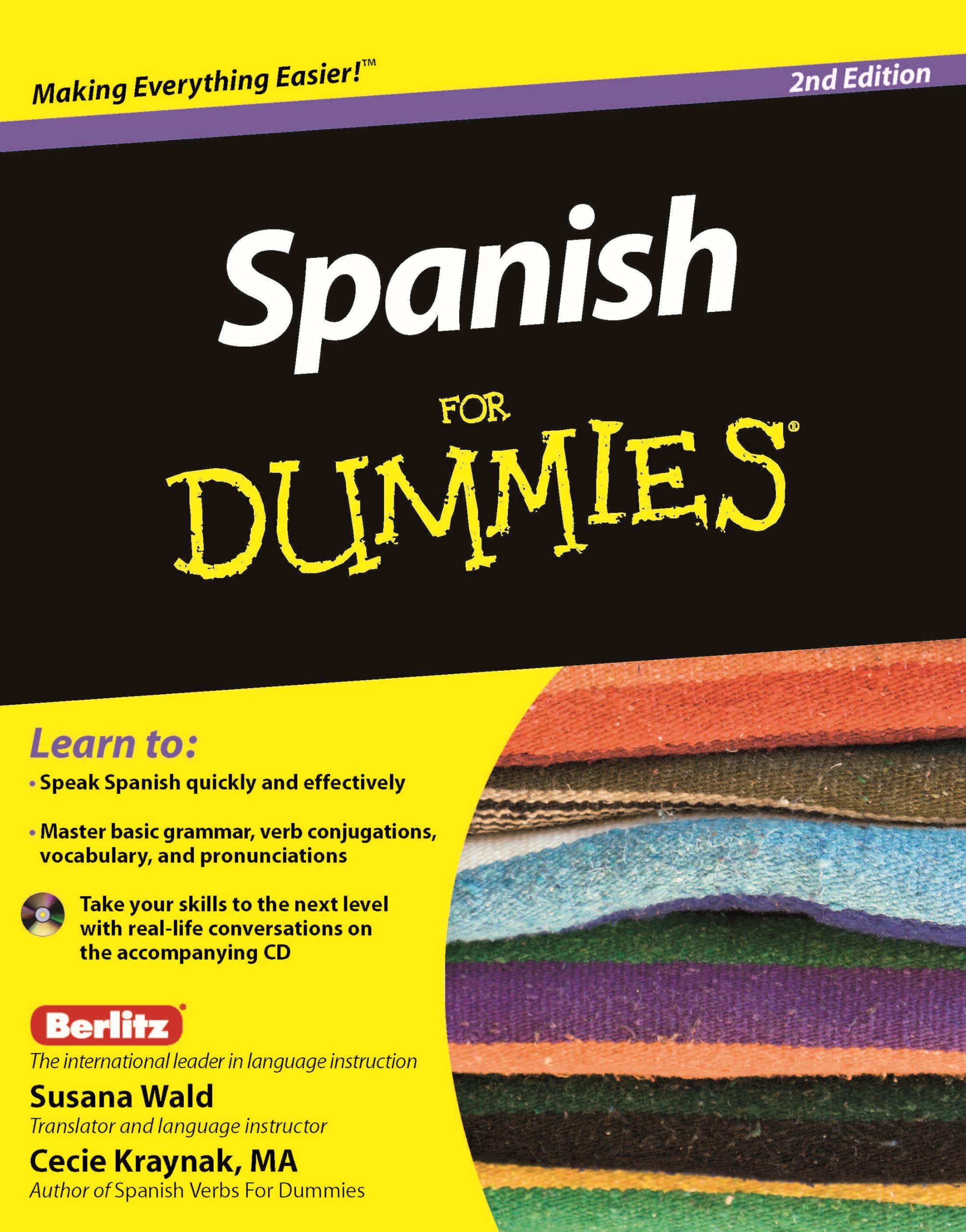
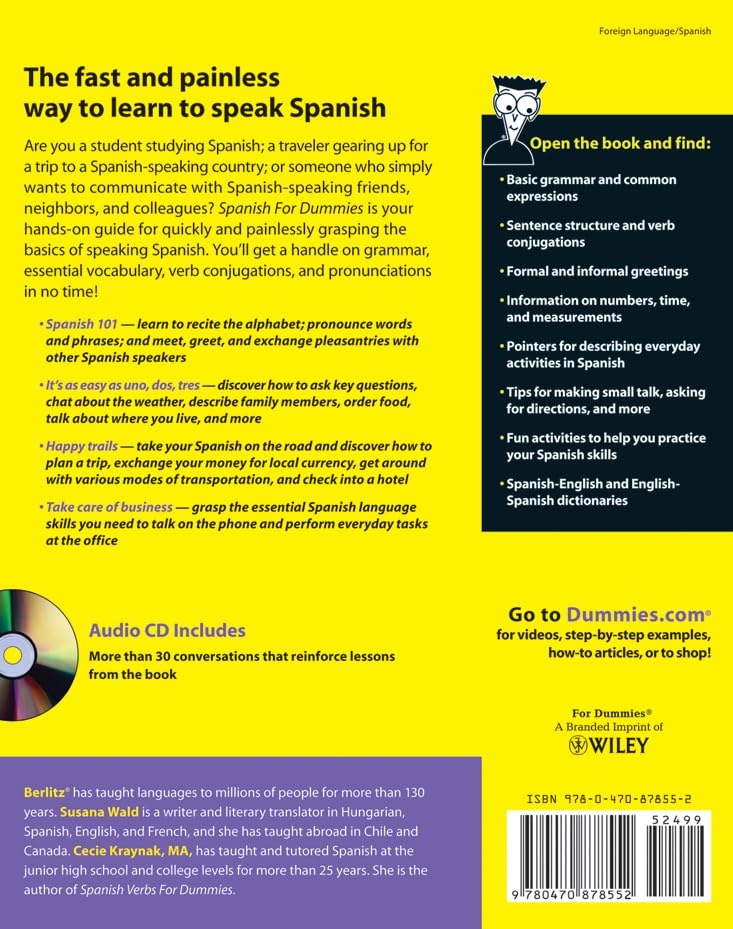

Spanish For Dummies
H**A
Ok
Ok
A**A
5 Stars- with reservations
My recent experiences with 2 Wiley ‘for Dummies’ books have led me to suspect that they don’t understanding the importance of proofreading. But…and this is important in a language book…this one is LOADED with pronunciation keys- something rare in other language books I’ve looked at.There aren’t many exercises included so you’ll probably want to also purchase the accompanying workbook. That one has LOTS of useful exercises and also explanations as to how answers are arrived at- again, invaluable- but, even as a beginner, I identified a number of errors in that book (including, in the same paragraph, the number 9 being translated as both ‘nueve’ (correct) and (once) incorrect).So, 5 stars for features but also a warning that you might not want this to be your only teaching source.
V**
Pretty good!
I'm still no fluent or anything but the book helped me build a decent foundation at my own pace.
D**A
Learning a lot
Fun to learn
C**Y
Great for beginners!
I bought this workbook for myself to help develop my basic Spanish skills, specifically vocabulary and grammar. My boyfriend speaks Spanish so I am familiar with the pronunciations, but I read and write very little Spanish besides the basics. I wanted to build a foundation for my Spanish so that I can concertante with my boyfriend and his family in Spanish easier. It is helpful to know the basics in grammar and the vocab before thrusting yourself into conversation like I have. This is useful when paired with Duolingo, but my boyfriend has noticed that some of the Spanish words are slang and or Spain Spanish instead of Latin American Spanish. Nonetheless, I enjoy the workbook and find that I am making progress as I complete chapters!
C**T
Intrigued but flummoxed
I like the way the book phonetically spells Spanish words. I like how it's constructed, how the lessons are laid out and how they build on the previous chapter. But I have found a couple of discrepancies that are throwing me off.First of all, there is a blatant contradiction: in Chapter 1, it cites "no se" (I don't know) as an "essential common expression." But in Chapter 19, the very same expression is listed as one of the "Ten Things Never to Say in Spanish" because it is "perceived as a snub." So which is it?Maybe I shouldn't be reading this book because I have been studying Spanish for six months using the Duolingo app on my phone, and this book says it's best for people who have never studied Spanish. I found that to be true in Chapter 2, the section about Forming Questions. It teaches the opposite of what I have been doing for six months on Duolingo. For example, this book says that to say "Is the school new" in Spanish, your sentence construction would be exactly the same in Spanish ("Es la escuela nueva?"). But for six months using Duolingo, I have been taught to say "La escuela es nueva?" ("The school is new?") I admit that the way this book teaches question construction is more logical to the American ear than how Duolingo teaches...but it's disconcerting to experience two totally different ways of speaking the same language. How do I know which one is the right way??
D**D
The Dummy series
Hard to beat the easy to grasp methods of the Dummy Books. Great for a quick overview of Spanish… I’m ready for my trip to Costa Rica
N**J
Helpful aid.
Great aid for experiencing conversational Spanish.
Trustpilot
1 month ago
3 weeks ago
1 month ago
3 weeks ago