

Desert Online General Trading LLC
Dubai, United Arab Emirates
Desert Online General Trading LLC
Dubai, United Arab Emirates

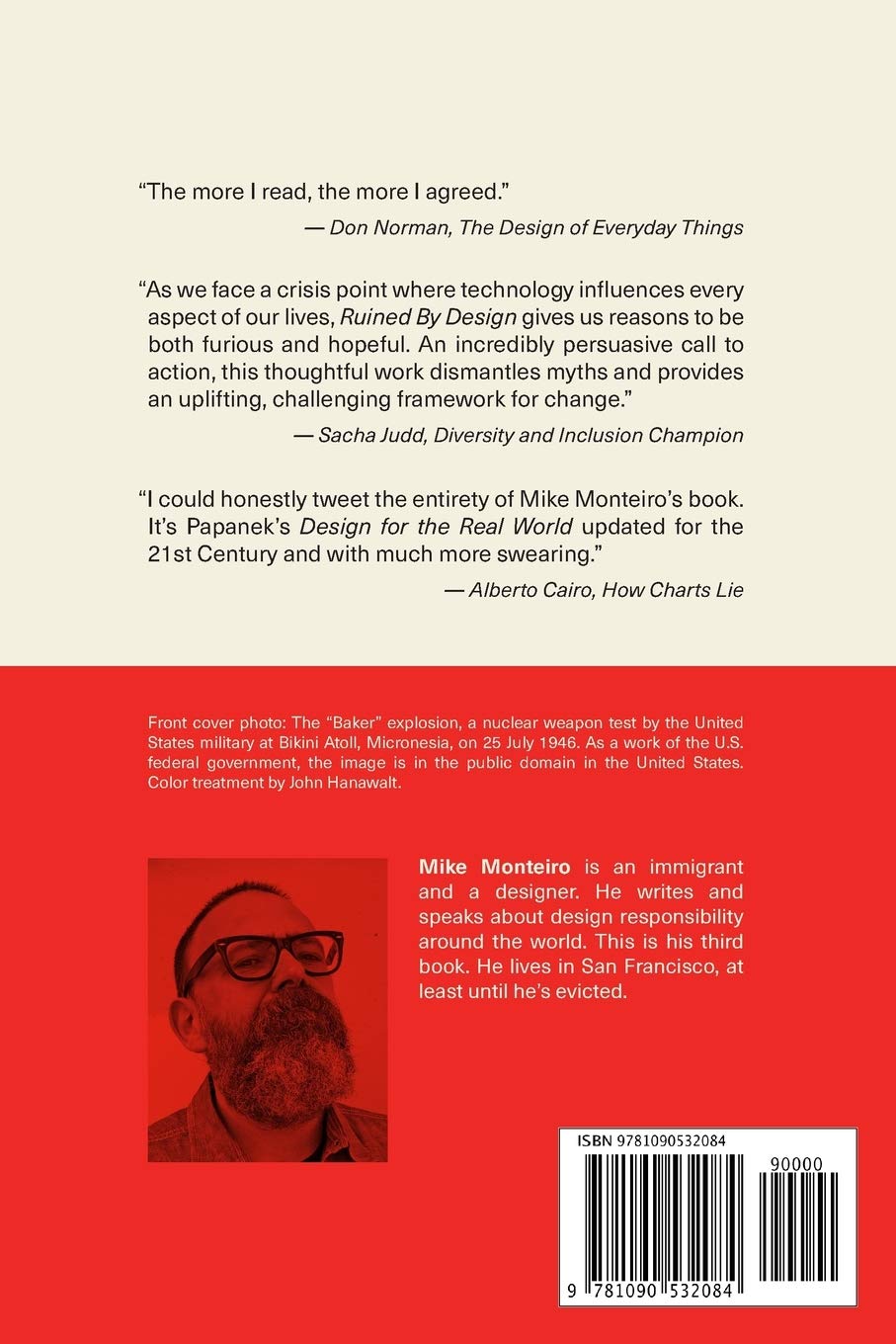
Full description not available
T**Y
Incisive, darkly humorous, and a great read
This isn't the only book pointing out the obvious, that Silicon Valley companies are disrupting a lot more than just old business models and are in fact fracking the foundations of society and democracy, but it makes its moral case both eloquently and bluntly — and in a way that speaks directly to anyone who has worked in a product team building this stuff. Monteiro's dark humor and clever framing makes this a good read for anyone looking to understand how things got so messy and who is best poised to step up and fix it.
K**Y
Real Design? Read this Book.
My friend glances over and says, “Woah - you said this was a design book, but it’s talking about business, lawyers, and politics? I didn’t know Designers [had this much influence].” I smirked wide and remembered they key to the book is that we are gatekeepers, not mere pixel pushers. We do have such influence through our choices.I let him know, “I’ve been realistically paid more to tell people to stop building dangerous things and to educate other designers on this, than I have by making screens, and that’s why Mike is similar to me. I want this outlook to be the new design norm.”I also believe the design licensing and unionizing ideas are essential, to protect our interests and value as Designers, (and to protect the general public, adhering to local & global safety)!P.S. Pretty please let me into the private Slack channel! [email protected] / @bitpixi on Twitter
D**S
If you work in tech it’s worth the reading, but...
The book addresses a very important point: the ethics that we follow or lack to follow in how we design products and how we take into account (or not) the impact of those design decisions.Good reading and food for thought and really a book that must be read by all people involved in the design of products (not just digital ones), although the author seems to think that ONLY designers should be the gatekeepers. I’d disagree with that. As a Product Manager is my job to be a gatekeeper as much as for those in Sales, Marketing, etc.My two issues with the book:1. It tends to go on rants and repetition making the book about 1/3 longer than it could be2. As much as it’s deserved, the author overuses two tech companies over and over again to emphasis his point, where in reality there are so many “guilty” parties
B**G
The Anti-"Tech Bro" Manifesto
As a designer and manager of designers, I found this book to be extremely necessary. I loved it so much I bought two copies for my mentees. It is a clear, cogent, and a devastatingly well-researched call to take responsibility for what we put out in the world. The book is incredibly funny, but beneath the humor is an urgency and a deep love of humanity that is woefully absent in a lot of tech literature out there. Everyone needs to buy this book and internalize the message before we design a world-sized coffin none of us will escape from.
A**S
This is a must read!
This is a must read, and if you’re a designer you should probably read Mikes other books too. It’s the right thing for the right reason and it might be your last chance to heed the warning life has been bombarding you with for years.
K**R
Repetitive
The book has one argument about designers being gate keepers and it was stretched all along. Didnt feel very useful or deep
M**Y
Engineering ethics should not be this surprising
Those who ding this work because it's an unabashedly political rant and call to arms are, I think, completely missing the point. Many designers (and by that term Monteiro and I both include everyone who designs things, including software developers and product managers as well as UI/UX professionals) have become utterly complicit in the unethical practices of the venture-capital fueled giant tech companies, and it's time for this to just stop. If you don't agree with that statement, you might as well not read this book. But if you do agree (and I happen to be on that side of the argument), this is a fairly short summary of the mess we're in, together with a few thoughts on how we might get out of it. I've certainly been guilty of designing bad things in the past - my stint at a combined multi-level marketing/adware company springs quickly to mind - but I've finally reached a point (either in my maturity or my career) where I have deliberately turned my back on that path. At this point I rate working on software that actually makes the world a better place far above squeezing money out of bigger fools. I hope that becomes a trend, though I fear that it will not.
M**S
You'll either nod in agreement or shake your head in frustration
Monteiro is a vocal and often outrageous firebrand, so it's no surprise that his book follows suit. He's written a manifesto for the modern designer, a call to arms, so to speak. While some will argue with his style, which I find brash yet amusing, it's hard to argue with the primary thrust of this breezy book: designers have an obligation to do the right, ethical thing.If I have any concerns about the book, it's that it feels a bit like preaching to the choir. As someone who's long advocated that all design is political, and that good design is responsible and humane, there are no big surprises in Monteiro's books, no major a-ha moments. Nonetheless, I think this is an important read for any designer starting out, and perhaps a good refresher for veterans. It might also be a useful read for non-designers, as they are often the ones most frustrated by designers trying to "do the right thing."
Trustpilot
2 weeks ago
1 week ago