

🪵 Repair like a pro, last like a legend.
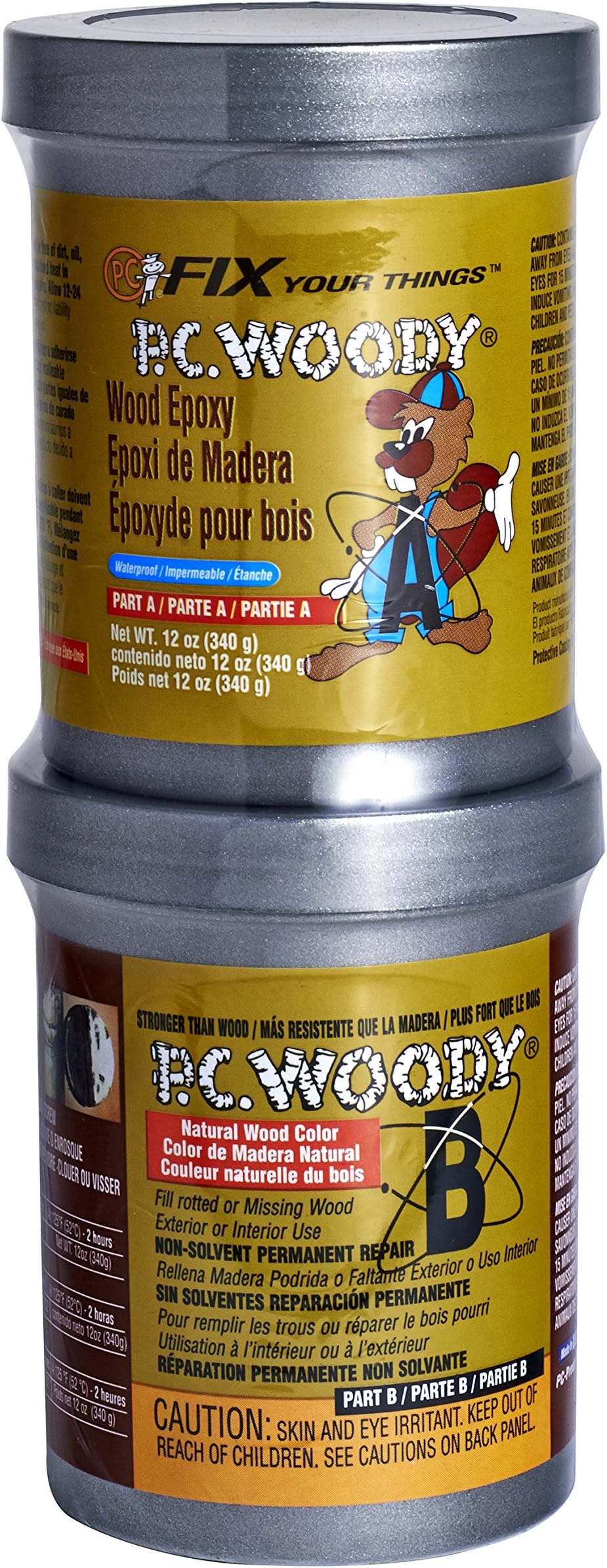
PC-Woody Wood Repair Epoxy Paste is a two-part, tan-colored epoxy designed to replace and restore damaged wood. Resistant to dry rot, UV rays, and both fresh and salt water, it works indoors and outdoors across a broad temperature range. Its high tack formula ensures clean application with minimal drips, making it ideal for professional-grade wood repairs.


| ASIN | B000H5O7Y8 |
| Best Sellers Rank | #4,382 in Tools & Home Improvement ( See Top 100 in Tools & Home Improvement ) #16 in Wood Filler |
| Brand | PC Products |
| Brand Name | PC Products |
| Color | Tan |
| Compatible Material | Wood |
| Container Type | Can |
| Customer Reviews | 4.5 out of 5 stars 5,948 Reviews |
| Full Cure Time | 24 Hours |
| Global Trade Identification Number | 00549831633372 |
| Included Components | (1) PC-Woody |
| Item Form | Paste |
| Item Height | 5.75 inches |
| Item Package Quantity | 1 |
| Item Type Name | PC-Woody Wood Repair Epoxy Paste, Two-Part |
| Item Weight | 12 Ounces |
| Manufacturer | Protective Coating Co. |
| Material | Epoxy Resin |
| Material Type | Epoxy Resin |
| Model | 16333 |
| Other Special Features of the Product | High Tack, Extended Working Time, Weather Resistant, Versatile Post-Curing |
| Special Feature | High Tack, Extended Working Time, Weather Resistant, Versatile Post-Curing |
| Specific Uses For Product | Repair, Woodworking |
| Tensile Strength | 850 Pounds Per Square Inch |
| UPC | 054983163337 549831633372 |
| Unit Count | 12.0 Ounce |
| Viscosity | High Viscosity |
| Volume | 12 Fluid Ounces |
| Water Resistance Level | Water Resistant |
C**.
Wood rot remedy to avoid major repair job, easy enough product for DIY to work with
PC-Products Wood Repair Epoxy Paste and Wood Hardener Kit is a wood rot remedy to use in order to avoid a major repair job. It is an easy enough product for a DIYer to use and work with. No real special tools are needed. The PC Woody paste is a 2 part epoxy (part A and part B) wood resin which has a chemical cleanup with acetone. The PC Petrifier is a liquid type glue which has a H2O cleanup with regular water. The hardened epoxy is easy to sand, by hand and using regular sandpaper. The epoxy doesn't sag very much and has a long enough working time, even in 85 degree sunny weather, when using it in small mixed batches. You fill holes, crevices and depressions with a glob of the epoxy but it will take longer for it to set up, dry and begin curing. You can build up the epoxy in layers, even after sanding it. It takes primer and paint well. The PC Petrifier is to be used after exposing the rotted wood area and cleaning out as much rot as you can reasonably do with out taking out everything or at least cleaning and prepping the area as if you were going to just be painting it--meaning, get it to reasonably sound and clean state which may involve sanding, removing the debris, then wiping down with isopropyl alcohol. The PC Petrifier is a liquid and the best way to apply it if it is not a flat horizontal surface is to paint it on with a small sponge brush from a disposable plastic cup. Be warned that it can get messy and dries like hardened glue to whatever it gets on so tape off the sounding areas and really tape off below the area with perhaps plastic sheeting overlaid with newspaper to soak up the drips and have a rag and bucket of water nearby toe wipe if necessary. The PC Petrifier will soak into the wood as much as the wood will take and then dries to a darker hardness. Here is what I used (and recommend to use) for repairing about 10 window sills on my house that had various degrees of weathering/aging conditions, the worst being on the south side: disposable gloves, multiple pairs; a rectangular 5"x8" or so piece of thick plastic or plexiglass that is smooth to mix the 2 part epoxy on and use as a pallette to apply the epoxy from; a 1 1/2" putty knife with the corners slightly eased or at least not sharp pointy to mix the epoxy, apply it to the surface and shape with; 2 popsicle sticks or a pint stir stick cut down to similar size,then clearly mark one A and the other B (for each of the epoxy parts); acetone, at least a quart to start; paper towels, lots; painter's blue tape, enough to tape off areas where you don't want epoxy to get on and may want to use paper in conjunction with the tape to cover more as needed; wax paper if filling crevices next to surfaces you don't want epoxy to get on and bond to; paper to tape off surrounding areas as needed, any paper but newspaper or painters paper work well; a small wood rasp, like Stanley tools small 8 inch that is shaped with flat side and a rounded side, each side is half rough and half finer for rapsing and can easily knock down the dried high edges and boogers left from applying the epoxy; sandpaper in 60/80 grits and 100/120 grits to smooth out the dried epoxy; and, acetone, or isopropyl alcohol to wipe the finished sanded surface. Things to remember about epoxy in 2 parts: READ the directions, watch some videos to see how people do it and suggestions, even the dumbs one, so you get an understanding of the product and what to do with it; the size of each epoxy container is going to be doubled in totality so 6 ounces of part A and 6 ounces of part B equals 12 ounces; it is better to get only as much as you think you need but always prepare to get a bit more; the PC Petrifier seems to go a long way in comparison to the epoxy but definitely use what the repair area can soak in; keep each epoxy container well marked, like a A on one lid and B on the other, and closed when not scooping some out; only take out small amounts of epoxy to mix at a time because it does start to get harder to work with in 20-30 minutes time and you can always mix more; when you measure the PC Woody epoxy parts for mixing, use one popsicle stick for only that container of epoxy and wipe it clean with a paper towel soaked in acetone after getting the epoxy part off the stick and set it aside then do the same with the other epoxy part--scoop, deposit, clean and set aside; mix thoroughly the two parts of epoxy for at least 30 seconds to 1 minute, it should like light brown like fluff-n-nutter/peanut butter mixed with marshmallow; smear on the mixed epoxy and smooth it out as much as possible--PC Products says you can smooth it out with acetone to minimize sanding later but I found it to be a little difficult to not make a bigger mess so using the putty knife and layering was better for me even if it took a little more time to get to the final sand; warmer air and direct sunlight cuts down the epoxy work time so you may have to move faster at applying it during certain times of the day/season; let the dry fully,which is 24-48 hours before sanding because it will gum up and ruin the epoxy layer you had put on and need repair; if doing multiple layers, perfecting the smoothness of the repair, and sanding in between, wipe the surface down with acetone or rubbing alcohol to remove the dust; use wax paper, not parchment paper, to stick between the areas where you are putting the epoxy and where you do not want to end up with epoxy (see photos 4 & 5 show where I had to fill in missing wood at the bottom of the sill but I did not want it to seal or get on the siding below); CLEAN your plastic palette and putty knife after each time you apply the epoxy with acetone and paper towel so that you take off any residue and refresh those surfaces--your tools will not get gummed up and you will be able to mix more epoxy without issues; and, take your time. Also, if you need to attach something to what you are repairing, PC Products make a 2 part epoxy adhesive in a syringe for that--it worked great, did not sag and held a 1/4" piece of wood good as I went nailed it. I have used the PC Woody Epoxy and PC Petrifier years ago and I think the repair made then, although on wood in direct contact with the gravel on the ground, is still holding up. I am banking on that what I accomplished with the window sills will be as effective or more so because I don't want to revisit this particular house maintenance issue again. I can definitely tell you NOT to use Bondo on wood as was recommended to me years ago because it does not hold up at all. Bondo is actually more difficult to work with in my opinion, too. I recommend PC Woody.
J**.
Great product!
This stuff is awesome. It is the perfect consistency. It spreads easily but is also firm enough not to sag. Dries super hard and the work time is accurate as stated on the container. Many products like this, the more you work it, the harder it is to keep things smooth and you end up making more of a mess trying to fineness it. I found it very easy to fineness and spread. No pinholes or air pockets. I like that you can aggressively sand the product one it dries without it turning to dust or burning into what you just applied. Now that I am confident in it's capabilities, I've already ordered another batch tonuae on other projects.
H**D
Good stuff, just check it when it first arrives
I have ordered this item 4 times now for various projects. This stuff is strong, cures solid, and adheres well even in "thick" sections since it is a 2 part epoxy (in contrast to some DAP wood filler I tried, which didn't cure when in thick sections, was not sticking well). I used this outdoors to repair termite damage and damage from dry rot on doors and window frames. Note, it is pretty messy to work with because it is so thick and sticky, and starts curing after a few minutes. I ended up putting it on and not worrying too much about uneven surfaces, and doing LOTS of sanding. I also found that if I used some sturdy plastic packaging to make "forms" for edges and corners, and applied those "forms" onto areas where I had applied the PC Woody, the forms would come off easily after curing a day and be close to the final shape. From there you either sand or fill more. I removed one star because two of my orders had issues. The first one, the cap on the white Part A jar had loosened, and the contents had started to dry out. A hard crust had formed on the top. It was still usable. The second issue was the bottom of the Part B jar had cracked. I used tape and plastic cling wrap to seal it up so it wouldn't leak or dry out. For the price, they really need to package it better. Lesson: check the bottles thoroughly when you first receive from Amazon, make sure they are not dried out, tightly capped, and the bottles are not damaged.
B**.
Great hardener. Didn't love the epoxy paste.
The wood hardener is magic. I used it on several dry rotted areas and it restored the wood so it could be filled in without replacing it, saving me from having to replace an old window sill. The epoxy paste was too hard upon opening it and didn't mix well...the results are too sticky, and gloopy, and might have been old. I didn't hate it, but I will look for a better product. It does sand well but filling in holes or cracks doesn't work easily. It's like using the stickiest chewing gum. It ends up globbing on with peaks and bubbles and areas that you can't fill in at all because it sticks to the putty knife, or hands. Unfortunate. My feeling is PC Woody makes good products, and I can't picture a better hardener, but buy that one alone and try a different wood filler.
M**L
Fixed our door frames and windowsill
Our 100+ year old house had some issues, and now that we're working on our first baby's room, it was time to address some of them. Namely, the door that was held to the frame with NAILS and 2 out of 3 screw holes were stripped completely, and a windowsill with severe water damage. We took the hinges off the frame, doused all exposed wood with the hardener, and about 48 hours later stuffing as much epoxy as we possibly could into the destroyed frame. Let me just pause to say how impressive the wood hardener is; the wood we were working with went from giving way with a push of our fingers, to completely solid in 24 hours. One tip for mixing and placing epoxy - use two putty scrapers so you can scrape from one to the other. Filling the door frame was pretty easy, but the windowsill was another story. Due to years of neglect, the wood had rotted away from certain parts of the sill, and we used the epoxy to recreate the missing wood. This was a bit difficult because the epoxy is sooooo sticky, creating a smooth finish was impossible. I gave up at some point with the idea that sanding would help hide my failure. I was kind of right - sanding did help a little, but not as much as I was hoping. Luckily, a coat of white paint helped tremendously and eventually the blinds and curtains will help most of all when they cover my project most of the time. We also used this product to repair the door frame to our basement stairs. When I moved in, the door was being held on with one screw. I've spent years in this home pulling the door completely out of the doorway and placing it up against our China cabinet. We figured we really couldn't make it worse, so we started with this one and I'm proud to say the screws are now firmly attached to both the door and the frame. TLDR: is this product a permanent fix for our uses? Maybe. For now our doors feel very sturdy and it's a big improvement that didn't cost us a fortune and/or our relationship. I recommend this product but also recommend some patience and to prepare yourself for a little more effort than just harden, mix, and fill.
J**E
Reliable results to fill and mold rotten wood.
Have used this before so I am back. I use it on cellar widows and On parts of our wooden fence. The hardener makes wood fossilize. The two part paste is the ideal viscosity to reach into small cracks and enough viscosity to mold edges. It sands like bondo but is made for wood. I use 80 and larger as it is not rock hard. Using 200 grit does not fill up the paper so finishing is easier than bondo. You will not need to use any Micro filler paste with this product. The places I have used it I cannot remember where they were as they still look good after several years. Some of the wood was decorative exterior moulding that was treated three and four years ago.
J**8
great product
I buy this product a couple of times a year. I really like it but thier's a bit of a learning curve on how best to use and apply it. After its mixed its sets up slow which is both good and sometimes bad. it stays gooy for awhile so i usually let it sit before i apply it. if you putting it in small cracks then let sit for about 5 minutes or so. if your molding larger repairs then you could wait up to an hour before applying. It sticks to your fingers quite a bit especially when its first mixed so I always spray a little WD-40 on my fingers before touching it. It takes awhile to get good and hard so I always give it atleast 24 hours before sanding. once dry it sticks and stays where you put it and doesn't shrink. Works great for out door projects! i've got some on outdoor windowsills and handrail repairs for 3 years and still holding up great with no issues! it doesn't take stain that well but not sure any plastic wood epoxy does?
G**L
Too sticky and thick to work with
Not sure why folks give it 5 stars when they also complain about the poor workability of this product, it is very difficult to work with, so sticky and thick I thought I got a bad batch. Yes it does dry very well to a solid state but I don’t think I’ll be buying more
Trustpilot
2 months ago
3 days ago