Desert Online General Trading LLC
Dubai, United Arab Emirates
Desert Online General Trading LLC
Dubai, United Arab Emirates
Full description not available
S**I
An ode to the locomotive quite unlike any other!
A really good book has a strange way of finding you when you need it the most. Locked up inside an apartment in the urban sprawl of Mumbai in the middle of a pandemic, Monisha's book was nothing short of a lifeline, much like it's star character. An ode to the locomotive quite unlike any other; a journey of gargantuan proportions equal parts incredible, audacious and enthralling; descriptions crafted so exquisitely that Monisha's memories of her travels could well be your own.This book left me feeling happy, grateful for a many splendored world and hopeful that some day in the not do distant future, my feet shall get busy again, travelling and exploring. Highly recommend this read! Happy travels :)
A**A
“ANYTHING IS POSSIBLE ON A TRAIN”
“Anything,” says travel writer Paul Theroux, “is possible on a train: a great meal, a binge, a visit from card players, an intrigue, a good night's sleep, and strangers' monologues framed like Russian short stories.”British journalist Monisha Rajesh, the author of ‘Around India in 80 Trains,’ begins this book by recalling her train journeys in India and her resolve to avoid anything so ambitious in future. However, in her own words, “… the railways had followed me home – their dust in my hair, their rhythm in my bones, their charm infused in my blood…” which compelled her to travel again, on a global scale this time. So she sets out from St Pancras station in London, accompanied by her fiancé Jeremy (“Jem”), who quit his job to travel with her.The book consists of 15 chapters which chronicle the journeys of Monisha and Jem across the globe. They travel in a leisurely manner, with substantial breaks en route. Starting from their base in London, they travel across France, Spain, Italy, Switzerland, Germany, Lithuania and Latvia; until they reach Moscow, where they board the legendary Trans-Siberian Express. They pass through Mongolia and eventually reach Beijing. Now they turn south, and travel across Vietnam, Thailand and Malaysia, till they reach the ‘Death Railway’ built by Allied prisoners of war under the supervision of the Japanese Army. Next, they visit Japan, where they meet survivors of Hiroshima and Nagasaki. On a different note, they also travel on bullet trains and stay in a very modern hotel serviced by robots.In the next phase of the journey, they take a flight from Tokyo to Vancouver, where they board the legendary ‘Canadian,’ described as “a line of silver Dualit toasters from the 1950s.” After a couple of diversions when they get to interact with residents of north Canada (including Karen, the “train evangelist”) they reach Toronto. After a brief stay, they cross the border to reach New York, where they run into actor Robert De Niro, who turns out be quite unfriendly! Having used their Amtrak passes for multiple trains in the US, they fly back to Beijing and onwards to Pyongyang.Monisha and Jem spend the next ten days taking a closely supervised tour of secretive North Korea, led by “Sarah, a lovely Londoner in her mid-twenties with shiny bobbed hair, high-top trainers and a bright smile.” This is arguably the most informative part of the book, considering how few tourists are allowed to enter that country. There are engrossing descriptions of the author’s visits to various monuments dedicated to their late leaders Kim Il Sung and his son Kim Jong Il. The reader also learns that 1912, the year Kim Il Sung was born, is called Juche 1 and all subsequent years are counted in Juche units.After North Korea, Monisha and Jem return to Beijing for the third time, visit the Great Wall at Badaling and take a high speed train to Shanghai, eventually making their way to Lhasa. In the meantime, they have been joined by Marc, a photographer who Monisha had met in India. The trio spend a few days in Lhasa, struggling with altitude sickness and visiting the Potala Palace – where they get mistaken for Indians and are treated with the courtesy due to citizens of the country which has given shelter to the Dalai Lama.Next they visit Xi’an, where they are disappointed to see the famed terracotta warriors. Their next stop is Urumqi, capital of the Xinjiang province. After a stopover at remote Turfan, they cross the border to Kazakhstan, where they visit Almaty and Astana. They take yet another train to Moscow, where they part company with Marc, and travel to Venice via Warsaw, Berlin and Munich. In the last leg of the journey, they travel on the luxurious Venice Simplon Orient Express from Venice, back to London.The author gives us eloquent descriptions of places and people. For instance, this is what she says about Beijing: “Smoking, sprawling, crawling, built up, and bound by ring roads and tangles of motorway, Beijing was like a city of cities. Thick with fumes, the air tasted of oil and exhausts, reaching into my throat and coating my tongue.” In sharp contrast, this is how she describes the journey to Lhasa: “But for a few breaths of cloud, the sky sang arias of joy, lakes shimmered like molten metal and Tibetan antelope sprang in and out of sight. The higher we climbed, the more dreadlocked yaks lumbered into view, nibbling at tufts of grass or tethered by nomad tents strung with rainbow-coloured prayer flags. Higher and higher still, the yaks faded away and mountains sharpened by ice closed in around the train as it pushed into places no railway was ever meant to go.”The author’s passion for train travel is revealed at many locations in the book, for instance: “Trains are rolling libraries of information, and all it takes is to reach out to passengers to bind together their tales… Unlike air travel, which eases you into a city, weaning you from the plane through the airport, and eventually onto the street, train travel parachutes you in… Lying on our backs, we gazed up at the sky as it followed the course of the train. Silent but for the sound of our breathing, the cabin had turned into our private planetarium…”Despite her fondness for train travel, Monisha does not claim any interest in the technical aspects of railways: “‘Foamer’ is a snide term coined by railroad staff for obsessive rail fans who get so excited about engines, gauge, hydraulics, mileage, dates and times, that they foam at the mouth. When it comes to measuring rail enthusiasm, I am nowhere near foamer levels, having absolutely no interest in anything mechanical or technical. I am positively a ‘daisy picker by comparison – the nickname for those more interested in the scenery, and usually to be found getting in the way of foamers photographing the brake rigging.”On the whole, this book – with its neat Bembo font, colourful cover and glossy pictures – provides a fairly satisfying reading experience, but I hesitate to award it five stars. For one thing, I would have liked to see more photographs of the people and places described by the author, especially because Marc, a professional photographer, accompanied her for much of the trip. Secondly, there is not a single map, which could have enabled the reader to trace the path of the author across the continents. Finally, a simple list of the 80 trains would have been quite welcome, to satisfy the reader’s curiosity.Allow me to end with another quote from Paul Theroux, which applies to the reader as much as is applies to the author: “You go away for a long time and return a different person - you never come all the way back.”
N**I
Travel
Best for travel ethylism
J**J
What a way to travel the world
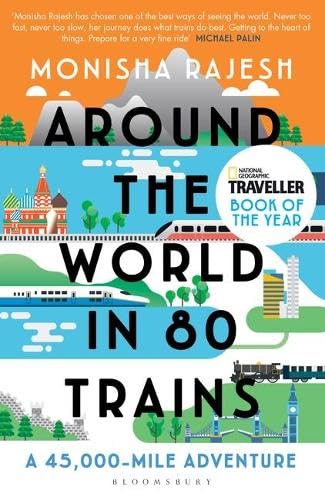
An absolute delight of a read. Monisha manages to share a bit of history, a lot of geography and a smattering of philosophy at regular intervals throughout the book. You don't want to put this book down till you reach the last page.Be warned - your bucket list will be revised after you've read this book.And I just love the cover - it's one of the Best I've ever seen.Tip: Do read her first book as well, if you haven't already - Around India in 80 trains.
A**R
Bit boring
Not upto the mark
J**I
Where is the route Map !
The book gives the charm and thrill of her journey along with us. A wonderful narration with wit and fun makes you smile but it takes us in to the regions we unknown.A world map with her route would have given a better idea to us. Lack of a map in the book ( I purchased paperback) is a great minus point - I feel.you may feel that you are lost in " some where " as the book has no map.The narration goes on and on as if you knew the world map thorough ! Many of the places she mentioned in this book are just mearly geographical dots to us, unless a map is given !Monisha Rajesh has proved again her writing skills as if we read a thriller !Hats off to Monisha and to the publisher for making us to forget "our time" in their time capsule !Thank you !
B**T
Great read!
I had already read the author's 'Around India in 80 trains' and had high expectations from this one. And Monisha DID NOT disappoint. With a lucid, descriptive style of writing, the book takes you around the world in 80 fascinating train rides, never boring and never making you feel tired of the travel.With the occasional wry joke and often rich portrait of her stops around the globe, Monisha manages to keep you constantly invested in her adventure. The trains and their routes are themselves vividly described and make you long to take the same journey. With just the right amount of travel-talk and personal musings, the author has managed to put together a fantastic book which is a must-read if you like train travel or just travel in general.
P**R
Fresh
Finally a travel book by a non-American author. You can read it once. Not boring.
Trustpilot
1 month ago
2 days ago