
DOWNLOAD THE APP


Customer Support

Desert Online General Trading LLC
Warehouse # 7, 4th Street, Umm Ramool, Dubai, 30183, Dubai
DOWNLOAD THE APP
Customer Support
Desert Online General Trading LLC
Warehouse # 7, 4th Street, Umm Ramool, Dubai, 30183, Dubai
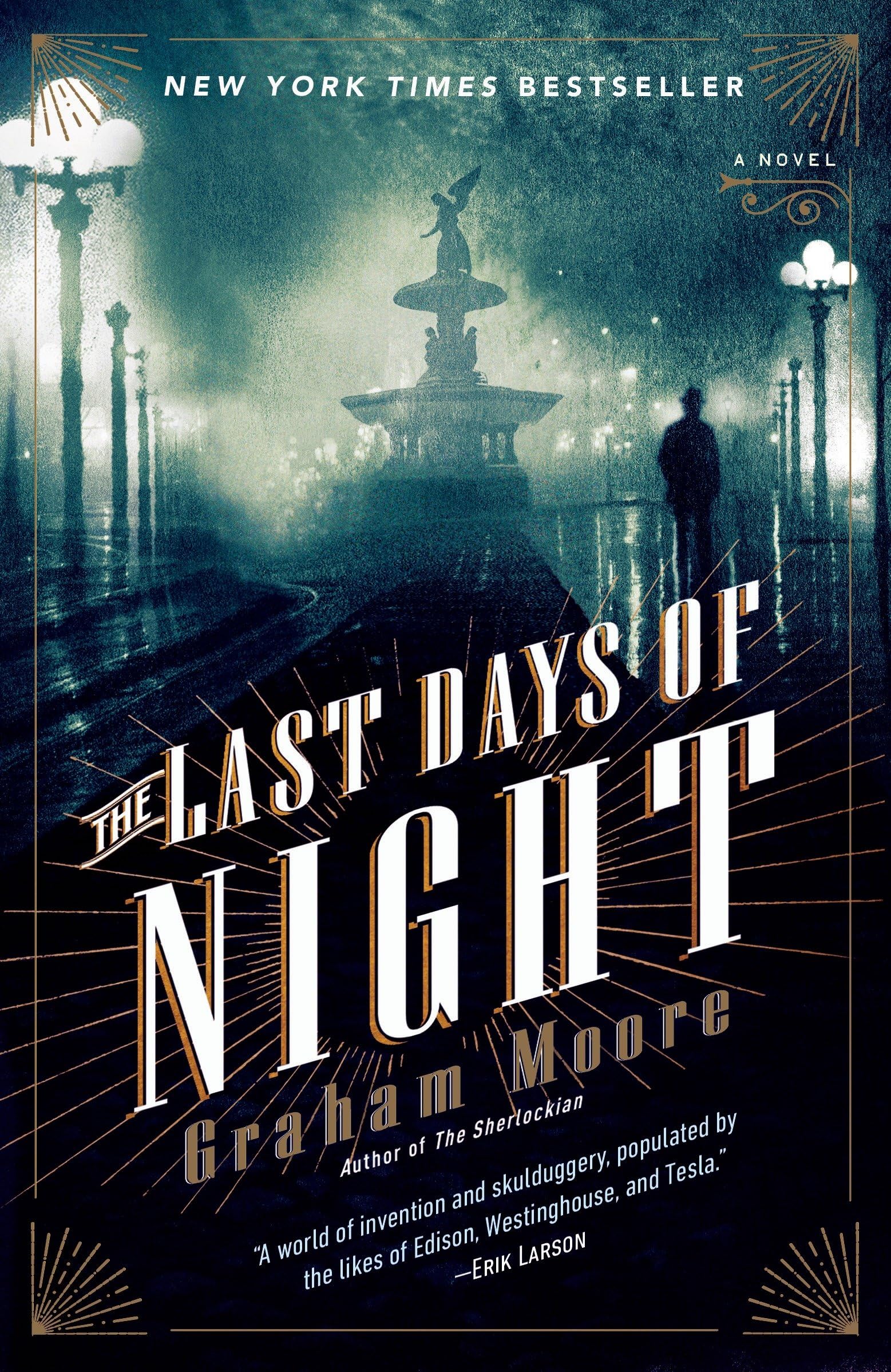
The Last Days of Night: A Novel


R**K
The Great Edison-Westinghouse War and a Young Paul Cravath
Historical fiction, with famous actual people interacting with a novel's synthetic characters, has become familiar in American writing since at least 1981 when E.L. Doctorow published "Ragtime" to great acclaim. When historical fiction is well written, based on substantial research and reasonable projections beyond fact, it is a joy to read and quite stimulating. That is the case with this fine and gripping novel written by the author of the screenplay for "The Imitation Game" about British computer pioneer Alan Turing. The author in that script demonstrated consummate skill in dialogue, excellent ability to shape a plot, and very careful use of language to its maximum effect.Here the story (set in 1888) develops against the background of the real war between George Westinghouse and Thomas Edison regarding who held the patent to the incandescent light bulb, and which current (DC or AC) was superior for the transmission of electricity safely. One might think that a story about fighting over light bulbs and electrical transmission techniques would hardly be the stuff of an exciting story--but that is just what the author has so effectively delivered. We have important real historical figures aplenty involved, including some who also made appearances in "Ragtime" set at roughly the same time: most prominently Nikola Tesla, J.P. Morgan (who contrary to the author's designation was not the richest American of the period--being small potatoes in comparison with Rockefeller and Carnegie to name just two plutocrats), and the central character, a green young lawyer Paul Cravath, familiar to we members of the legal profession for having invented the modern corporate law firm in his real life.One of the main things a reader looks for in historical fiction is that it be believable. This requires substantial research into original sources (such as newspapers of the time), study of individual biographies of the principal historical characters, and seamless melding of the historical facts with the novel's dramatic inventions. If these factors are present, as they are here in spades, then the story sparkles with authenticity, and everything flows nicely. Here, the author has researched not only the "war" but also the personalities, business practices, and ambitions of the main historical figures--he does a particularly nice job handling both J.P. Morgan and Westinghouse, such that when they speak on the page you can almost hear them. Integrating all this into a skillfully woven plot produces an engrossing story which also provides some historical education in the process.I liked the author's note at the end of the volume where he recounts how the novel was written, what he researched, and in Cravath's case, his life subsequent to the Edison-Westinghouse conflict. He also specifies what is truth and what is fiction. I would have bet a dollar that Cravath's female ally, a supposedly famous opera singer of the time, was as authentic as a $3 bill--but I was wrong for she actually existed much as in the book. Any reader of this book will be well rewarded on a number of fronts--the most basic being it is just a super yarn that demands constant reading to the end.
A**R
Very good read
Read this book for a book club and found it a good read once you get into it. Even with it's gruesome opening, I wasn't intrigued. But it is a very good story based on true events. I am extremely grateful to the author for very taking the time to very meticulously give you the fiction vs non-fiction of the book in the back. It is very much appreciated and shows how very well he did his research. Given this is centered on Science (my least favorite subject) I really did enjoy it. And I'm grateful for the time he took to explain things in layman's terms as I would truly have been lost. I totally appreciate the education. I also liked that it was something different outside of some of the other historical novels I read. I'd definitely give it 4.5 stars. I think my expectations (and what I'm somewhat use too) is most of the characters being fictional and not all. I didn't read the back of the book first. I am very familiar with Edison and Westinghouse but wasn't so much with Tesla. So therefore did not know of the other character's history (although wondered if Cravath was related to one of the co-founders of Fisk University. And he is. So this is a very, very good novel and thanks to Mr. Moore detailed info on the characters in the back, an excellent start to digging deeper into the history of great Scientist/Inventors. Thanks Mr. Moore for a very insightful Science History lesson (the best way to get me to learn Science :) )
R**S
Wow, Wowser, Wowsest.
God Said, “Let There Be light.”Thomas Edison Said, “Not Yet.”By Bob GelmsGraham Moore is an exceptionally good writer who makes himself increasingly significant every time he touches a keyboard. In my view, he has already turned himself into a writer who must be read. I’ll now read anything he writes.Mr. Moore has won an Academy Award for the screenplay he wrote for the motion picture The Imitation Game. It also won him a Writers Guild of American Award from his peers and was nominated for a Golden Globe.Flush with success, he quickly published his first novel, The Sherlockian. It raced up the charts into best-seller-land and I wrote about it in the last issue of 365ink. Tempus Fugit and along comes his second novel, The Last Days of Night. It, too, is a best seller but a bigger one at that and one of the best examples of historical fiction that comes to mind. If you’ll pardon a colloquialism, it’s a humdinger squared.The events that take place in the book are all true. The major characters and a few of the minor ones are all real people. I found it incessantly fascinating. You will read about the relationships between George Westinghouse, Nicola Tesla, Thomas Edison, Westinghouse’s lawyer, Paul Cravath, an appearance by J. P. Morgan, and a whole congregation of New York socialites, mega-wealthy business men and politicians. Most of these relationships became poisonously deadly.At issue first was the light bulb. Thomas Edison conned the public into believing that he had invented the little glass miracle that glowed in the dark. He didn’t. Men by the names of Sawyer, Man, and Joseph Swan did the real inventing and held the patents. Edison “borrowed” their work which gave him a massive leg-up. Edison improved the design just enough for the Patent Office to issue him a patent.Then George Westinghouse did to Edison what Edison did to Sawyer, Man, and Swan. He made a better light bulb, but in Westinghouse’s case he did make a better bulb…much, much better in almost every way. Edison promptly sued Westinghouse for one billion dollars with a “B.”While this was going on, there was a life and death struggle to see which form of electricity would wind up in use all over the world in people’s houses and businesses. Would it be Edison’s DC (direct current) which was massively inefficient, outrageously expensive, and horrifically dangerous? Or would it be Tesla’s and Westinghouse’s AC (alternating current) which was efficient, inexpensive, and safe? It was a war. Read and learn.Nicola Tesla was a bona fide, 5 star, golden genius, the kind of genius that would be mentioned in the same sentence with Sir Isaac Newton and Leonardo da Vinci. He was also psychotic in the clinical sense. He described getting his ideas fully formed from dreams or hallucinations that were vivid, lasted days, and were sometimes scary. He, eventually, had a total nervous breakdown.Tesla should have been born at the end of the 21st century. He was that far ahead of the times. In the 1890s, he described in detail television, cell phones, radio and wireless communication. When Gugliemo Marconi “invented” radio using 17 of Tesla’s patents, the court case that ensued went all the way to the SCOTUS. Six months after Tesla died a penniless vagrant in a flop house in New York, the SCOTUS vacated Marconi’s claim of inventing radio and gave the invention’s ownership to Tesla because of Marconi's patent infringement. Nicola Tesla invented radio not Marconi.Tesla worked for both Edison (which ended incredibly badly) and Westinghouse (which also ended badly). Tesla was not a businessman and being thrown into the proverbial tank with sharks like Morgan, Edison and Westinghouse, poor Nicola Tesla was torn apart and eaten alive.Westinghouse, Edison, J. P. Morgan, and Paul Cravath who was Westinghouse’s wunderkind attorney, managed to resist killing each other despite the fact that they all had serious thoughts of doing so. They came together in a genius settlement that Mr. Cravath, who was 27 years old at the time, devised. That didn’t stop a massively hostile takeover attempt by one or more of the lads of one or more of the existing companies. The Edison General Electric Company, in what was nothing more than a malicious act of payback by someone who had the power to do it, removed Edison’s name from the company and that, dear reader, is how we got General Electric.Graham Moore’s The Last Days of Night is a grand slam home run. It’s wonderfully written, plotted and spellbinding. It is endlessly entertaining. I give it 8 stars out of a possible 5. You will not be disappointed.
4**L
visionaries, inventors and businessmen…
Visionaries, inventors and businessmen, plus a little more. This normally is not a book that would interest me. Because it is history I dove in and I’m glad I did!The tale is told during a truly fascinating, magnificent time. The last chapters are the best.
Trustpilot
2 weeks ago
2 days ago