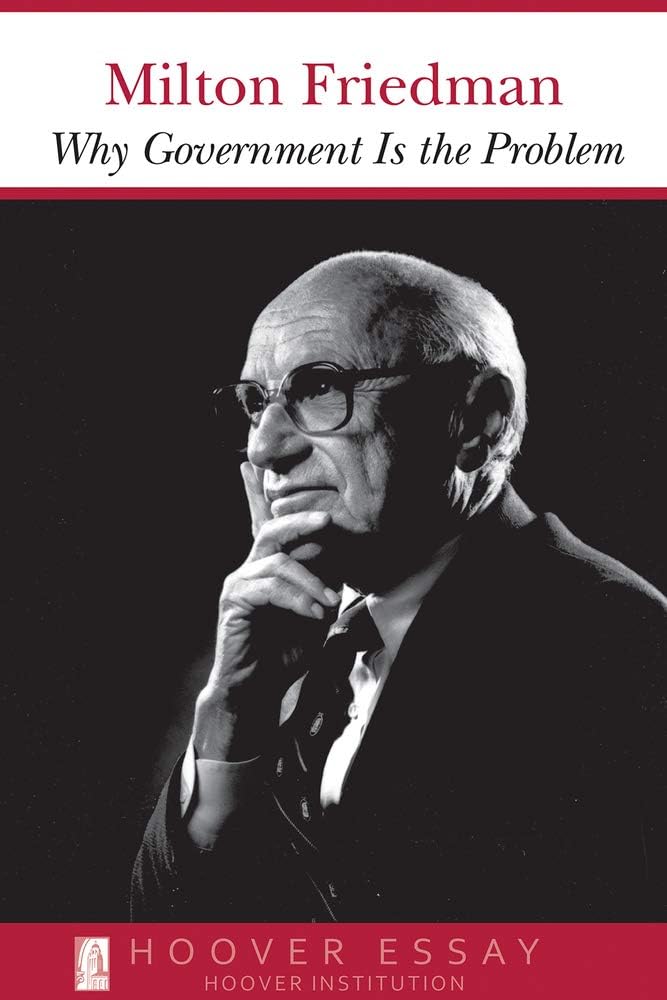
Why Government Is the Problem (Essays in Public Policy) (Volume 39)
Product ID: 4506666
Desertcart purchases this item on your behalf and handles shipping, customs, and support to Portugal.
Full description not available
R**T
Amazing, common sense and highlights important facts/ideas
I like this essay which highlights very important discrepancies with government. I used this book to gain some good knowledge on why the government does some of the things it does. One of the point that Milton points out is the government does bad the things it should do well, and puts its hands on things it has not hand in needing to do. Example would be the DMV, the government regulates the roads but go to the DMV and you'll wait for a license, or the government should be taking care of the national roads and does a horrible job at it. An area where the government does not need to have it hands in is telling individuals what to do with its body or the government should not be subsiding businesses that fail. Its a great essay and it does bring many more good points. Hope everyone enjoys it as much as I did.
K**R
Clear Thinking from Uncle Milton
This essay is a great example of Milton Friedman's ability to distill complex problems down to their fundamental issues, and explain them clearly and concisely so that you don't need a PhD in economics to understand them. I don't necessarily agree with him on every point, e.g. his claim that private enterprises won't pollute since it is cheaper for them not to pollute, and several of his predictions in this essay turned out to be false (he predicted the remainder of the 1990s would see sluggish growth because of President Bush's economic policies), but I find it's still helpful to read him closely and think about what he's saying.
L**M
Great info
It’s short but packed full of info!
G**O
Reads like it was happening today
Very good read, a little dated but certainly worth reading. He kind of speaks in a common sense way and causes you to wonder how much has history changed?
D**N
Short booklet with powerful ideas
A quick read, Milton Friedman’s essays on why government is the problem explain very clearly how the government, no matter how well intentioned, messes things up. One important fact for every reader to note, though, is how many libraries do not have Friedman’s books on their shelves. I searched online for ebooks owned by libraries around the country, and about half of them did not have even his most famous book, “Free to Choose.” It’s scary that the gatekeepers of wisdom have so much power that they can stop people from learning the ideas of this Noble Prize winning economist. It’s important, therefore, for people to ask their libraries to buy Friedman’s books.That being said, one of the interesting points that Friedman says comes from a story he tells: “I once attended a breakfast with Senator Long when he was chairman of the Senate Finance Committee; I remember very well his saying, ‘You know we never could have adopted by legislation the rates of tax we now impose on low and middle incomes. When those rates were adopted, they were on high-income people, but inflation made them applicable to low-income people.’ I believe that was an important effect of inflation on expanding government.” What an amazing strategy that the government uses to increase taxes on everyone, including those who are in the lower and middle earning levels. The government sets rate for the high-income folks, and then waits for inflation to raise everyone’s salary (not their real earnings, just their nominal take-home pay), and then all those folks get swept into the net of taxes. Pretty sneaky!I also appreciated his pointing out that the freer a nation is, the less likely racism will rear its head. Friedman writes, “The great virtue of a free market system is that it does not care what color people are; it does not care what their religion is; it only cares whether they can produce something you want to buy. It is the most effective system we have discovered to enable people who hate one another to deal with one another and help one another.”This booklet, as well as “Free to Choose,” should be required reading in all high schools (“required,” that is, unless the government will finally get out of the business of forced schooling and allow for greater competition in the education realm).
R**Z
As clear and concise of an argument you can get.
In this essay, Milton Friedman is not against complete absence of a government. Government is a necessary entity, but not in the matters of business and in certain public interests (such as medicare, postal services, etc.) that he believes can be run in the private sector. He points out what makes the government incapable and why with other published sources to support his argument. The following is a section from one of my favorite points:"We all complain about highway congestion. That is interesting for a different reason. The private automobile industry is able to produce all the automobiles anybody wants to drive, but the government is apparently not able to produce a comparably adequate highway system, a clear contrast." (p.95)He then offers his elaborations to the points he made in the previous portion of his essay. The following piece is a section of another favored segment of this essay:"With the best intentions in the world, they can try to persuade the people who hold the purse strings to finance the enterprise on a larger scale, to dig deeper into the pockets of the taxpayers to keep the enterprise going. That illustrates a general rule: If a private enterprise is a failure, it closes down—unless it can get a government subsidy to keep it going; if a government enterprise fails, it is expanded. I challenge you to find exceptions. The general rule is that government undertakes an activity that seems desirable at the time. Once the activity begins, whether it proves desirable or not, people in both the government and the private sector acquire a vested interest in it. If the initial reason for undertaking the activity disappears, they have a strong incentive to find another justification for its continued existence." (p. 151-156)He offers some light humor to entertain readers as well--it's not all serious and monotone. A great read.
A**R
The lessons in this book are timeless.
The United States have gone too far the socialist route that it would take a lot of effort educating the voters that their decisions in the ballot box on the federal level have made this country what it is today.
Trustpilot
2 months ago
1 day ago