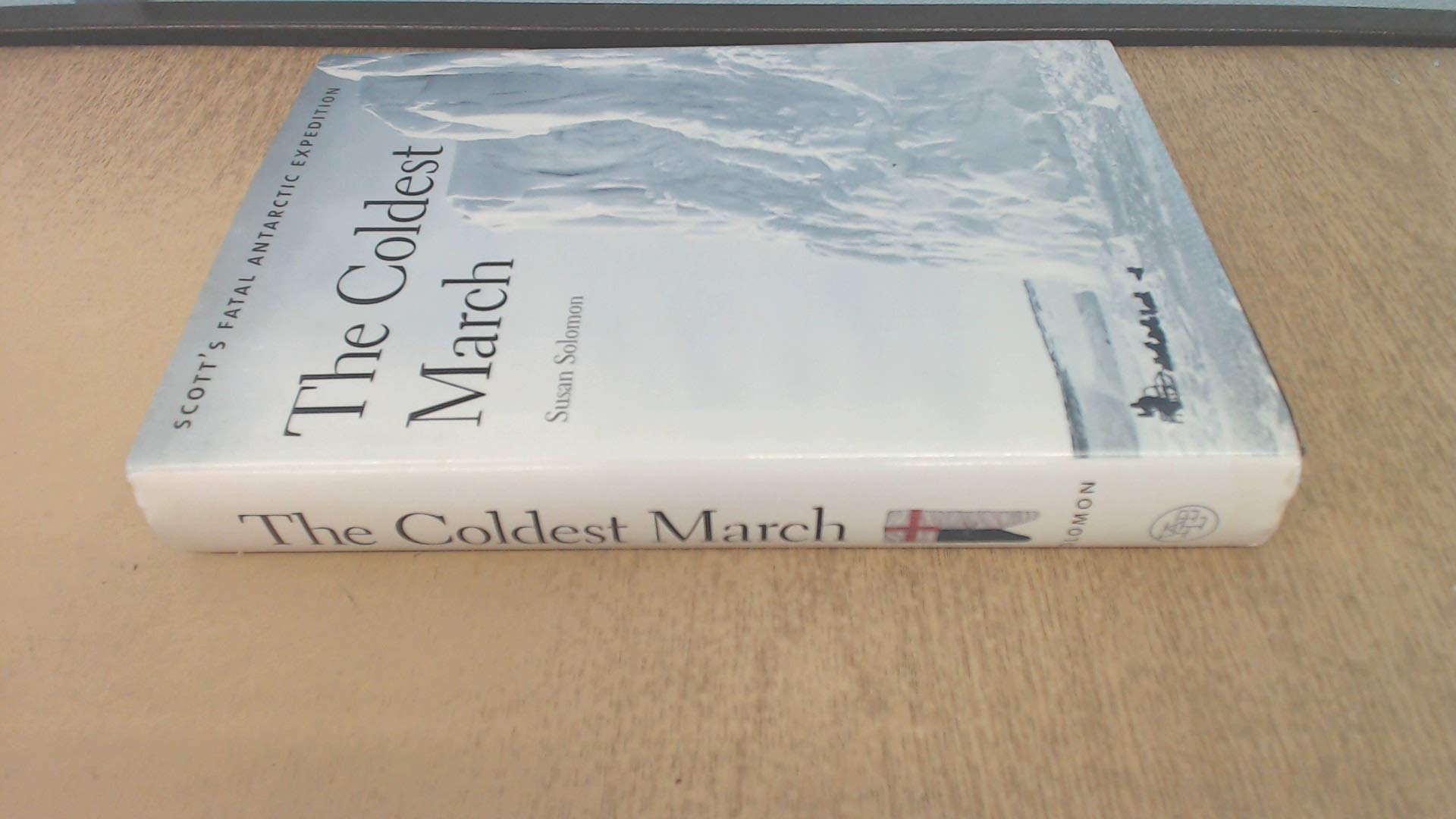
The Coldest March – Scott′s Fatal Antarctic Expedition
M**7
An excellent scientific explanation rather than a vindication
Given that Soloman's Scott account is from a Scientist's perspective I thought I was going to be in for a hard read. I couldn't have been more wrong. Well written and well researched, Soloman smoothly guides the reader over the scientific complexities with a style not unlike a detective novel - in itself a mark of distinction.However, to say that this is a vindication of Captain Scott's fatal expedition is, at the very least, an enthusiastic overstatement promulgated, I suspect, by Scott devotees desperate to reincarnate the misguided glory bestowed on him for the first decade or so after his and his men's deaths.Nevertheless, as a scientific explanation, Solomon offers the reader a completely new and refreshing breakaway from the Victorian and Edwardian commentaries that have hitherto stacked the `Antarctic Expedition' book shelves.Refreshing, informative, probing and, not least, a damn good read.
J**A
Extraordinary men, extraordinary time.....
This journey is a balanced one, and settles somewhere between heroism, stupidity and bad luck in terms of why these brave men died. It still amazes me that they could even undertake such a journey at that time. I have experienced temperatures of - 40, and know that normal people need to go inside after five minutes, regardless of what they are wearing! These men were extraordinary, and the book demonstrates this time and time again. It is elegantly written, though I admit to having skipped the introduction to each chapter which puts a modern perspective on the place and time. I would also have appreciated one comprehensive map because I found myself many times foraging for the right one. These two details aside, I found the book very readable, comprehensive and appealing.
P**R
Scott's fatal polar exploration.
A good read. A replacement for a copy lost some years ago. The story of the fateful expedition told with firsthand notes and great detail from the diaries of the explorers themselves. Susan Solomon writes of the background to the exploration and gives an insight into the preparation needed for such a journey. She tells the story in such a way that the details make you feel the cold, the struggles with the equipment and the camaraderie among the explorers are happening right now and not a hundred years ago. Ultimately a story of human endurance, victorian values and British pride at being first.
M**T
great scott!
bought as a gift but it was very well received.
J**D
A good buy
This is a well researched balanced review of the events. Notably it benefits from an author who writes well and who has the acknowledged scientific expertise to be able to describe the expedition and put forward credible explanations. Very readable - This is one of the best books I have read covering Captain Scott’s fateful journey.
M**K
very disappointed
this review is for the actual book not the content. i have bought many books from world of books and have always been delighted with the used books. however this copy is absolutely filthy. it will have to be cleaned before i can read it. no way can it be described as "very good" it would appear to have slipped the net. please ensure you revert to your usual excellent standards. thank you.
M**R
Four Stars
Useful account of a tragic episode
A**Y
A very well researched account of the ill-fated expedition
A very well researched account of the ill-fated expedition, one that benefits from the input of modern meteorology as well as the author's personal experience of the Antarctic. Scott's misjudgements aren't ignored, but some of the accusations of blundering made by other writers are disputed. They rode their luck, basically; and didn't have sufficient margin of safety when the weather that year proved to be much colder than their limited previous experience suggested was likely.The final chapter is completely new to me, as evidence is presented that Scott's account of the weather they were experiencing in their final days could not have been accurate. Without claiming to have entirely revealed that which we can never know, Dr Solomon goes on to suggest a scenario of might have happened in their final camp, in some ways more tragic than the traditional account.
S**R
An intriguing polar mystery story
I am not an avid reader of polar exploration but I found this tale of adventure, exploration and bravery very much like a good detective story. Even though you know from the beginning what the ending will be, the author slowly reveals facts and builds suspense about the outcome of parts of the story. While reading this book in the comfort of my home, I could imagine what it must have been like in that frozen world: spending several hours inching my way into an ice-filled sleeping bag or rescuing my companions when they repeatedly fell into one of the hundreds of crevices in the ice. The controversy about Scott's leadership was fully discussed, with the author showing his flaws as well as his contributions. I had my favorites among Scott's party and was so involved with them that I found myself almost talking to them. I particularly enjoyed the stories about the modern visitor to Antarctica at the beginning of each chapter which revealed how difficult life there can still be. The "visitor" plot lines always tied into some aspect of the story, illustrating some point or raising a question.There cannot be final proof about the cause of the polar party's deaths but Susan Solomon makes a convincing case that unusually cold weather was a deciding but not the only factor. The author poses an interesting hypothesis at the end of the book about the final factor that prevented the party from reaching the one-ton depot and safety, but I won't spoil it for you.Most of us will never have the opportunity to go to Antarctica, lead explorations or perform feats of daring. This is the appeal of Scott and his men and why this is such an interesting story.
M**.
The Book that Nailed It
After 3 months of reading about the South Pole expeditions, starting with Huntford and ending with Fiennes and then this book brought me full circle as regards Robert F. Scott. This book really does justice to known facts, seen in a new light, and the last few chapters are really excellent, and I follow her breakdown of the last few days completely. You CAN make some reasonable assumptions if you base it on the Diaries; there is a story there and I'm certain Wilson and Bowers were not about to leave the Captain behind to die, as they ventured out on their own attempt to get home. And Wilson and Bowers were smart enough to know the journey to One Ton Depot involved 11 very difficult miles into a strong wind. This very well-written book systematically approaches all of the main "contentious" claims about Scott and then handles them fairly, clearly assigning blame where it belongs. It's amazing how the quality of your sleeping bag or walking boots, or lack of quality, could be a life-threatening risk factor! This business of your breath freezing into Rime on the inside of the tent and the inside of your sleeping bag, and having to take an hour to get your freezing boots on in the morning, month after month, would surely wear all of us down. Scott and his two companions were not out of food yet but they were out of fuel, so they could not cook or get drinking water. After three brutal weeks of much colder than normal weather, they were already played out. The best thing about this book is that - for me - it answered all of the nagging questions I had accumulated via reading other books about the tragedy. The author puts Scott's reputation in a much better light. Whether it's a leaky valve of a red can of kerosene or an extended period of colder than normal weather, which completely changed the texture (and increased the resistance) of the snow, the big picture - about Scott and Amundsen - is still an astounding subject to read about. Now at the left end of my somewhat extensive library on the subject is Roland Huntford's Last Place of Earth, and, at the right end in The Coldest March.
M**R
Solomon's defense of Captain Scott the most articulate so far
Susan's effort was the first I've read about the Scott expedition. Her insights are most interesting in understanding what those poor men faced in 1911-1912. However, she didn't convince me that Scott was only a poor victim of miserable condition.How can you, on one hand, be viewed as a "scientific officer" and show interest in progress and advancement and, on the other hand, force everybody to travel like cavemen men-hauling when dog-sledging with ski had prooven far more adequate and superior?That non-sense it's so obvious it makes Solomon's case irrelevant.But if you want to somewhat balance Roland Huntford's views and opinions on Scott, this is the book to read.
R**O
Scott was as good as dead when he saw Amundsens tent at the pole.
Now that the cold weather is upon us my thoughts turn again to the poles.A self professed polar historian, my love for the regions both North and South began decades ago.Since then I have read mostly all of the original works by the explorers themselves and a multitude of other related works pertaining to the Arctic and Antarctic(my personal favorite).One day I hope to review them all.Nevertheless,Solomons book on Scotts attempt at the South Pole and subsequent failure to return takes a look at how the weather played its part in the doomed enterprise.It is well written and Solomons own Antarctic experience is a plus.Her reputation speaks for itself and most who know the South know of her work on ozone.In the book she gives evidence, more than excuses, to dispell and soften the common view that Scott was well,"a bumbler" when it came to planning and execution of a most important and dangerous undertaking.Let's face it, he took chances leaving little room for error.The disasterous cold took up that room stalling the "march home" which happened to be in the month of March, hence the books title could be taken both ways.March on the barrier is a time of change. It is considered late in the season when sunlight hours decrease and temperatures begin to drop.Scott it seems blamed much of his delay and troubles at progress and then retreat on the cold and blizzard conditions he encountered.Amundsen had no such trouble and was already in by that time safe and warm with his prize,the South Pole.His team faced the same conditions but planned their trip well,knew the risks and worked them out ahead of time which ultimately contributed to their success.Just read Amundsens work ~The South Pole~.Scott continued to worry and question the degree of cold they were facing and based on meteorological data it does seem that he was faced with an unusually rare anomaly in 1912 in as much as the data then and now bare it out.He just happened to be in bad place at a bad time and got clobbered.Was it just poor luck,miscalculation or was it that he just couldn't face coming home a failure without the pole and perhaps resigned himself to die in his tent knowing he was a short distance from a depot that would have saved his life and those of his companions.These questions of causative factors will always remain.His approach was outmoded and he couldn't compete with the Norwegians on this despite Nansen's advice to master ski and dogs.The book reads well and its writing is crisp and clear and would serve as a good primer on the whole expedition for someone new to polar history.I was expecting lots of boring weather charts and data and less analysis but the mix of the two works well.It is a fast read with a pleasant lead in section at the start of every chapter that gives a modern day description of what conditions are like at the pole today. Her assessment leaves the reader to make a personal decision as to what happened.Was it poor planning or the weather?.As was said about Scott by Meares in the DVD version of 'The Last Place On Earth',"anyone who sits in his tent in the Antarctic and whines about the weather is not fit to lead".This is a very succinct and telling statement.Scott did not account for dehydration and fluid intake at high altitudes but they did not know about such things at the time so I'll give him that.Pulling the sledges across snowy sandpaper another thing they should have investigated before hand was not even considered.Hundreds of miles of that essentially burned them out quickly.Nutritionally, their diet couldn't keep a guinea pig alive for long under the strain of those conditions.Personally, I feel it was more than the cold that did in Scott.I believe that seeing Amundsens tent at the pole,realizing they had lost the race put Scott into such a traumatic depression he became increasingly unable to generate and maintain the lifeforce to continue had he been the first which would have energized the whole party.The intense cold just enabled that helplessness to take hold with an icy grip he couldn't break out of.The British of course will continue to defend Scott and maintain him as a hero of the South Pole dying for the cause and will continue to vilify Amundsen.I understand the pressure they have from the Scott family and for Britania at large.Let them delude themselves.Those of us who are in the know,know better.The cold was a factor yes, but the ultimate failure was in the cards even before the Terra Nova left the dock.He essentially died twice,mentally at the pole and physically on the barrier.Depression can sap your energy faster than physical hardship.They both played a part in his demise.For armchair explorers this book will be just what you need to escape and trade one cold environmment for an even colder one.For those who are familiar with the territory of the polar plateau and its environs it is a good reference, well written, and should be read as an adjunct opinion.Not apologetic or revisionist as other reviewers seem to think as I detected no great overbearing push to exonerate or excuse Scott's bumbling as it is put often in the book, but the learned opinion of someone who has looked at the cold conditions faced at the time and to come to an agreement that Scott was not overly exagerating his findings.It was cold, very cold perhaps too cold for humans to work in.Katabatics were in play but their duration could not have lasted long and cannot be used as an excuse.Scotts wish for sunny, calm, beautiful days for marching on the barrier had come and gone.The window of opportunity had closed weeks earlier.However,this book is worthy of a place in your polar library and it was a joy to read the tale again under Sue Solomons guiding hand despite her opinions which she has a right to present and does very well, that is, from the meteorological examination of the record.
T**.
Damn Fool
Read this book if you want to see a guy who takes an uneducated chance and losses it all. Damn fool.Updated March 2013Doug, I see your comment dated January 2013. As I can remember the book: Scott takes a longer trek than was necessary. If he took the shorter route, he would have made it back. Further, Scott begins his venture by fooling around making exploritory trips that had nothing to do with the goal of reaching the South Pole. He could have better spent his time by moving critical supplies forward for his return trip.Scott's greatest error was in not recognizing that the last few steps of his return were the most dangerous of his journey. (Any conscionable explorer is well aware of this.) He was out of supplies, energy, and will. He died along with his heroic (yet foolharty) party members.Scott was singly-focused on winning the title of "First to the South Pole." As the story tells, he lost to a better prepared competitor. He was acting as a spoiler and he lost real big. Without the need for further scientific study he was a: Damn fool!
Trustpilot
2 weeks ago
1 month ago