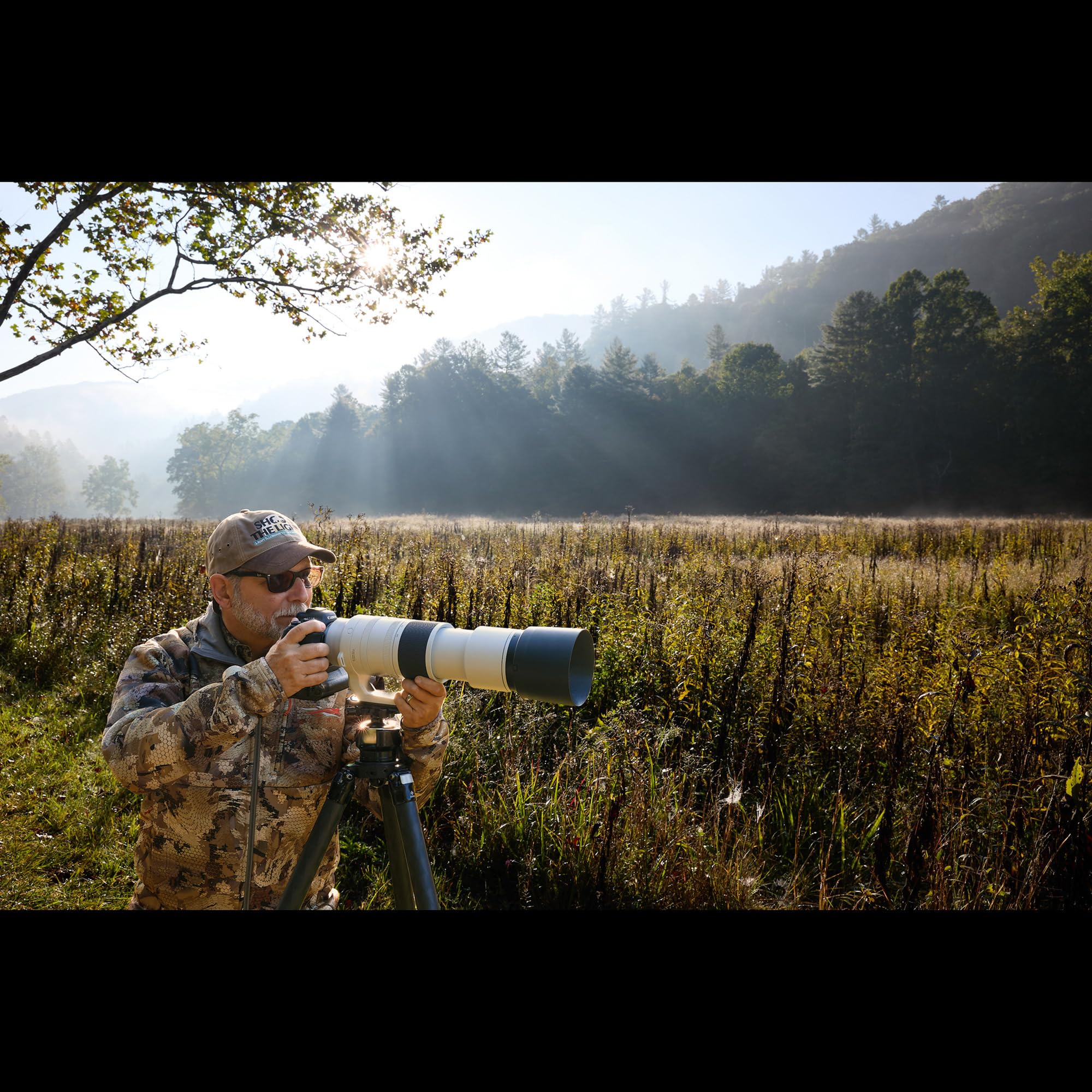
🔭 Capture the wild like never before — zoom into greatness!
The Canon RF200-800mm F6.3-9 IS USM is the world’s first autofocus super-telephoto zoom lens with an 800mm reach, designed for mirrorless RF-mount cameras. Weighing just 4.5 pounds, it combines powerful 4x zoom with up to 5.5 stops of image stabilization, enabling comfortable handheld shooting. Compatible with RF extenders, it offers exceptional optical performance for wildlife, nature, and sports photography in a compact, portable form.


| ASIN | B0CMDDY3D1 |
| Best Sellers Rank | #55 in SLR Camera Lenses |
| Brand | Canon |
| Built-In Media | Lens, accessories |
| Camera Lens | Canon RF200-800mm F6.3-9 IS USM |
| Camera Lens Description | Canon RF200-800mm F6.3-9 IS USM |
| Compatible Camera Models | Canon RF-mount cameras |
| Compatible Camera Mount | Canon RF |
| Compatible Mountings | Canon RF |
| Customer Reviews | 4.7 out of 5 stars 102 Reviews |
| Focal Length Description | World’s first AF super-telephoto zoom lens with telephoto end of 800mm1 |
| Focus Type | Auto/Manual |
| Global Trade Identification Number | 00013803370331 |
| Image stabilization | Optical |
| Item Height | 4 inches |
| Item Weight | 4.5 Pounds |
| Lens | Telephoto |
| Lens Coating Description | Super Spectra Coating |
| Lens Design | Zoom |
| Lens Fixed Focal Length | 200 Millimeters |
| Lens Mount | Canon RF |
| Lens Type | Telephoto |
| Manufacturer | Canon USA |
| Maximum Aperture | 6.3 f |
| Maximum Focal Length | 200 Millimeters |
| Minimum Aperture | 54 f |
| Minimum Focal Length | 800 Millimeters |
| Model Name | Canon RF200-800mm F6.3-9 IS USM |
| Number of Diaphragm Blades | 9 |
| Photo Filter Size | 95 Millimeters |
| Real Angle Of View | 12 |
| UPC | 013803370331 |
| Warranty Description | 1 year manufacturer |
| Zoom Ratio | 4.0:1 |
G**E
great optical quality and focal range
This is a hreat lense. paired with R50 it provide great focal range and clarity. I bought tjis mainly to take pictures of birds. The lens is obviously bulky and somewhat heavy, but not as heavy as I was expecting.
T**D
Probably the best wildlife lens today 👌
This is a tremendous lens. I used to use the the R5 with the RF 100-500L and it was a killer combination. But, tbh I think the R3 with the RF 200-800 is better. The reach is a big part of that. I have lower megapixels with the R3, but there's basically no need to crop with the 200-800's reach. Plus, it's very fast to focus with my R3, and the pictures are sharp. Sure, it's fairly heavy, the throw is quite a bit (basically how you zoom in and out), and finally the collar can't be removed. But, those are really the only cons I can think of. This lens really is an amazing combination of value and quality. Probably the best wildlife lens out there tbh. You won't regret buying this bad boy. *Fyi I use the JJC DLP-8II as a case / pouch for the lens.
D**G
The reach is 200mm over all comparably priced competitors
First of all I like the reach. Of course whenever trying out a new lens there is a learning curve. In this case spotting birds in flight at 600-800mm is a skill I need to work on quite a bit more to say I'm confident.. The weight is another plus. Yes I will use this lens on a tripod or a monopod often enough, but I have a detailed, sharp image of the moon taken as a handheld device. For the money, this lens cannot be beaten for people who do not make their living selling photos or prints to the media. This lens is all I need to capture birds in flight which is one of the main reasons I picked up the photography hobby in the first place. This is not an "L" less, and did doesn't have to be. Canon is finally providing good quality glass to photographers like me who want to improve their skills without draining their bank accounts. The aperture range of 6.3-9.0 is not a problem especially if I take advantage of every good light situation when I want to use this lens.
K**.
Very satisfied
Great lens for what it is. I use it on my Canon R7. Don't expect L series lens quality but this is very sharp and a blast to use. I have used it for wildlife and air shows so far. Having that extra reach to 800mm is great. I have enjoyed it tremendously!
K**K
Canon is absolutely the best forget the rest
This is an Awesome lens and well worth the money It is a bit heavy if using in the field for a long time
D**R
A beautiful high focal length Canon RF lens for the price
I really only bought this because it's slightly faster (brighter) at 800mm than my existing Canon RF800mm prime lens (f/9 versus f/11). This costs about twice as much as the RF800mm, but Canon have an even faster RF800mm f/5.6 prime that costs almost 10x this, hence I feel it is good value upgrade from my existing 800mm f/11. I had already used that prime lens to photograph full-frame moon pictures, plus pictures of Jupiter with the Magellanic moons visible, Saturn with the rings visible and Mars with some surface relief visible using my 30MP full-frame Canon EOS-R and the Canon 2x teleconverter. The 2x makes it effectively a 400mm to 1600mm zoom which is up-to 32x magnification and better than most telescopes would be without magnifying eypieces. But, the field of view is only about 3 degrees without the teleconverter and 1.5 degrees with it which is admitedly very narrow compared to a telescope. Nevertheless, this lens has a focal length that can extend as far as basic home telescopes. The visible planets are about 1% of the frame area on my 30MP full-frame Canon EOS-R making the camera meter unusable for exposure but that's just a matter of better "exposure guessing" gained from experience over repeat shoots. The lens is too heavy to handhold usefully, but works well on a tripod. The zoom range is good enough to permit having it wide at 200mm for broad scene observation then zoom in on a specific object of attraction, e.g. long range wildlife shooting. The zoom tension can be adjusted to allow zooming with low force and minimize disturbing tripod alignment too much. I'm attaching two photographs. They are the same mountain top taken minutes apart at between three and four miles distant to the East in the evening before sunset. The poor quality one is from my cellphone camera's 100x zoom mode but with the phone on a tripod, the better quality one was with this Canon lens using a 2x teleconverter, on my Canon EOS-R. I estimate there is about 25x as much detail in the scene taken using this lens, you can see individual tree trunks, branches and more with this lens at 32x magnification whereas there's very little detail in the phone pic at 100x magnification. If someone was hiking you would be able to tell a person was in the shot with this lens. The reason for the better detail at 32x magnification (teleconverter 2x included) than with 100x magnification on my phone is that my phone zoom crops and expands a section of a 12MP sensor output if the zoom is more than 3x. Doing the frame math, I'd estimate this lens with the 2x teleconverter still has a 30MP camera sensor, whereas my phone at 100x zoom I estimate is equivalent to a 1.2MP camera at 33x magnification. The detail in the strata of the rock at the peak from this lens is much better, you can barely tell it's present in the phone picture. There's other nice detail, the rock at the peak is geographically tilted, raised at the left, lowered at the right, you can see it in the full camera shot from both the angled rock strata and the fact that the trees grow vertically, regardless of their floor. In the phone shot there's no quality to any of the trees that permits deducing that. I'm really looking forward to trying this lens when Saturn is easier to view in two months. I should be able to get pictures again where the rings are visible as I did with my slower RF800mm f/11 prime lens. Another advantage of this over the Canon RF800mm f/11 is the aperture is adjustable on this lens but is fixed at f/11 on the prime lens. Depth of field adjustment is possible with this lens (minimum focus distance is 2.6 feet at 200mm and 10.8 feet at 800mm) so consider wildlife at a quarter mile on a bright day instead of my planetary and 3 to 4 mile distant mountain tests then use of depth of field artistically seems possible plus the full automatic exposure isn't limited to setting shutter speed. In a bright enough scene you can reduce shutter speed and let the aperture compensate, also making for potentially better exposure compensation and bracketing results. It's only detail but this comes with a lens hood and the RF100mm to 400mm zoom and the RF800mm f/11 don't.
B**Y
Huge Reach!
If you're looking at this lens, it's for the 800mm reach, probably for birds and wildlife. I just got it and took it out for some birding. I used it on the R7 for a 1280mm field of view on the long end. I'm happy with how it performed. Autofocus was speedy and performed well. I'm coming from a first version EF 100-400. So that's all I have to compare the autofocus to. It was faster and more accurate. But not by miles. F9 is not great but that's the trade off and you know it going in. You're going to have to use high ISO. Today was overcast but I was able to stay at ISO 1600 and get nice shots. Of course it would have been better with more light, but with the great IS of the lens and R7 you can get by with a lower shutter speed. The female Norther Harrier was shot at 800mm f9 ISO 1600 1/640. It was pretty still on the perch so it worked. If it was in flight I would have needed ISO 3200 at least, and even then have to work to get a good shot. So yes, f9 is something you'll have to work with. If you use it on an R5 or 6 it will be better but then you'll loose the reach of the R7. You'll probably need noise reduction, I use camera raw and while it's slow on my PC the results are good. None of these images used it though. Overall it's a great lens and I had a great time using it today and look forward to many more days of fun with it. There's no other way to get this reach for anywhere near this price. If you want something faster, get this and rent a 600 f4 or 800 f5.6 for a day to get it out of your system. Then enjoy the fact you can carry this around and use it all the time.
N**S
Killer Lens
Fantastic lens. A little heavy but not anywhere near as heavy as the Sigma 150-600 Got some great shots of the moon & looking forward to Eagle season. I'm sure I will be able to get great results with this lens.
Trustpilot
2 months ago
1 week ago