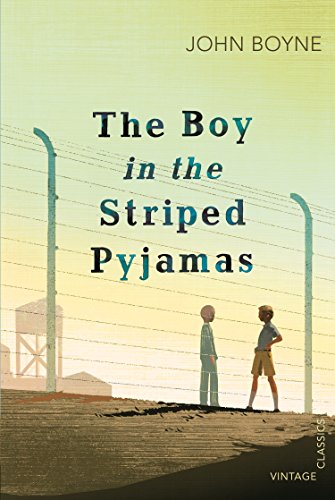


Boy in the Striped Pyjamas, The : John Boyne: desertcart.in: Books Review: "Innocence Meets Tragedy" - The boy in the stripped pajamas by John Boyne is an innocent yet haunting take on the tragic events of history in Nazi Germany. Innocent as the author tells the story through the eyes of two young boys - Bruno and Shmuel - which makes the story of the time feel more heartbreaking. Set against the backdrop of holocaust the story revolves around the friendship of two boys - Bruno and the boy on the other side of the fence. Both of them become friends overtime but Bruno is unaware of what goes on the other side of the fence, who are all those people in the stripped pajamas? He wants to go to the other side and play with his friend but is not allowed to do so. He somehow reaches there and what happens at the end is heart-wrenching. The theme of the book talks about friendship, compassion and humanity the young hearts carry around through tough times. The writing style is innocent and childlike, which matches the perspective of the young protagonist Bruno. For example - the way he mispronounces "Auschwitz" as "Out-With" and the "Führer" as "The fury" highlights how little he knows about the world around him. One of the most powerful parts of the book is how it shows the difference in maturity between Bruno and Shmuel, despite them being the same age. Bruno, who comes from a comfortable and privileged background, thinks like a typical nine-year-old full of curiosity, questions and confusions. There are moments where he complains about his life, feeling bored or lonely after moving to the new house, completely unaware of how fortunate he actually is. In contrast, Shmuel has lived through cruelty that no child should experience. This has forced him to mature and grow far too early. He never questions anything because he knows his questions cannot be answered or there are no answers because the life he is living right now is his reality. This is why he never really fully answers Bruno questions and explains how life is like on the other side of the fence because some things can only be understood when you experience them - a tragic truth Bruno comes to know too late. I would definitely recommend this book to everyone as it offers a deep glimpse of cruelty and unimaginable suffering faced by the Jews and the other communities at the hands of the so-called world leaders. There is something profoundly moving about telling a story of dark times through the lens of children. Their innocent and pure hearts makes you realize that it was never difficult to choose and spread love and empathy over hatred and cruelty. The boy in the stripped pajamas is not just a story - it is a reminder of the dreadful past, of human choices to be evil and of the cost of silence. It's a kind of book that urges you to want to know more about the Nazi Germany, the holocaust, the world war II and the other countless untold stories of that era. Review: The Boy In The Striped Pyjamas - A Haunting Tale of Innocence and Ignorance: A Review of "The Boy in the Striped Pajamas" John Boyne's "The Boy in the Striped Pajamas" is a poignant and thought-provoking story set against the backdrop of the Holocaust. The novel's narrative revolves around two young boys, Bruno, the son of a Nazi commandant, and Shmuel, a Jewish boy imprisoned in the concentration camp adjacent to their home. Their unlikely friendship, born out of innocence and curiosity, serves as a powerful counterpoint to the horrors of the war that surrounds them. Bruno, a curious and imaginative boy of nine, is uprooted from his comfortable life in Berlin when his father is promoted to commandant of a concentration camp. Reluctantly moving to the desolate countryside, Bruno finds himself isolated and bored, yearning for companionship. One day, while exploring the perimeter of the camp, he stumbles upon a young boy clad in striped pajamas, Shmuel, a prisoner on the other side of the fence. Despite their vastly different worlds, Bruno and Shmuel develop an unlikely friendship. They meet regularly under the fence, sharing stories, food, and dreams. Their bond deepens as they navigate the complexities of their circumstances, their innocence shielding them from the full grasp of the atrocities unfolding around them. Boyne masterfully captures the innocence and vulnerability of childhood through Bruno's perspective. Bruno, oblivious to the true nature of his father's work, sees the camp as a strange and mysterious place, unaware of the suffering and persecution that lie within its walls. His naivety highlights the absurdity and cruelty of the Nazi regime, emphasizing the devastating impact of war on the minds of children. Shmuel, on the other hand, bears the weight of the world's horrors. His experiences in the camp have stripped him of his childhood, leaving him with a profound understanding of loss and suffering. Yet, amidst the despair, he finds solace in his friendship with Bruno, a reminder of the humanity that still exists amidst the darkness. As their friendship deepens, Bruno's innocence gradually crumbles. He witnesses the brutality of the camp guards and the despair of the prisoners, slowly piecing together the truth about his father's role in the atrocities. The realization shatters his world, forcing him to confront the harsh realities of the world he has been shielded from. The novel's climax is both heartbreaking and thought-provoking. Bruno's innocent act of kindness leads to a tragic end, highlighting the devastating consequences of prejudice and ignorance. The final scene leaves a lasting impact, a stark reminder of the human cost of war and the importance of empathy and understanding. "The Boy in the Striped Pajamas" is a powerful and moving tale that resonates deeply with readers of all ages. Its exploration of innocence, friendship, and the horrors of war serves as a poignant reminder of the human capacity for both compassion and cruelty. The novel's enduring legacy lies in its ability to challenge our perspectives and inspire us to confront the darkness of the world with a glimmer of hope.
| ASIN | 0099572869 |
| Best Sellers Rank | #2,312 in Books ( See Top 100 in Books ) #2 in Young Adult Nonfiction on Social & Family Violence #2 in Historical Holocaust Fiction for Young Adults #4 in Children's Nonfiction on Violence |
| Country of Origin | United Kingdom |
| Customer Reviews | 4.6 4.6 out of 5 stars (32,370) |
| Dimensions | 13 x 1.8 x 18.9 cm |
| Generic Name | BOOK |
| ISBN-10 | 9780099572862 |
| ISBN-13 | 978-0099572862 |
| Importer | Penguin Random House India Pvt Ltd |
| Item Weight | 172 g |
| Language | English |
| Net Quantity | 500.00 Grams |
| Packer | Penguin Random House India Pvt Ltd |
| Paperback | 256 pages |
| Publisher | Vintage Children's Classics (2 August 2012); Penguin Random House Ireland Limited; [email protected] |
| Reading age | Customer suggested age: 11 years and up |
V**A
"Innocence Meets Tragedy"
The boy in the stripped pajamas by John Boyne is an innocent yet haunting take on the tragic events of history in Nazi Germany. Innocent as the author tells the story through the eyes of two young boys - Bruno and Shmuel - which makes the story of the time feel more heartbreaking. Set against the backdrop of holocaust the story revolves around the friendship of two boys - Bruno and the boy on the other side of the fence. Both of them become friends overtime but Bruno is unaware of what goes on the other side of the fence, who are all those people in the stripped pajamas? He wants to go to the other side and play with his friend but is not allowed to do so. He somehow reaches there and what happens at the end is heart-wrenching. The theme of the book talks about friendship, compassion and humanity the young hearts carry around through tough times. The writing style is innocent and childlike, which matches the perspective of the young protagonist Bruno. For example - the way he mispronounces "Auschwitz" as "Out-With" and the "Führer" as "The fury" highlights how little he knows about the world around him. One of the most powerful parts of the book is how it shows the difference in maturity between Bruno and Shmuel, despite them being the same age. Bruno, who comes from a comfortable and privileged background, thinks like a typical nine-year-old full of curiosity, questions and confusions. There are moments where he complains about his life, feeling bored or lonely after moving to the new house, completely unaware of how fortunate he actually is. In contrast, Shmuel has lived through cruelty that no child should experience. This has forced him to mature and grow far too early. He never questions anything because he knows his questions cannot be answered or there are no answers because the life he is living right now is his reality. This is why he never really fully answers Bruno questions and explains how life is like on the other side of the fence because some things can only be understood when you experience them - a tragic truth Bruno comes to know too late. I would definitely recommend this book to everyone as it offers a deep glimpse of cruelty and unimaginable suffering faced by the Jews and the other communities at the hands of the so-called world leaders. There is something profoundly moving about telling a story of dark times through the lens of children. Their innocent and pure hearts makes you realize that it was never difficult to choose and spread love and empathy over hatred and cruelty. The boy in the stripped pajamas is not just a story - it is a reminder of the dreadful past, of human choices to be evil and of the cost of silence. It's a kind of book that urges you to want to know more about the Nazi Germany, the holocaust, the world war II and the other countless untold stories of that era.
A**R
The Boy In The Striped Pyjamas
A Haunting Tale of Innocence and Ignorance: A Review of "The Boy in the Striped Pajamas" John Boyne's "The Boy in the Striped Pajamas" is a poignant and thought-provoking story set against the backdrop of the Holocaust. The novel's narrative revolves around two young boys, Bruno, the son of a Nazi commandant, and Shmuel, a Jewish boy imprisoned in the concentration camp adjacent to their home. Their unlikely friendship, born out of innocence and curiosity, serves as a powerful counterpoint to the horrors of the war that surrounds them. Bruno, a curious and imaginative boy of nine, is uprooted from his comfortable life in Berlin when his father is promoted to commandant of a concentration camp. Reluctantly moving to the desolate countryside, Bruno finds himself isolated and bored, yearning for companionship. One day, while exploring the perimeter of the camp, he stumbles upon a young boy clad in striped pajamas, Shmuel, a prisoner on the other side of the fence. Despite their vastly different worlds, Bruno and Shmuel develop an unlikely friendship. They meet regularly under the fence, sharing stories, food, and dreams. Their bond deepens as they navigate the complexities of their circumstances, their innocence shielding them from the full grasp of the atrocities unfolding around them. Boyne masterfully captures the innocence and vulnerability of childhood through Bruno's perspective. Bruno, oblivious to the true nature of his father's work, sees the camp as a strange and mysterious place, unaware of the suffering and persecution that lie within its walls. His naivety highlights the absurdity and cruelty of the Nazi regime, emphasizing the devastating impact of war on the minds of children. Shmuel, on the other hand, bears the weight of the world's horrors. His experiences in the camp have stripped him of his childhood, leaving him with a profound understanding of loss and suffering. Yet, amidst the despair, he finds solace in his friendship with Bruno, a reminder of the humanity that still exists amidst the darkness. As their friendship deepens, Bruno's innocence gradually crumbles. He witnesses the brutality of the camp guards and the despair of the prisoners, slowly piecing together the truth about his father's role in the atrocities. The realization shatters his world, forcing him to confront the harsh realities of the world he has been shielded from. The novel's climax is both heartbreaking and thought-provoking. Bruno's innocent act of kindness leads to a tragic end, highlighting the devastating consequences of prejudice and ignorance. The final scene leaves a lasting impact, a stark reminder of the human cost of war and the importance of empathy and understanding. "The Boy in the Striped Pajamas" is a powerful and moving tale that resonates deeply with readers of all ages. Its exploration of innocence, friendship, and the horrors of war serves as a poignant reminder of the human capacity for both compassion and cruelty. The novel's enduring legacy lies in its ability to challenge our perspectives and inspire us to confront the darkness of the world with a glimmer of hope.
L**O
Gripande!
T**S
Boy in pajamas This book is one of the best book that I have read this month. The Boy in The Striped Pajamas, while sad, is a story worth reading. It inspires the reader to think about the Nazis and how terribly wrong they were. A bond is formed with both of the boys, demonstrating the heartbreak the Jews must have felt when their own friends and family were mercilessly killed. The Boy in the Striped Pajamas tells the story of Bruno, a young German boy growing up during World War II. As a nine-year-old, Bruno lived in his own world of imagination. He enjoyed reading adventure stories and going on expeditions to explore the lesser-known corners of his family’s massive house in Berlin. Although his father served as an officer in Germany’s Nazi Party, Bruno understood little about his work. Nor did he understand anything about the war. Bruno’s main concerns in life were to follow the strict rules set forth by his parents and to steer clear of his older sister, Gretel. Otherwise, he enjoyed seeing the hustle and bustle of Berlin and spending time with his three best friends: Karl, Daniel, and Martin. This is sad but also a heartwarming story. I recommend this to any ages above 10. This book teaches an important life lesson for everyone to learn
D**S
Ottimo per chi ha bisogno di consolidare la conoscenza della lingua inglese. Non troppo facile, né troppo difficile.
A**R
The Boy in the Striped Pajamas by John Boyne is a well-written piece of literature, in which we follow Bruno, a nine-year-old boy, while he goes through circumstances that will transform his life. The book starts out in the city of Berlin, Germany, where Bruno is quite content with what his life consists of. He has a big house with five floors (if you count the basement and the little room at the top with the window), as well as three best friends for life. He comes home one day and discovers that the maid is packing all of his possessions into four large crates, then later finds out from his mother that they are moving. When he arrives at the new house he utterly loathes it. The new house only has three floors, is miles from any other dwellings, and there’s a strange tall fence behind it. Bruno meets a boy on the other side of the barricade and befriends him, but a perfect friendship doesn’t always promise a perfect ending. Written from a child’s point of view, innocence is a major theme of The Boy in the Striped Pajamas. Bruno doesn’t know the difference between good and evil, and can’t seem to figure out the difference between himself and the boy on the other side of the fence. Bruno’s friendship with this boy demonstrates an extreme lack of knowledge. The people on the other side of the fence were Jews, and he was German. During that time there was extreme prejudice held against the Jews. They were considered less than human, and no German that wanted any respect would have anything to do with them. Innocence and prejudice go hand in hand, a lack of innocence can lead one to prejudice, but if one has innocence, there can be no prejudice. Innocence can keep you from harm, but in Bruno’s case, it led him straight into it. John Boyne’s writing captures the very essence of equality. None of the adults realize that Jews are no different than they are, and yet Bruno can see past the mask of prejudice and recognizes that he is indeed the same as the boy on the other side of the fence. Boyne writes the way a child would think, for example: “[Bruno’s] mouth made the shape of an O (pg 6).” The average adult would not think this way. Boyne also supplants words like “Führer” with “Fury”. Because Boyne is writing from a child’s point of view, his writing corresponds with the mentality of a child. Boyne’s sentences are exceedingly lengthy and sometimes slightly confusing, which can make reading aloud quite difficult, rereading certain passages may be necessary. Silent reading will essentially eliminate this problem, and will keep the message unhindered. Reading The Boy in the Striped Pajamas is a great experience, and it will definitely be worth your while. John Boyne’s book reveals the major injustices of the Holocaust, while creating a bond between us and the characters. Overall The Boy in the Striped Pajamas is a fantastic novel that everyone should take the time to read.
S**I
Muy buen libro escolar recomendable, mejorable el precio
Trustpilot
2 weeks ago
3 days ago