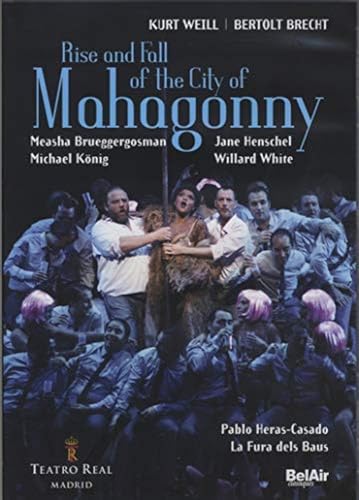
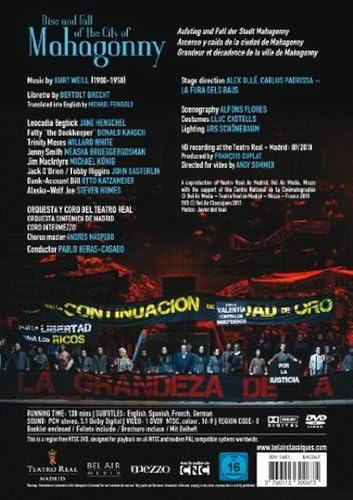

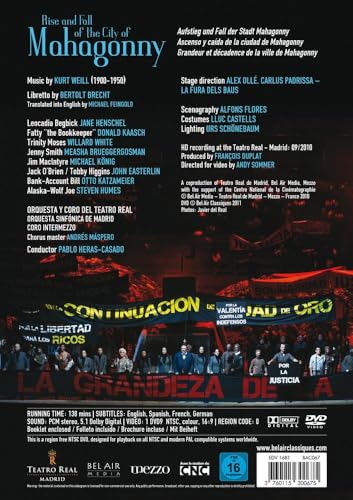
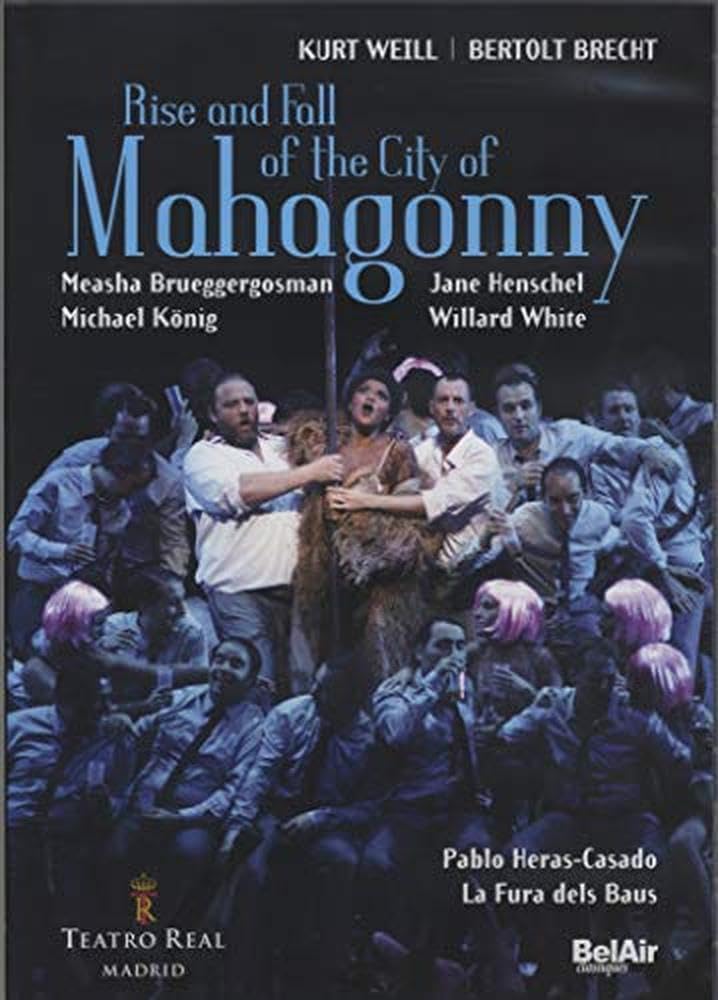
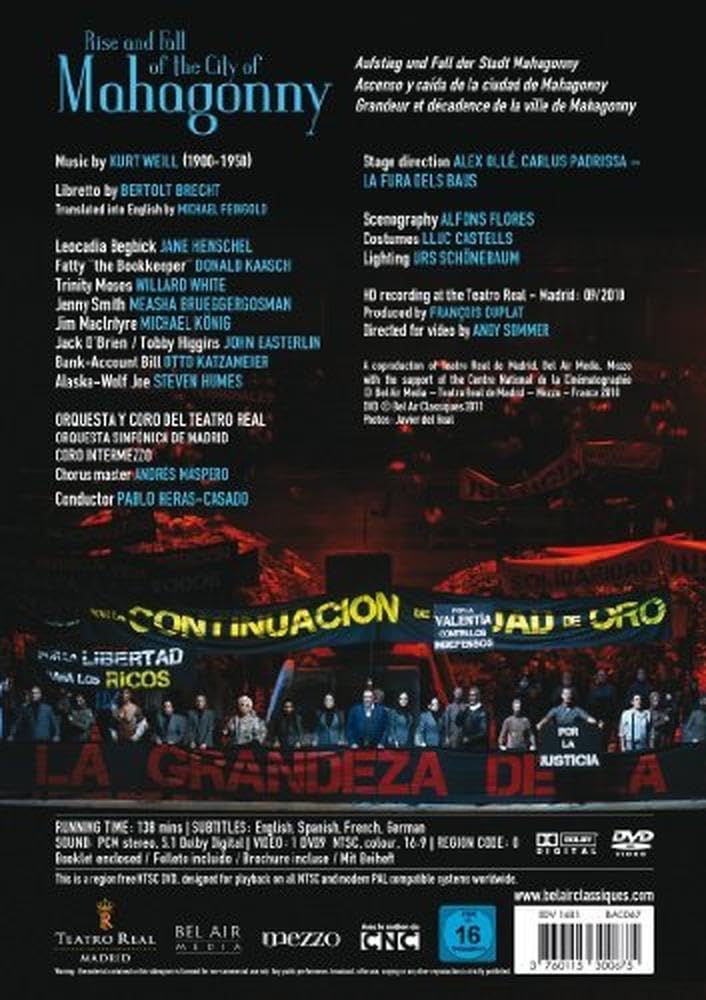
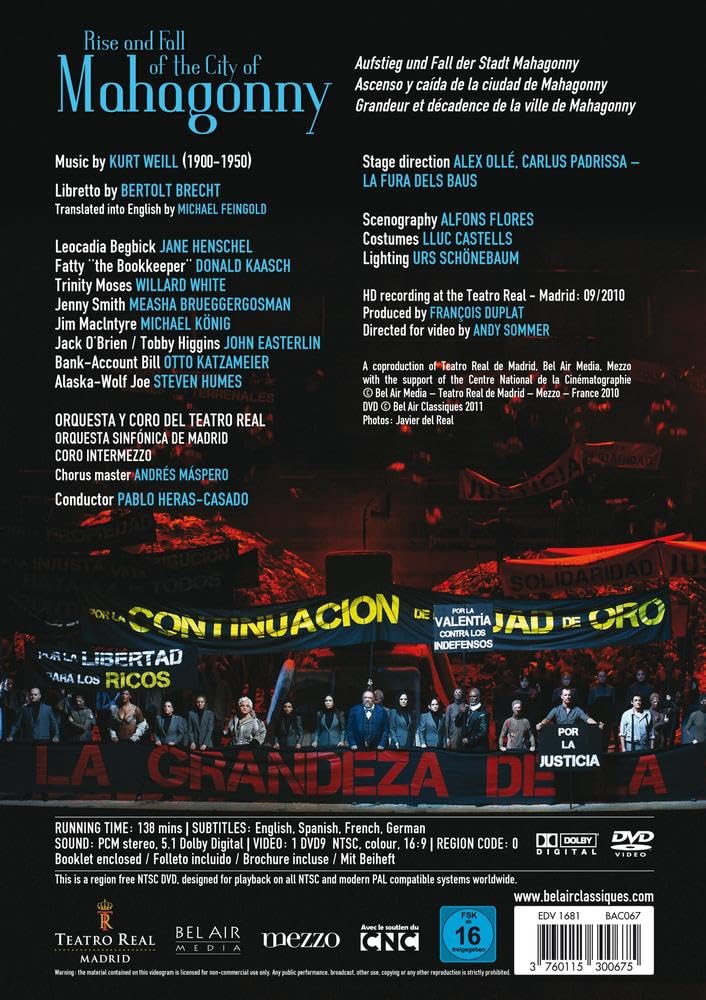
Jane Henschel, Willard White, Measha Brueggergosman, and Michael Koenig star in this La Fura dels Baus/Teatro Real production of the Weill opera conducted by Pablo Heras-Casado. Review: It don't get much better - I was NOT prepared for this dvd. Diffidently (after all, what does Madrid know about Weill?), I ordered it simply to have another copy of MAHOGANNY, a work I adore. Can you spell "schmuck"? That's what I was calling myself ten minutes into the performance. It is, simply, the most intelligent production of this "opera" I have seen (pray, be not impressed; I've seen only three others, but I've re-seen them many times). Conducting: one couldn't wish for better. The cast: not one dud amoung them, not a one (check out Jenny's trill in "Moon of Alabama" - it is to swoon). The mise en scene? Oh, man, don't get me started. It's like a Broadway show; it's like the best of contemporary opera; it's like the old 60's days of the Living Theater. Yet it's too something "also" on which right now I can't put my finger. To borrow a phrase from Talulah B, it's a goddamn miracle. The chorus? Spot on. Underlying all is the translation of Brecht's libretto into American English. It's superb, comperable to the translation (Blitzstein's ?) of the Threepenny Opera that put Weill/Brecht on the Manhattan scene back in the 50's. For a while my Inner Purist (who can be SUCH a bore!) fussed about losing the German...until I remembered that Weill, upon coming to Manhattan and claiming a historical place among Broadway's greats, being so ashamed of his native country rolling over for the Nazis, refused to speak a word of German. That made it all right. That made it OK. In this performance, Mahoganny, takes its place in musical history in an entirely new context: Weill in Manhattan. I think he would have loved it. But all that's intellectual twaddle. If you have a love for Weill and his works, please do not deny yourself the pleasure of this performance. And don't expect a better one anytime soon. I know of none better, though I know of one very close. Madrid, bravo! Er...make that bravissimi! Tutti! Disclosure: I am not acquainted with anyone involved in the production of this dvd, nor do I have any financial interest therein. Review: Good La Fura dels Baus production - When it was originally composed in 1930, Kurt Weill and Bertolt Brecht intended Rise and Fall of the City of Mahagonny (Aufstieg und Fall der Stadt Mahagonny) to be as much a satire of opera and a reaction to the state of the Weimar Republic. Now, when taken alongside such like-minded work contemporary works by Hindemith and Berg, it just sounds like great opera - but it still functions as a scathing satire on all the subjects it deals with, particularly the nature of capitalism, on which it still has very relevant points to make. You can call it music theatre if you like, but Weill's score for Rise and Fall of the City of Mahagonny is considerably more sophisticated than that, working in a variety of styles to create a deliberate alienating effect, drawing on specific references, creating dissonance and unsettling arrangements, using unexpected plot points to keep the listener engaged and keep them from complacently and unquestioningly accepting operatic conventions. If you need any convincing that Rise and Fall of the City of Mahagonny can aspire to great opera however, this 2010 production at the Teatro Real in Madrid, directed by La Fura dels Baus might be just the ticket. Their unconventional approach to opera staging, which could even be considered anti-theatre, certainly has a Brechtian influence, so it's no surprise to find that that the Catalan group are absolutely perfect for this particular work. Directed by Alex Ollé and Carlus Padrissa, there are no projections this time - other than the titles of each of the sections (in Spanish here, not translated on the screen) - and no elaborate designs, no acrobatic wire work and no off-the-wall concepts. Everything is tailored directly towards the expression of the ideas in the work, finding the most imaginative and impactful way of putting it across, without relying on stagy conventions. The satire effectively makes all its points - from the expectations of the individual to the concept of justice - all within the umbrella of the capitalist system, and it doesn't need any specific or easy-target anti-American agenda attached for the concept to stand on its own and be applied by the listener to their own experience of the system. I'm not sure why it was chosen to use the US revision of the original opera, singing it in English and changing Jimmy Mahoney to Jimmy MacIntyre, particularly as there are a few native German speakers in the cast here and others, like Henschel, have a strong footing in German opera. If it's another attempt at alienation effect to keep the audience guessing, then it works. Most importantly however, the casting and singing is superb. Jane Henschel is superbly capable in the whole range from singspiel-like dialogue to more conventional opera singing, as well as being a fine actress in the role of Widow Begbick. Jenny Smith is an important piece of casting, and Canadian soprano Measha Brueggergosman makes an incredible impression, oozing sensuality and absolutely electric in her scenes with Michael König's fine Jimmy MacIntyre. The balance right across the board in the other roles seems perfect, consistently hitting the right note, as do the Chorus of the Teatro Real, who give their all in the scantiest of costumes and in the most... well... indelicate situations. One can't fault the commitment either of the Madrid orchestra under Pablo Heras Casado. I don't know if it's to do with the encoding, but Bel Air releases often look a little juddery in motion on my set-up - but generally the image is fine, and even if movements aren't smooth, I didn't find it too distracting. The audio tracks, in LPCM Stereo and DTS HD Master Audio 5.1, are both good, but there's not much to choose between them. There are no extra features on the disc, and only a synopsis in the booklet.
| ASIN | B005FMQB4M |
| Actors | John Easterlin, Measha Brueggergosman, Michael König, Otto Katzameier, Willard White |
| Aspect Ratio | 1.78:1 |
| Best Sellers Rank | #285,892 in Movies & TV ( See Top 100 in Movies & TV ) #218,136 in DVD |
| Customer Reviews | 4.1 4.1 out of 5 stars (29) |
| Director | Andy Sommer |
| Dubbed: | None |
| Is Discontinued By Manufacturer | No |
| MPAA rating | NR (Not Rated) |
| Media Format | Classical, Color, Multiple Formats, NTSC, Widescreen |
| Number of discs | 1 |
| Producers | Duplat |
| Product Dimensions | 7.6 x 0.79 x 5.28 inches; 3.46 ounces |
| Release date | November 15, 2011 |
| Studio | Bel Air Classiques |
| Subtitles: | English, French, German, Spanish |
S**N
It don't get much better
I was NOT prepared for this dvd. Diffidently (after all, what does Madrid know about Weill?), I ordered it simply to have another copy of MAHOGANNY, a work I adore. Can you spell "schmuck"? That's what I was calling myself ten minutes into the performance. It is, simply, the most intelligent production of this "opera" I have seen (pray, be not impressed; I've seen only three others, but I've re-seen them many times). Conducting: one couldn't wish for better. The cast: not one dud amoung them, not a one (check out Jenny's trill in "Moon of Alabama" - it is to swoon). The mise en scene? Oh, man, don't get me started. It's like a Broadway show; it's like the best of contemporary opera; it's like the old 60's days of the Living Theater. Yet it's too something "also" on which right now I can't put my finger. To borrow a phrase from Talulah B, it's a goddamn miracle. The chorus? Spot on. Underlying all is the translation of Brecht's libretto into American English. It's superb, comperable to the translation (Blitzstein's ?) of the Threepenny Opera that put Weill/Brecht on the Manhattan scene back in the 50's. For a while my Inner Purist (who can be SUCH a bore!) fussed about losing the German...until I remembered that Weill, upon coming to Manhattan and claiming a historical place among Broadway's greats, being so ashamed of his native country rolling over for the Nazis, refused to speak a word of German. That made it all right. That made it OK. In this performance, Mahoganny, takes its place in musical history in an entirely new context: Weill in Manhattan. I think he would have loved it. But all that's intellectual twaddle. If you have a love for Weill and his works, please do not deny yourself the pleasure of this performance. And don't expect a better one anytime soon. I know of none better, though I know of one very close. Madrid, bravo! Er...make that bravissimi! Tutti! Disclosure: I am not acquainted with anyone involved in the production of this dvd, nor do I have any financial interest therein.
K**E
Good La Fura dels Baus production
When it was originally composed in 1930, Kurt Weill and Bertolt Brecht intended Rise and Fall of the City of Mahagonny (Aufstieg und Fall der Stadt Mahagonny) to be as much a satire of opera and a reaction to the state of the Weimar Republic. Now, when taken alongside such like-minded work contemporary works by Hindemith and Berg, it just sounds like great opera - but it still functions as a scathing satire on all the subjects it deals with, particularly the nature of capitalism, on which it still has very relevant points to make. You can call it music theatre if you like, but Weill's score for Rise and Fall of the City of Mahagonny is considerably more sophisticated than that, working in a variety of styles to create a deliberate alienating effect, drawing on specific references, creating dissonance and unsettling arrangements, using unexpected plot points to keep the listener engaged and keep them from complacently and unquestioningly accepting operatic conventions. If you need any convincing that Rise and Fall of the City of Mahagonny can aspire to great opera however, this 2010 production at the Teatro Real in Madrid, directed by La Fura dels Baus might be just the ticket. Their unconventional approach to opera staging, which could even be considered anti-theatre, certainly has a Brechtian influence, so it's no surprise to find that that the Catalan group are absolutely perfect for this particular work. Directed by Alex Ollé and Carlus Padrissa, there are no projections this time - other than the titles of each of the sections (in Spanish here, not translated on the screen) - and no elaborate designs, no acrobatic wire work and no off-the-wall concepts. Everything is tailored directly towards the expression of the ideas in the work, finding the most imaginative and impactful way of putting it across, without relying on stagy conventions. The satire effectively makes all its points - from the expectations of the individual to the concept of justice - all within the umbrella of the capitalist system, and it doesn't need any specific or easy-target anti-American agenda attached for the concept to stand on its own and be applied by the listener to their own experience of the system. I'm not sure why it was chosen to use the US revision of the original opera, singing it in English and changing Jimmy Mahoney to Jimmy MacIntyre, particularly as there are a few native German speakers in the cast here and others, like Henschel, have a strong footing in German opera. If it's another attempt at alienation effect to keep the audience guessing, then it works. Most importantly however, the casting and singing is superb. Jane Henschel is superbly capable in the whole range from singspiel-like dialogue to more conventional opera singing, as well as being a fine actress in the role of Widow Begbick. Jenny Smith is an important piece of casting, and Canadian soprano Measha Brueggergosman makes an incredible impression, oozing sensuality and absolutely electric in her scenes with Michael König's fine Jimmy MacIntyre. The balance right across the board in the other roles seems perfect, consistently hitting the right note, as do the Chorus of the Teatro Real, who give their all in the scantiest of costumes and in the most... well... indelicate situations. One can't fault the commitment either of the Madrid orchestra under Pablo Heras Casado. I don't know if it's to do with the encoding, but Bel Air releases often look a little juddery in motion on my set-up - but generally the image is fine, and even if movements aren't smooth, I didn't find it too distracting. The audio tracks, in LPCM Stereo and DTS HD Master Audio 5.1, are both good, but there's not much to choose between them. There are no extra features on the disc, and only a synopsis in the booklet.
L**E
Magnificent
Like another reviewer, I was hesitant about a production that was not sung in the original German. Silly, silly me. This is a great production, complete with a couple of surprises. The singing is superb and the staging ingenious. I really love this.
U**R
Weill was born in Dassau,Germany 1900.His teachers were Humperdinck, who was the composer of the opera Hansel and Gretel.He helped Wagner prepare his score of Parsival for the Premiere. Weill also joined Busoni's composition master class.In otherwords,he was throughly versed in the tradition of the serious music of the time.(the review further on).He worked in the local opera house under Knappertsbusch who was music director.Stravinsky's neo classicism influenced Weill,also he started to gain a social consciousness.In the mid 1920's he discovered tonal and Jazz music.In 1926 he married Lotte Lenya. Weill was established as a leading composer in the Weimar Republic,and in 1927 he gave Brecht an unknown writer, a chance with his Mahagonny Songspiel,then followed the Threepenny opera(1928),Happy end (1929),Rise and Fall of the city of Mahagonny.(1930)and Das Jasager.Weill and Brecht drifted apart, because Brecht felt there was too much music in the operas and music plays. His deeply felt Communist views annoyed Weill who was a humanist.In 1933 Weill left Germany because of the Nazi's and emigrated to France.There was a brief reunion with Brecht who wrote the libretto for Seven deadly sins.In 1935 Weill and Lenya left for the USA. Weill wanted music to be accessible to a wide variety of listeners.So in Germany he transformed into high art the songs and dance music of the time,also drawing from classical and romantic music.Basically, the libretto and the music was a parody of happy endings and romantic lyrical arias.The works were a combination of spoken theatre and popular musical idioms.Thus,you have a risque text with beautiful tunes,such as that within the Rise and fall of Mahagonny.Sometimes the music is entirely different to the words being sung.Weill wanted to reform opera,he called the Threepenny opera a song play.In the Rise and Fall of Mahagonny,he wanted the words to be sung. Had not performances been interpreted by the Nazi regime,Weill would have worked to tighten the action and resolve the conflict between operatically trained singers and decidedly unoperatic material.Some may think Weill only wanted artists from the fields of Cabaret,because of Lotte Lenya and musical comedy. But he did use singers from operetta.Some of his songs music sound as if they are from operettas,as a couple are from this opera,almost song play The synopsis is a dig at the social conditions of the time of the Weimar Republic,but it does resonate with audiences of today,with the problems caused by the global economy;capitalism at its worse.Based upon the Reaganite values of deregulation;let the market rip and small government,where positive human values are seen as being weak and politically correct.Brecht and Weill developed a logic of negative values.A City is founded by criminals,humanity is unreal,love is for sale and friendship selfish.There is a kind of justice,but it is one in which the poor suffer. If he cannot produce a bribe it is the person without money who is excuted rather than the murderer. It ends by saying,no one can help anyone.Premiere 1930 Leipzig,Neues theatre.Otto Klemperer director of the Kroll theatre,Berlin,known for his avanteguarde performances,thought it crass. Both authors changed the work. Stage direction is by Alex Olle,Carlos Padrissa-La Fura Dels Baus.Known for their work on Wagner's Ring cycle,called the Valencia Ring.The set is mainly a rubbish dump,which in turn becames a golf course,created by artifical turf. Chairs,tables and beds are used creatively by the troup la fura Dels Baus,who are involved in the opera in crowd scenes.Modern dress.The Orchestra Teatro Real Madrid is conducted energetically by the young Pablo Heras-Casado. There are trained opera singers in this cast as there should be. Weill wanted his work to be sung,not shouted. Jenny Smith is sung very well by Measha Brueggergosman.She is different to Lenya,who was like a caberet singer who was not trained.Weill adjusted his parts to her.According to Conductor Maurice Abravanel who knew Weill very well,when interviewed by Mauceri,he stated,"Lenya was a fantastic actress.She wanted to sing and there is this big misunderstanding that Kurt(Weill) wanted it.Never!Never!.It should be sung without any sentimentality but with very strong emotion.Sing.!Sing".(Decca booklet, recording of Weill's seven deadly sins).Hear Measha sing the Alabama Song. Show us the way to the next whisky bar. Michael Konig is Jim Mc Intyre,who tells the others to "Do it".Do what ever they like.He is executed in the end for not being able to pay a bribe. The widow, Leocadia Begbick is sung by Jane Henschel, who is operatically trained, is very animated in the part. Trinty Moses is Willard White,who has played Wotan in the Wagner's ring cycle. He is even a boxer in this opera.John Easterlin plays Jack o'Brien who dies of over eating. Tobby Higgins is his other part.He is let off for murder because of a bribe.Fatty, Donald Kaasch,Played Dantine in the perfect American,an opera by Glass about Walt Disney.A very well directed and sung opera in English,which I much prefer to the German.10 CD box set under 10 pounds with Brecht and Weill's works,plus works from his American period.(see my review) Another composer who deals with society is American,Phillip Glass who is classically trained, taught composition by Nadia Boulanger,who was a pupil of Faure.He is a minmalist,but uses popular music along with Indian tabla inspired music,plus influences from classical music.His work is very tuneful.His music is a reaction against atonal music.He is the only composer to be on Broadway,have an opera playing at the Met,be in the popular music charts and play at Carnegie Hall all in a year.Even David Bowie likes his music.I wonder if Weill's music inspired Glass?Also,he has deeply held humanitarian views like Weill. SUBTITLES:English,Spanish,French,German. Sound: PCM Stereo. 5.1 DTS HD Master Audio. 1080i Full HD.16.9. REGION code.A.B.C.Booklet included which only has the synopsis.Recorded live Madrid 9 2010. References: Batta,A. Opera.2005. Konemann. Ewen,D.20th Century opera music.1968. Prentice-Hall. Guinn,G. Stone,(Eds)The St James Encyclopdedia.1997.Visible Ink. Holden,A.(Ed).Penguin opera Guide.1995.Viking.
D**S
Von einer Inszenierung von La furas dels baus darf man wahrlich mehr erwarten. Brav an der (offensichtlich nicht wirklich verstandenen) Handlung entlang erzählt - dazu eine ziemlich mäßige Besetzung, stimmlich gerade okay, szenisch völlig überfotdert. Schade und enttäuschend...
C**S
Soyons clairs: ce spectacle ne sera pas du goût de tout le monde car, dénonciation prophétique du capitalisme, du matérialisme et de leurs excès, c'est la vision la plus acerbe, la plus noire du chef d'oeuvre de Brecht et Weill. Dès le lever du rideau, un choc: tout le plateau est envahi d'un amas de détritus, reliefs d'une société de consommation au bord de l'abîme. D'étranges créatures féminines, elles aussi objets de consommation, s'extirpent de ce décor unique tandis que les hommes s'alimentent le long d'une vaste mangeoire tels des poulets en batterie. L'inévitable catastrophe arrive: tout commence dans les ordures et y finira. Images fortes, sales, dérangeantes se déroulent dans une demi-obscurité. Dans le cadre chic du Teatro Real de Madrid, à deux pas de la place où manifestent Los Indignatos, ce Mahagonny apocalyptique prend une signification actuelle.Ceux qui pensent que l'art lyrique peut éveiller les prises de consciences et provoquer des secousses telluriques ne seront pas déçus! Il fallait des caractères bien trempés pour assumer de tels partis pris: Jane Henschel, opulente veuve Begbick; Willard White, inquiétant Moïse la Trinité; Donald Kaasch, Fatty sans scrupule et surtout l'incroyable bête de scène qu'est Measha Brueggergosman, la mieux phrasée de toutes les Jenny à laquelle Michaël König donne la plus solide réplique. Le jeune Pablo Heras-Casado dirige la partition d'un geste qui tend les lignes et accentue la nervure du drame. Un grand bravo au réalisateur François Duplat qui a su filmer les scènes dans une semi-obscurité. Attention, l'opéra est en anglais et non pas en allemand, sa langue originelle.
M**L
Era un regalo. Es una producción excelente del teatro Real de Madrid. Al estar cerrada definitivamente su tienda resultaba imposible conseguir. Ha sido una gran suerte poder comprarlo por Amazon.
M**R
Dans un immense terrain vague servant de dépotoir, 3 malfrats en cavale (2 mecs et une femme) vont construire une ville provisoire, avec les matériaux dont ils disposent sur place (tables, plumards, chaises, etc) afin d'attirer les chercheurs d'or du coin. Pour celà ils leur proposent 4 centres d'activité : bouffe, baise, boxe, et beuverie. Les hommes rappliquent, excités par le whisky et les prostituées aux perruques roses et aux bas élimés. Mais les 3 criminels ont la dent dure : leur seul mot d'ordre c'est le pognon et rien que le pognon. Si tu peux pas payer, t'es foutu. C'est ce qui adviendra à Jim, le "bûcheron d'Alaska" qui, ruiné, sera jugé et exécuté. 1930- l'opéra est interdit en Allemagne. 2010- les "indignés" manifestent, en Espagne et ailleurs. L'opéra de Brecht-Weill fustigeait le capitalisme, comme un monstre auto-destructif. A Madrid, dans un décor sordide, La Fura fait défiler sur scène un choeur désenchanté brandissant d'illusoires banderoles. Et Madrid a fait un triomphe à ce spectacle intelligent. La musique (dont le fameux "Alabama Song" a fait le tour du monde, de Bowie à Dalida) traine des airs de bastring, que l'on retrouve dans tous les opéras de Weill, et qui n'ont rien perdu de leur familiarité racoleuse.
Trustpilot
1 day ago
3 weeks ago