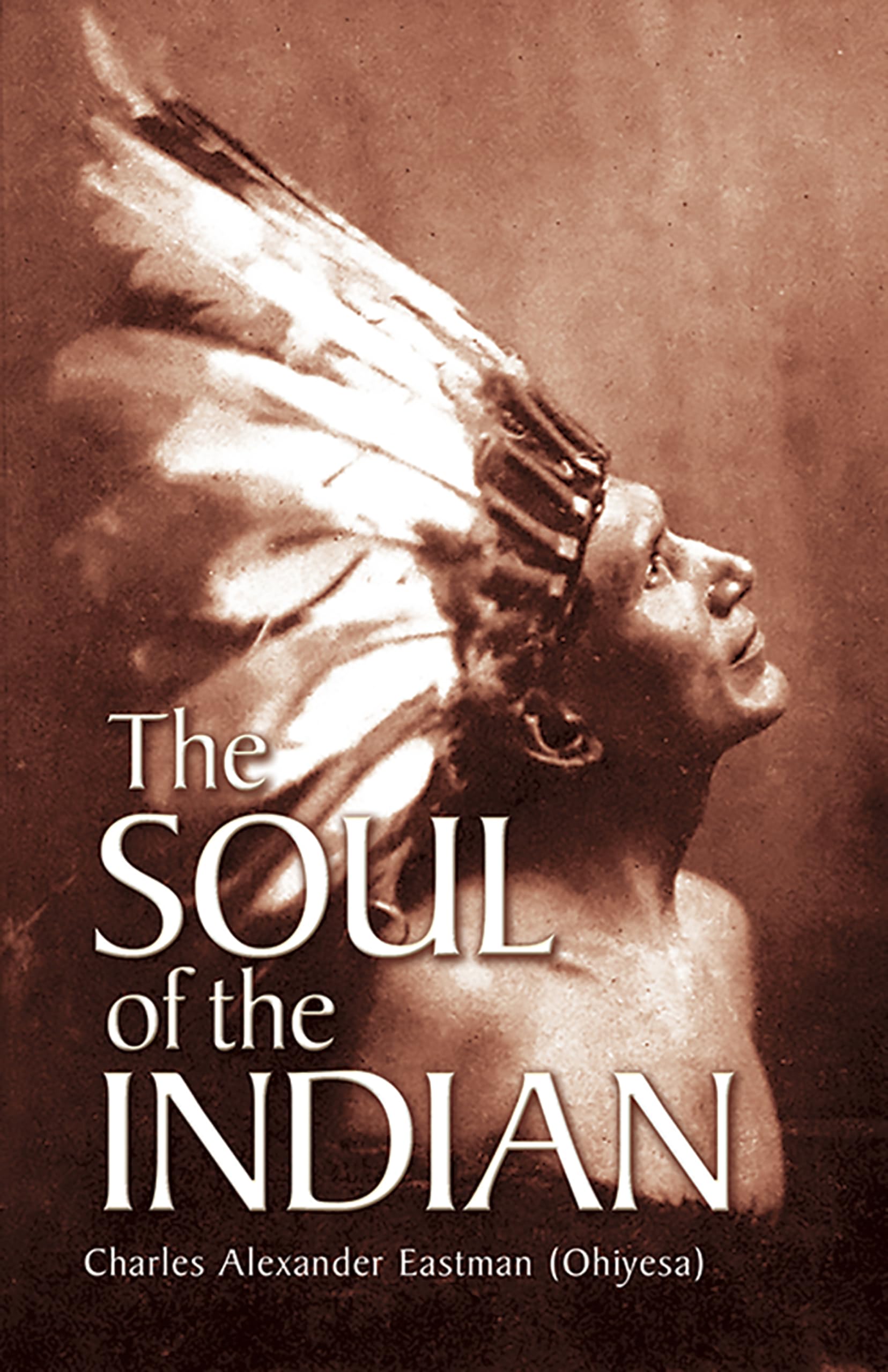
The Soul of the Indian (Native American) [Eastman, Charles Alexander (Ohiyesa)] on desertcart.com. *FREE* shipping on qualifying offers. The Soul of the Indian (Native American) Review: Biased but beautiful - Biased, but deeply honest. Ohiyesa/Eastman truly pours his heart into this summary of the spiritual life of the plains Indian. As a historical source document, certain biases stand out - but the author is truly self aware enough to give plenty of hints and warnings as to when his personal bias enters the equation - something almost unheard of in primary sources. Example - he often speculates on how things were in the "old days", as he accurately witnessed the corruption of his own culture from outside forces. He can paint a bit of an idealistic picture of those days of yore (which he did not witness)- the Indian living largely without jealousy and petty vengeance, with violence only occurring in ritualized ancestral warfare, and never for reasons of conquest. This is a pretty bold assertion, but one that I estimate must at least partially be true, as even in this modern age we witness ever corrupting "mind viruses" (greed, political corruption, extremist religions, etc.) effecting the parts of the world where "civilization" has been the longest. Eastman also paints a pretty rosy picture of his contemporaries in the US government and their treatment of his people, perhaps in an effort to avoid retribution at a time when our nation was extremely jingoistic and anti-other. Why give a 5 star review then? Simply because this book imparts deeply powerful messages and truths about life, and because you cannot help but feel the positive energy that embodied this man through his writing. I was especially moved by certain passages about brotherly friendship, the value of silence and reflection, and the sacred relationship between mother and child. Scattered across the globe, there are truly sacred elements of truth in the world left behind - and some of them are here in this book. Review: A Must Read - This book is a must read for anyone interested in Native culture and thought. Ohiyesa (Charles Alexander Eastman) writes well, and his voice is both authentic and poetic. Because he came of age in a time and place when and where the old ways were still being taught and lived, he provides insights a more modern man probably couldn't have. This is one of my favorite passages: "As a child I understood how to give, I have forgotten this grace since I became civilized. I lived the natural life, whereas I now live the artificial. Any pretty pebble was valuable to me then; every growing tree an object of reverence. Now I worship with the white man before a painted landscape whose value is estimated in dollars! Thus the Indian is reconstructed, as the natural rocks are ground to powder and made into artificial blocks which may be built into the walls of modern society." That passage, and the rest of "The Soul of the Indian" gives some small idea how much was lost in the mad rush to so-called Manifest Destiny. One day, we may come to regret our hubris and our embrace of the idea that Nature is something to be conquered, rather than accommodated.
| Best Sellers Rank | #173,084 in Books ( See Top 100 in Books ) #103 in Native American Demographic Studies #171 in Indigenous History #275 in Native American History (Books) |
| Customer Reviews | 4.5 out of 5 stars 726 Reviews |
A**R
Biased but beautiful
Biased, but deeply honest. Ohiyesa/Eastman truly pours his heart into this summary of the spiritual life of the plains Indian. As a historical source document, certain biases stand out - but the author is truly self aware enough to give plenty of hints and warnings as to when his personal bias enters the equation - something almost unheard of in primary sources. Example - he often speculates on how things were in the "old days", as he accurately witnessed the corruption of his own culture from outside forces. He can paint a bit of an idealistic picture of those days of yore (which he did not witness)- the Indian living largely without jealousy and petty vengeance, with violence only occurring in ritualized ancestral warfare, and never for reasons of conquest. This is a pretty bold assertion, but one that I estimate must at least partially be true, as even in this modern age we witness ever corrupting "mind viruses" (greed, political corruption, extremist religions, etc.) effecting the parts of the world where "civilization" has been the longest. Eastman also paints a pretty rosy picture of his contemporaries in the US government and their treatment of his people, perhaps in an effort to avoid retribution at a time when our nation was extremely jingoistic and anti-other. Why give a 5 star review then? Simply because this book imparts deeply powerful messages and truths about life, and because you cannot help but feel the positive energy that embodied this man through his writing. I was especially moved by certain passages about brotherly friendship, the value of silence and reflection, and the sacred relationship between mother and child. Scattered across the globe, there are truly sacred elements of truth in the world left behind - and some of them are here in this book.
T**E
A Must Read
This book is a must read for anyone interested in Native culture and thought. Ohiyesa (Charles Alexander Eastman) writes well, and his voice is both authentic and poetic. Because he came of age in a time and place when and where the old ways were still being taught and lived, he provides insights a more modern man probably couldn't have. This is one of my favorite passages: "As a child I understood how to give, I have forgotten this grace since I became civilized. I lived the natural life, whereas I now live the artificial. Any pretty pebble was valuable to me then; every growing tree an object of reverence. Now I worship with the white man before a painted landscape whose value is estimated in dollars! Thus the Indian is reconstructed, as the natural rocks are ground to powder and made into artificial blocks which may be built into the walls of modern society." That passage, and the rest of "The Soul of the Indian" gives some small idea how much was lost in the mad rush to so-called Manifest Destiny. One day, we may come to regret our hubris and our embrace of the idea that Nature is something to be conquered, rather than accommodated.
5**0
Worth Reading... and thinking about
“The Soul of the Indian” by Charles Eastman The short version is that this brief booklet is well worth the read. To flesh the review out a bit... Eastman was a White-trained Sioux of the late 19th century. He wrote at a time when the Indians had been already been marginalized and, along with the Wild West, was becoming a romanticized part of our national self-image. White America was eager to picture the now-tamed Indian as a noble figure – about one notch below the classic Tragic Hero. Indians like Eastman picked up on, and played to, that nuance immediately.... the early beginnings of another Great White Guilt Trip. But that is all just background. Eastman compares descriptions of Indian spirituality and morals “pre-Contact” with “post-Contact”. This is a good approach for students – especially if the writer is scrupulously honest which Eastman falls a bit short with, but not by much. It sets him up to place the blame for all the Indian atrocities on the “bad influence of the Whites”. To some extent it is correct but he goes way, way overboard with it. It also gives him the stage to fire self-righteous criticisms at White religions and the religious hypocrisies of many Whites while inferring no such “looseness” among the “pre-Contact” Indians. But he does show where and why Whites, especially missionaries, failed to grasp the true character of Indian Spirituality.
A**H
The clearest and most personal view of 19th Dakota religious life
Ohiyesa - Dr. Charles Eastman - grew up in challenging circumstances of war, frequent relocation, and attempted cultural genocide through the dubious graces of the mission schools. It is truly remarkable that he emerged from this background as a skilled physician, humanitarian, and as one of America's finest writers, if not indeed finest people. Though his bias toward his first culture is clear and unashamed, neither does he ignore the scientific or religious lessons gained from his university studies, and paints many clear strands between the Christian perspective and the more individualistic and intuitive religious life to which he was accustomed in his youth. In a surprisingly short work, Dakota spirituality as it was lived shortly before the violent subjugation of the northern Plains is fairly summarized and lovingly recounted. The social description is incidental but empathetic, like that of many ethnographies in the post-Boas era, but more than filled out by Ohiyesa's discussion of the affective side of his faith experiences. It makes this book half philosophy, half social critique. I strongly recommend this book to anyone with an interest in Plains culture and spirituality, the Indian Wars era, or the exploration of colonial and post-colonial religion. Reading this shifted me from being an admirer of Eastman to an actual fan, and I have since been enthusiastically seeking out his (many!) other writings.
D**L
Eastman gives you great insight into the spiritual world of the indigenous American
Wonderful - introduction to the people who helped shape America. I loved it. Eastman has a wonderful way of helping us understand the people who held the land before our fathers came.
E**D
Good not great. Compelling all the same.
Great book to introduce yourself to the cultures of native Americans in contrast to mainstream society. Author lived both lifestyles. While not earth shattering it is a nice insight from someone who has seen and lived on both sides of each culture.
L**E
Wonderful insight to a misunderstood culture.
Very well written with deep insight to a world that is disappearing. I was intrigued throughout this book, understanding the ways of these people. My ancestors are from Pennsylvania tribes and I wondered about their spiritual beliefs which I now know why I believe as I do. It is very deep rooted in my family and my soul. Loved this book and have shared it with my family. It brought about interesting conversations. I highly recommend it.
E**N
A Valuable View Into the Native American World View
Charles A. Eastman's book, "The Soul of the Indian," is an extremely valuable insight into the Native American world view, especially since he was a Sioux Indian himself. This book is valuable for anyone who will be involved with people of other cultures. It is a caution to take the time and effort to learn the other man's culture and world view in order to communicate meaningfully. While Eastman was fully conversant with both Indian an American culture it is doubtful that he ever found an American counterpart who knew and respected his Indian culture and without placing it in judgement. Therefore, as Eastman grew older he was inexorably drawn back to his original Indian world view and values, being increasingly disappointed with American culture and values. He attempted to reconcile his Indian culture and world view with biblical values and teaching. However, I think this attempt was not successful. One is left with deep respect for Eastman and sadness for the tragedy of the Native American.
Trustpilot
1 month ago
2 months ago