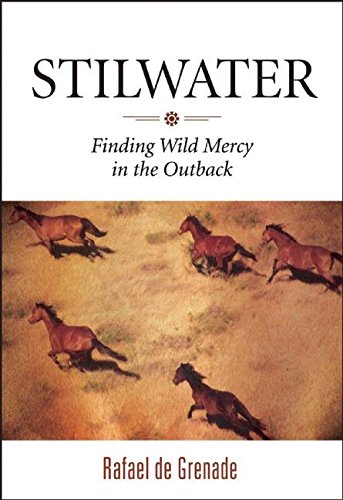
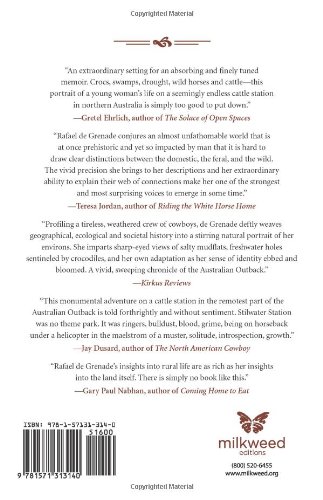
Full description not available
K**T
Riveting from start to finish!!!
So well written you can sense and smell the outback. As a native born Australian, I was enthralled at the depth of connection to the land,and it's colourful people and animals that this book gives from the very first page. I recommend it to anyone, from arm chair explorers, to people with a deep passion for adventure. It is rugged and gritty, told with all the raw reality that life can throw at you. Bravo to the author for a vast and sweeping piece of literary magic!
K**R
A woman's brave and insightful journey into another world
What an incredible first book for Ms. de Grenade! The language and description of her solo trip to a working station (ranch) in the outback of Australia is beautiful, riveting and succinctly relates the harshness and beauty of everyday life there.Throughout her narration/journal, Ms. de Grenade gives us the history of Australia, describing the flora and fauna in loving detail and importing life's lessons that made me stop to ponder their meaning in the grander scheme of life. A great read.
S**S
A book of strength, science, and poetry
This is a brutal book. This is a beautiful book. Where brutality and beauty come together, we often find a truth that takes us deeper than either. De Grenade's voice in this memoir of her time spent in the Australian Outback is strong and clear, and it brings us that truth.Stilwater presents us with a few short months of de Grenade's life, months that were both lonely and crowded with characters and experiences. The book opens with this young woman stepping out of a small mail plane onto a remote cattle station among strangers. As the story unfolds, the reader's questions are slowly answered: the why, the how, the where... especially the where. The author's science background, as well as her roots in agriculture and the land, come strongly into play as de Grenade paints the picture of a place that is almost unreal. And yet, she makes it real for us by adding in the economics, the people, the livestock, and the work.The thing the writer of this book accomplishes better than almost anyone I've ever read is to highlight the intimacy that a human might find with the land if she so desires, even if that place is one she will leave behind. "I was both witness and wilderness, swinging violently between being a sympathetic and not-so-sympathetic participant and observer," she writes.I began reading out of curiosity. I kept reading because I had no choice. I wanted to be there, too.My one criticism of this memoir is that at times it is impersonal and perhaps a bit too academic. I wonder if the writer got to know her horses and the terrain better than she got to know the people she worked with daily. I don't fault her a bit for that, but she hides at times behind the lens of observation and we miss some of the humanity.In her acknowledgments, de Grenade says, "The journey of writing, though much longer than my stint at Stilwater, has itself transformed me."It is a joy to be present to this brutal, beautiful transformation.by Amy Hale Aukerfor Story Circle Book Reviewsreviewing books by, for, and about women
M**K
Panoramic, yet intimate
I happened to have grown up in the ‘50s, when the vehicle for many movies, books, and TV programs was the Western theme. Much of the action took place on ranches or out on the range and, although cattle and cattle ranching was the backdrop, the stories were often about the men, women, and families who worked them. After years of such shows, hundreds of them, I apparently assumed I had a sense of what cattle ranching was about. But, Rafael de Grenade’s “Stilwater” showed me I had no idea at all about the actual nature of cattle ranching.Rafael de Grenade’s “Stilwater” is the first account I’ve read that takes you behind the curtain and into the world of working with and herding cattle. It’s set in a huge isolated rangeland by the sea in Northeastern Australia, and it details the experiences and adventure of modern cattle ranching with four-wheelers, trucks, horses, and especially helicopters. But looking deeper through this modern lens, you can get a good sense of the dangerous and arduous daily world of ranching as it must have been fifty, or even a hundred-and-fifty years ago in the American West.Rafael de Granade was a young but skilled and experienced cattlewoman when she spent six months at the Stilwater cattle station, and she guides you into a special world with writing and storytelling that creates vivid images in your mind and keeps you reading. It’s a book that’s hard to put down, and hard to forget.
S**G
A Book Like No Other
Stilwater is Rafael de Granade’s riveting account of the time she spent working on a cattle station in the Australian wild, mustering feral cattle. The work was as dangerous, brutal and impossible to master as the land itself. She had gone there because “solitude has it’s own wings,” has felt them before and “wants more,” felt them first perhaps, in Central Arizona where she worked cattle from the time she was twelve. The Australian wilderness is harder, though, meaner, the cattle wilder, and it is all the little crew she works with can do to bring them in. In those wild encounters, they try not to get killed in the chaos of hooves and fleeing cattle. “Order didn’t have much to do out in the scrub,” she writes. But de Granade’s book is far more than an account of wrestling tough cattle in a tough land, it is an account of her coming to a relationship to that land. “I was losing the sense of who I used to be,” she writes, “finding my identity shift into the place, into hibiscus flower, kookaburra, cattle dust dreaming.” 227 After it all, she finds she sees “the world in a new way.” And when you read this beautiful book, you too, can find yourself transformed by sharing her experience.
Trustpilot
2 weeks ago
4 days ago